April 14, 2026
Introduction
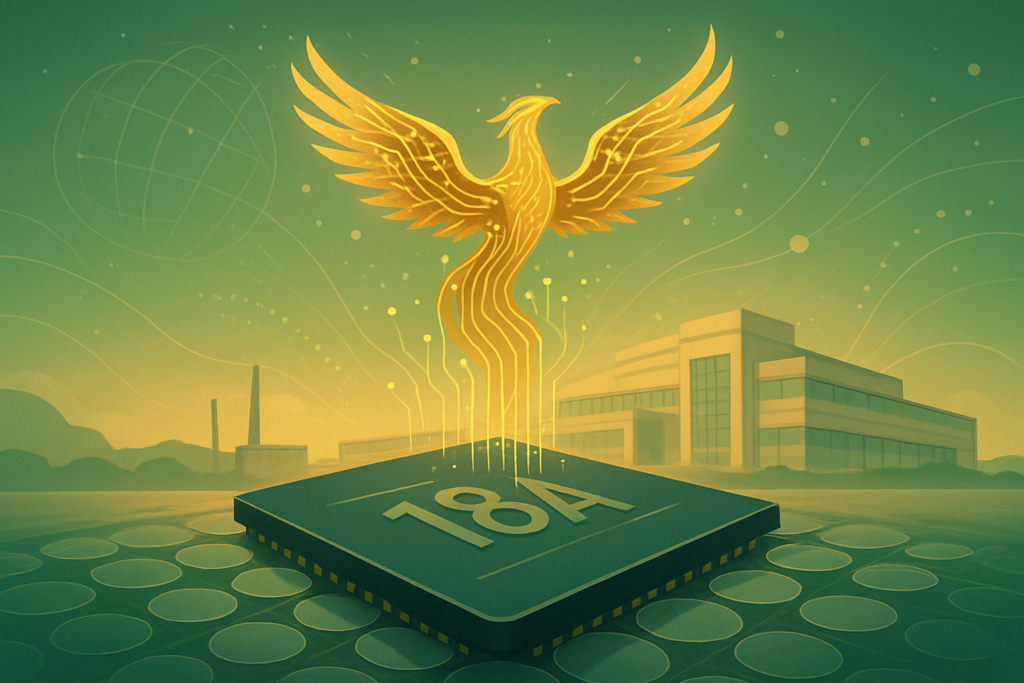
Intel Corporation (NASDAQ: INTC) stands today at the most pivotal juncture in its 58-year history. After a grueling five-year turnaround effort that pushed the company to the brink of a structural breakup, the semiconductor giant has emerged as a transformed entity. Once the undisputed king of the PC era, then a laggard in the mobile and AI revolutions, Intel is now attempting to occupy a unique dual-role: a leading-edge chip designer and the Western world’s primary alternative to Taiwan’s foundry dominance. With the recent commencement of high-volume manufacturing on its 18A process node, Intel is no longer just a "legacy" blue chip; it is the center of a geopolitical and industrial storm that will define the next decade of computing.
Historical Background
Founded in 1968 by Robert Noyce and Gordon Moore, Intel was the architect of the microprocessor revolution. From the 4004 to the ubiquitous "Intel Inside" campaign of the 1990s, the company defined the "Tick-Tock" cadence of Moore’s Law. However, the 2010s were marked by stagnation. Manufacturing delays on the 10nm and 7nm nodes allowed rivals like Advanced Micro Devices (NASDAQ: AMD) to seize market share, while the rise of mobile computing saw Intel lose out to ARM-based architectures.
The return of Pat Gelsinger as CEO in 2021 launched the "IDM 2.0" strategy, an ambitious plan to regain process leadership by delivering five nodes in four years (5N4Y). Following Gelsinger’s retirement in late 2024, the torch was passed to Lip-Bu Tan, who has spent the last year refining Intel's focus into a leaner, more disciplined manufacturing powerhouse.
Business Model
Intel’s business model has been fundamentally restructured into two primary, reporting-distinct divisions:
- Intel Products: This includes the Client Computing Group (CCG), which dominates the "AI PC" market, and the Data Center and AI (DCAI) group. This segment focuses on designing world-class CPUs and the Gaudi line of AI accelerators.
- Intel Foundry: This is the most radical shift in the company’s history. Intel now operates as a third-party foundry, manufacturing chips for external customers—including direct competitors. By separating the foundry’s financial reporting and operations, Intel aims to build the trust necessary to win business from the likes of Amazon and Microsoft.
- Other Segments: This includes Altera (FPGA) and Mobileye (NASDAQ: MBLY), though Intel has progressively spun off or sold portions of these assets to fund its massive capital expenditure (CapEx) requirements.
Stock Performance Overview
The performance of INTC over the last decade is a tale of three distinct eras:
- 10-Year View (2016-2026): Investors who held through the decade saw a "lost period" followed by a parabolic recovery. For much of 2018–2024, the stock languished as competitors soared.
- 5-Year View (2021-2026): The stock entered a "Valley of Death" in early 2025, hitting a multi-decade low of $18.25 following a dividend suspension and record losses.
- Recent Momentum: Over the trailing 12 months, INTC has undergone a historic rally. As of yesterday’s close (April 13, 2026), the stock hit an all-time high of $65.18, a gain of over 220% from its 2025 lows, driven by the successful launch of the 18A process node and massive new foundry contracts.
Financial Performance
Intel’s fiscal 2025 results, released earlier this year, show a company moving from "triage" to "growth."
- Revenue: 2025 revenue came in at $52.9 billion, a stabilization after years of decline.
- Profitability: Non-GAAP EPS for 2025 was $0.42. While modest, it represents a return to profitability after the deep losses of 2024.
- Margins: Gross margins have begun to climb back toward the 45% mark, though they remain well below the 60% peaks of the 2010s due to the high costs of building new fabs.
- Foundry Losses: The Foundry division reported an operating loss of $10.3 billion in 2025, a figure Intel describes as "peak investment drag" before expected profitability in 2027.
Leadership and Management
Under the leadership of CEO Lip-Bu Tan, Intel has moved away from the "growth at any cost" mentality toward extreme financial discipline. Tan, a former Cadence Design Systems CEO and a veteran of the semiconductor industry, was appointed in March 2025.
His strategy has been characterized by:
- Strict Operational Separation: Creating a "Chinese Wall" between the design and foundry teams to protect customer IP.
- Cost Cutting: Tan oversaw a 15% reduction in workforce (approximately 15,000 roles) and the divestiture of non-core business units.
- Customer Focus: Pivoting the foundry business to prioritize high-margin AI "lighthouse" customers over volume-based legacy manufacturing.
Products, Services, and Innovations
The crown jewel of Intel’s current innovation pipeline is the Intel 18A (1.8nm) process node. As of early 2026, 18A is in high-volume manufacturing, featuring two breakthrough technologies:
- RibbonFET: A gate-all-around (GAA) transistor architecture that improves performance and efficiency.
- PowerVia: The industry’s first backside power delivery system, which solves the wiring bottlenecks found in traditional chip designs.
On the product side, the Panther Lake processors (for PCs) and Clearwater Forest (for servers) are currently shipping. These are the first products to utilize the 18A node, positioning Intel to challenge the efficiency leads currently held by Apple and AMD.
Competitive Landscape
Intel faces a "two-front war" in the semiconductor market:
- Design Rivals: AMD continues to be a formidable opponent in the server market, holding nearly 40% of the x86 revenue share. In AI, NVIDIA (NASDAQ: NVDA) remains the dominant force with an 86% share of the data center accelerator market. Intel's Gaudi 4, released earlier this year, has captured a modest 6% share, positioning itself as a "value-per-dollar" alternative to Nvidia’s H-series.
- Foundry Rivals: Taiwan Semiconductor Manufacturing Co. (NYSE: TSM) remains the gold standard. However, Intel is increasingly viewed as the "Western Champion," winning business from US firms seeking to diversify their supply chains away from the Taiwan Strait.
Industry and Market Trends
The "AI PC" has become the primary driver of Intel’s client business. By April 2026, over 60% of new laptop shipments include dedicated Neural Processing Units (NPUs) for local AI tasks. Intel currently leads this segment with a 55% market share.
Simultaneously, the industry is shifting toward "Chiplet" architectures, where different parts of a processor are manufactured on different nodes and stitched together. This play favors Intel’s advanced packaging capabilities (EMIB and Foveros), which have become a standalone revenue stream for the company.
Risks and Challenges
Despite the recent rally, Intel’s path is fraught with risk:
- Foundry Execution: Any yield issues on the 18A node could result in catastrophic delays and the loss of multi-billion-dollar contracts.
- Capital Intensity: Intel is spending roughly $25 billion a year on CapEx. This leaves little room for error and has required the company to take on significant debt and bring in private equity partners (like Apollo) to co-invest in fabs.
- AMD Aggression: AMD’s Zen 6 architecture is expected later this year, threatening to erase Intel’s narrow performance lead in the desktop market.
Opportunities and Catalysts
- Foundry Backlog: Intel Foundry’s total lifetime deal value now exceeds $15 billion. Major wins with Amazon (AWS) and Microsoft for custom AI silicon are expected to begin contributing to revenue in the second half of 2026.
- The "Terafab" Project: A reported partnership with Elon Musk’s xAI and Tesla to build specialized robotics and AI chips in a new Texas-based facility could provide a massive halo effect for Intel’s manufacturing prowess.
- Sovereign AI: As nations seek "sovereign" chip capabilities, Intel is the only company capable of providing a full end-to-end Western supply chain.
Investor Sentiment and Analyst Coverage
Wall Street is currently "Cautiously Bullish" on INTC. After being a consensus "Sell" in 2024, the stock now boasts a majority of "Buy" ratings.
- Hedge Fund Activity: Large institutional players have returned to the stock, viewing it as a "deep value" play that is finally transitioning into a "growth" story.
- Retail Sentiment: Intel has regained its status as a retail favorite, with social media sentiment high following the successful 18A launch. However, some analysts warn that the 220% run-up in the last year may have priced in much of the "recovery" narrative.
Regulatory, Policy, and Geopolitical Factors
Intel is perhaps the most "geopolitically sensitive" stock in the world.
- CHIPS Act: Intel has finalized its $8.9 billion direct funding award from the US government. In a novel move, the US government now holds a 9.9% non-voting equity stake in Intel’s foundry subsidiary, effectively making the company a "public-private partnership" for national security.
- Export Controls: Tightening restrictions on AI chip exports to China continue to hamper Intel's sales of high-end Xeon and Gaudi processors in that region.
- Ohio Delay: To conserve capital, Intel has delayed the full opening of its "Ohio One" mega-fab until 2030, a move that drew some political criticism but was lauded by the market as a sign of Tan's fiscal discipline.
Conclusion
The Intel of April 2026 is unrecognizable from the struggling giant of 2022. By successfully delivering on the "5 nodes in 4 years" promise, the company has closed the technical gap with TSMC and reclaimed its seat at the head of the table in the AI PC era.
However, the "Intel Foundry" experiment remains a high-stakes gamble. The company is essentially betting its entire future on the idea that Western tech giants will pay a premium for a US-based supply chain. For investors, Intel represents a unique play: it is part-utility, part-national-infrastructure, and part-high-growth-AI-enabler. While the stock’s recent surge is impressive, the next 24 months will determine if Intel can turn its technical leadership into sustainable, high-margin profitability.
This content is intended for informational purposes only and is not financial advice.