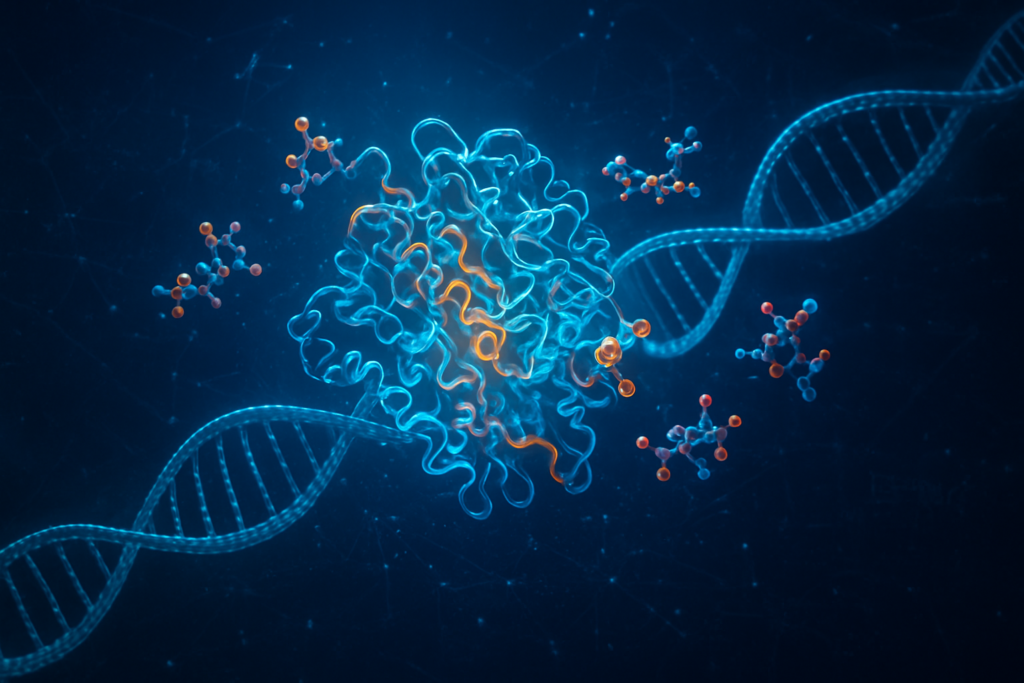
As of late 2025, the landscape of biological research has undergone a transformation comparable to the digital revolution of the late 20th century. At the center of this shift is AlphaFold 3, the latest iteration of the Nobel Prize-winning artificial intelligence system from Google DeepMind, a subsidiary of Alphabet Inc. (NASDAQ: GOOGL). While its predecessor, AlphaFold 2, solved the 50-year-old "protein folding problem," AlphaFold 3 has gone significantly further, acting as a universal molecular predictor capable of modeling the complex interactions between proteins, DNA, RNA, ligands, and ions.
The immediate significance of AlphaFold 3 lies in its transition from a specialized scientific tool to a foundational "operating system" for drug discovery. By providing a high-fidelity 3D map of how life’s molecules interact, the model has effectively reduced the time required for initial drug target identification from years to mere minutes. This leap in capability has not only accelerated academic research but has also sparked a multi-billion dollar "arms race" among pharmaceutical giants and AI-native biotech startups, fundamentally altering the economics of the healthcare industry.
From Evoformer to Diffusion: The Technical Leap
Technically, AlphaFold 3 represents a radical departure from the architecture of its predecessors. While AlphaFold 2 relied on the "Evoformer" module to process Multiple Sequence Alignments (MSAs), AlphaFold 3 utilizes a generative Diffusion-based architecture—the same underlying technology found in AI image generators like Stable Diffusion. This shift allows the model to predict raw atomic coordinates directly, bypassing the need for rigid chemical bonding rules. The result is a system that can model over 99% of the molecular types documented in the Protein Data Bank, including complex heteromeric assemblies that were previously impossible to predict with accuracy.
A key advancement is the introduction of the Pairformer, which replaced the MSA-heavy Evoformer. By focusing on pairwise representations—how every atom in a complex relates to every other—the model has become significantly more data-efficient. In benchmarks conducted throughout 2024 and 2025, AlphaFold 3 demonstrated a 50% improvement in accuracy for ligand-binding predictions compared to traditional physics-based docking tools. This capability is critical for drug discovery, as it allows researchers to see exactly how a potential drug molecule (a ligand) will nestle into the pocket of a target protein.
The initial reaction from the AI research community was a mixture of awe and friction. In mid-2024, Google DeepMind faced intense criticism for publishing the research without releasing the model’s code, leading to an open letter signed by over 1,000 scientists. However, by November 2024, the company pivoted, releasing the full model code and weights for academic use. This move solidified AlphaFold 3 as the "Gold Standard" in structural biology, though it also paved the way for community-driven competitors like Boltz-1 and OpenFold 3 to emerge in late 2025, offering commercially unrestricted alternatives.
The Commercial Arms Race: Isomorphic Labs and the "Big Pharma" Pivot
The commercialization of AlphaFold 3 is spearheaded by Isomorphic Labs, another Alphabet subsidiary led by DeepMind co-founder Sir Demis Hassabis. By late 2025, Isomorphic has established itself as a "bellwether" for the TechBio sector. The company secured landmark partnerships with Eli Lilly (NYSE: LLY) and Novartis (NYSE: NVS), worth a combined potential value of nearly $3 billion in milestones. These collaborations have already moved beyond theoretical research, with Isomorphic confirming in early 2025 that several internal drug candidates in oncology and immunology are nearing Phase I clinical trials.
The competitive landscape has reacted with unprecedented speed. NVIDIA (NASDAQ: NVDA) has positioned its BioNeMo platform as the central infrastructure for the industry, hosting a variety of models including AlphaFold 3 and its rivals. Meanwhile, startups like EvolutionaryScale, founded by former Meta Platforms (NASDAQ: META) researchers, have launched models like ESM3, which focus on generating entirely new proteins rather than just predicting existing ones. This has shifted the market moat: while structure prediction has become commoditized, the real competitive advantage now lies in proprietary datasets and the ability to conduct rapid "wet-lab" validation.
The impact on market positioning is clear. Major pharmaceutical companies are no longer just "using" AI; they are rebuilding their entire R&D pipelines around it. Eli Lilly, for instance, is expected to launch a dedicated "AI Factory" in early 2026 in collaboration with NVIDIA, intended to automate the synthesis and testing of molecules designed by AlphaFold-like systems. This "Grand Convergence" of AI and robotics is expected to reduce the average cost of bringing a drug to market by 25% to 45% by the end of the decade.
Broader Significance: From Blueprints to Biosecurity
In the broader context of AI history, AlphaFold 3 is frequently compared to the Human Genome Project (HGP). If the HGP provided the "static blueprint" of life, AlphaFold 3 provides the "operational manual." It allows scientists to see how the biological machines coded by our DNA actually function and interact. Unlike Large Language Models (LLMs) like ChatGPT, which predict the next word in a sequence, AlphaFold 3 predicts physical reality, making it a primary engine for tangible economic and medical value.
However, this power has raised significant ethical and security concerns. A landmark study in late 2025 highlighted the risk of "toxin paraphrasing," where AI models could be used to design synthetic variants of dangerous toxins—such as ricin—that remain functional but are invisible to current biosecurity screening software. This has led to a July 2025 U.S. government AI Action Plan focusing on dual-use risks in biology, prompting calls for a dedicated federal agency to oversee AI-facilitated biosecurity and more stringent screening for commercial DNA synthesis.
Despite these concerns, the "Open Science" debate has largely resolved in favor of transparency. The 2024 Nobel Prize in Chemistry, awarded to Demis Hassabis and John Jumper for their work on AlphaFold, served as a "halo effect" for the industry, stabilizing venture capital confidence during a period of broader market volatility. The consensus in late 2025 is that AlphaFold 3 has successfully moved biology from a descriptive science to a predictive and programmable one.
The Road Ahead: 4D Biology and Self-Driving Labs
Looking toward 2026, the focus of the research community is shifting from "static snapshots" to "conformational dynamics." While AlphaFold 3 provides a 3D picture of a molecule, the next frontier is the "4D movie"—predicting how proteins move, vibrate, and change shape in response to their environment. This is crucial for targeting "undruggable" proteins that only reveal binding pockets during specific movements. Experts predict that the integration of AlphaFold 3 with physics-based molecular dynamics will be the dominant research trend of the coming year.
Another major development on the horizon is the proliferation of Autonomous "Self-Driving" Labs (SDLs). Companies like Insilico Medicine and Recursion Pharmaceuticals are already utilizing closed-loop systems where AI designs a molecule, a robot builds and tests it, and the results are fed back into the AI to refine the next design. These labs operate 24/7, potentially increasing experimental R&D speeds by up to 100x. The industry is closely watching the first "AI-native" drug candidates, which are expected to yield critical Phase II and III trial data throughout 2026.
The challenges remain significant, particularly regarding the "Ion Problem"—where AI occasionally misplaces ions in molecular models—and the ongoing need for experimental verification via methods like Cryo-Electron Microscopy. Nevertheless, the trajectory is clear: the first FDA approval for a drug designed from the ground up by AI is widely expected by late 2026 or 2027.
A New Era for Human Health
The emergence of AlphaFold 3 marks a definitive turning point in the history of science. By bridging the gap between genomic information and biological function, Google DeepMind has provided humanity with a tool of unprecedented precision. The key takeaways from the 2024–2025 period are the democratization of high-tier structural biology through open-source models and the rapid commercialization of AI-designed molecules by Isomorphic Labs and its partners.
As we move into 2026, the industry's eyes will be on the J.P. Morgan Healthcare Conference in January, where major updates on AI-driven pipelines are expected. The transition from "discovery" to "design" is no longer a futuristic concept; it is the current reality of the pharmaceutical industry. While the risks of dual-use technology must be managed with extreme care, the potential for AlphaFold 3 to address previously incurable diseases and accelerate our understanding of life itself remains the most compelling story in modern technology.
This content is intended for informational purposes only and represents analysis of current AI developments.
TokenRing AI delivers enterprise-grade solutions for multi-agent AI workflow orchestration, AI-powered development tools, and seamless remote collaboration platforms.
For more information, visit https://www.tokenring.ai/.