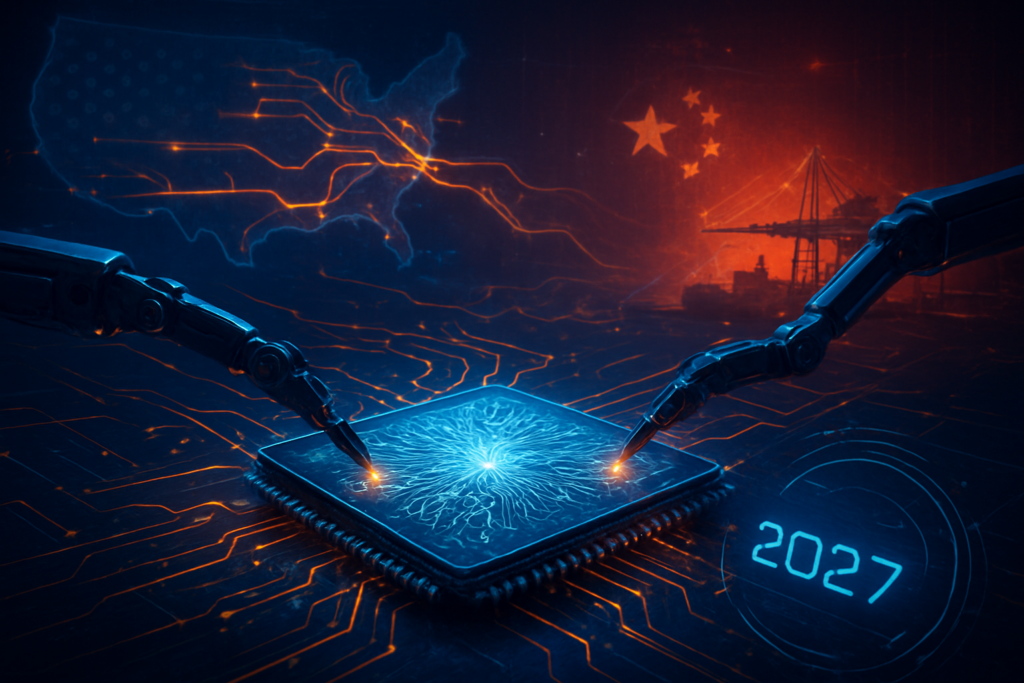
In a move that has sent ripples through the global technology sector, the Trump administration has officially announced a tactical delay of semiconductor tariffs on Chinese imports until June 23, 2027. This decision, finalized in late 2025, serves as the cornerstone of the "Busan Truce"—a fragile diplomatic agreement reached between President Donald Trump and President Xi Jinping during the APEC summit in South Korea. The reprieve provides a critical breathing room for an AI industry that has been grappling with skyrocketing infrastructure costs and the looming threat of a total supply chain fracture.
The immediate significance of this delay cannot be overstated. By setting the initial tariff rate at 0% for the next 18 months, the administration has effectively averted an immediate price shock for foundational "legacy" chips that power everything from data center cooling systems to the edge-AI devices currently flooding the consumer market. However, the June 2027 deadline acts as a "Sword of Damocles," forcing Silicon Valley to accelerate its "de-risking" strategies and onshore manufacturing capabilities before the 0% rate escalates into a potentially crippling protectionist wall.
The Mechanics of the Busan Truce: A Tactical Reprieve
The technical core of this announcement lies in the recalibration of the Section 301 investigation into China’s non-market practices. Rather than imposing immediate, broad-based levies, the U.S. Trade Representative (USTR) has opted for a tiered escalation strategy. The primary focus is on "foundational" or "legacy" semiconductors—chips manufactured on 28nm nodes or older. While these are not the cutting-edge H100s or B200s used for training Large Language Models (LLMs), they are essential for the power management and peripheral logic of AI servers. By delaying these tariffs, the administration is attempting to decouple the U.S. economy from Chinese mature-node dominance without triggering a domestic manufacturing crisis in the short term.
Industry experts and the AI research community have reacted with a mix of relief and skepticism. The "Busan Truce" is not a formal treaty but a verbal and memorandum-based agreement that relies on mutual concessions. In exchange for the tariff delay, Beijing has agreed to a one-year pause on its aggressive export controls for rare earth metals, including gallium and germanium—elements vital for high-frequency AI communication hardware. However, technical analysts point out that China still maintains a "0.1% de minimis" threshold on refined rare earth elements, meaning they can still throttle the supply of finished magnets and specialized components at will, despite the raw material pause.
This "transactional" approach to trade policy marks a significant departure from the more rigid export bans of the previous few years. The administration is essentially using the June 2027 date as a countdown clock for American firms to transition their supply chains. The technical challenge, however, remains immense: building a 28nm-capable foundry from scratch typically takes three to five years, meaning the 18-month window provided by the truce may still be insufficient for a total transition away from Chinese silicon.
Winners, Losers, and the New 'Revenue-Sharing' Reality
The impact on major technology players has been immediate and profound. NVIDIA (NASDAQ: NVDA), Advanced Micro Devices (NASDAQ: AMD), and Intel (NASDAQ: INTC) find themselves navigating a complex new landscape where market access is granted in exchange for "sovereignty fees." Under a new revenue-sharing model introduced alongside the truce, these companies are permitted to sell specifically neutered, high-end AI accelerators to the Chinese market, provided they pay a 25% "revenue share" directly to the U.S. Treasury. This allows these giants to maintain their lucrative Chinese revenue streams while funding the very domestic manufacturing subsidies that seek to replace Chinese suppliers.
Apple (NASDAQ: AAPL) has emerged as a primary beneficiary of this strategic pivot. By pledging a staggering $100 billion investment into U.S.-based manufacturing and R&D over the next five years, the Cupertino giant secured a specific reprieve from the broader tariff regime. This "investment-for-exemption" strategy is becoming the new standard for tech titans. Meanwhile, smaller AI startups and hardware manufacturers are facing a more difficult path; while they benefit from the 0% tariff on legacy chips, they lack the capital to make the massive domestic investment pledges required to secure long-term protection from the 2027 "cliff."
The competitive implications are also shifting toward the foundries. Intel (NASDAQ: INTC), as a domestic champion, stands to gain significantly as the 2027 deadline approaches, provided it can execute on its foundry roadmap. Conversely, the cost of building AI data centers has continued to rise due to auxiliary tariffs on steel, aluminum, and advanced cooling systems—materials not covered by the semiconductor truce. NVIDIA (NASDAQ: NVDA) reportedly raised prices on its latest AI accelerators by 15% in late 2025, citing the logistical overhead of navigating this fragmented global trade environment.
Geopolitics and the Rare Earth Standoff
The wider significance of the June 2027 delay is deeply rooted in the "Critical Minerals War." Throughout 2024 and early 2025, China weaponized its monopoly on rare earth elements, banning the export of antimony and "superhard materials" essential for the high-precision machinery used in chip fabrication. The Busan Truce’s one-year pause on these restrictions is seen as a major diplomatic win for the U.S., yet it remains a fragile peace. China continues to restrict the export of the refining technologies needed to process these minerals, ensuring that even if the U.S. mines its own rare earths, it remains dependent on Chinese infrastructure for processing.
This development fits into a broader trend of "technological mercantilism," where AI hardware is no longer just a commodity but a primary instrument of statecraft. The 2027 deadline aligns with the anticipated completion of several major U.S. fabrication plants funded by the CHIPS Act, suggesting that the Trump administration is timing its trade pressure to coincide with the moment the U.S. achieves greater silicon self-sufficiency. This is a high-stakes gamble: if domestic capacity isn't ready by mid-2027, the resulting tariff wall could lead to a massive inflationary spike in AI services and consumer electronics.
Furthermore, the truce highlights a growing divide in the AI landscape. While the U.S. and China are engaged in this "managed competition," other regions like the EU and Japan are being forced to choose sides or develop their own independent supply chains. The "0.1% de minimis" rule implemented by Beijing is particularly concerning for the global AI landscape, as it gives China extraterritorial reach over any AI hardware produced anywhere in the world that contains even trace amounts of Chinese-processed minerals.
The Road to June 2027: What Lies Ahead
Looking forward, the tech industry is entering a period of frantic "friend-shoring" and vertical integration. In the near term, expect to see major AI lab operators and cloud providers investing directly in mining and mineral processing to bypass the rare earth bottleneck. We are also likely to see an explosion in "AI-driven material science," as companies use their own models to discover synthetic alternatives to the rare earth metals currently under Chinese control.
The long-term challenge remains the "2027 Cliff." As that date approaches, market volatility is expected to increase as investors weigh the possibility of a renewed trade war against the progress of U.S. domestic chip production. Experts predict that the administration may use the threat of the 2027 escalation to extract further concessions from Beijing, potentially leading to a "Phase Two" deal that addresses intellectual property theft and state subsidies more broadly. However, if diplomatic relations sour before then, the AI industry could face a sudden and catastrophic decoupling.
Summary and Final Assessment
The Trump administration’s decision to delay semiconductor tariffs until June 2027 represents a calculated "tactical retreat" designed to protect the current AI boom while preparing for a more self-reliant future. The Busan Truce has successfully de-escalated a looming crisis, securing a temporary flow of rare earth metals and providing a cost-stabilization window for hardware manufacturers. Yet, the underlying tensions of the U.S.-China tech rivalry remain unresolved, merely pushed further down the road.
This development will likely be remembered as a pivotal moment in AI history—the point where the industry moved from a globalized "just-in-time" supply chain to a geopolitically-driven "just-in-case" model. For now, the AI industry has its reprieve, but the clock is ticking. In the coming months, the focus will shift from trade headlines to the construction sites of new foundries and the laboratories of material scientists, as the world prepares for the inevitable arrival of June 2027.
This content is intended for informational purposes only and represents analysis of current AI developments.
TokenRing AI delivers enterprise-grade solutions for multi-agent AI workflow orchestration, AI-powered development tools, and seamless remote collaboration platforms.
For more information, visit https://www.tokenring.ai/.