
As the Q2 earnings season wraps, let’s dig into this quarter’s best and worst performers in the thrifts & mortgage finance industry, including Walker & Dunlop (NYSE: WD) and its peers.
Thrifts & Mortgage Finance institutions operate by accepting deposits and extending loans primarily for residential mortgages, earning revenue through interest rate spreads (difference between lending rates and borrowing costs) and origination fees. The industry benefits from demographic tailwinds as millennials enter prime homebuying age, technological advancements streamlining the loan approval process, and potential interest rate stabilization improving affordability. However, significant headwinds include net interest margin compression during rate volatility, increased competition from fintech disruptors offering digital-first experiences, mounting regulatory compliance costs, and potential housing market corrections that could impact loan portfolios and default rates.
The 12 thrifts & mortgage finance stocks we track reported a slower Q2. As a group, revenues missed analysts’ consensus estimates by 3.4% while next quarter’s revenue guidance was 10.1% below.
Amidst this news, share prices of the companies have had a rough stretch. On average, they are down 14.9% since the latest earnings results.
Walker & Dunlop (NYSE: WD)
Originating as a small mortgage banking firm during the Great Depression in 1937, Walker & Dunlop (NYSE: WD) provides commercial real estate financing, property sales, appraisal, and investment management services with a focus on multifamily properties.
Walker & Dunlop reported revenues of $306.7 million, down 3.9% year on year. This print fell short of analysts’ expectations by 8.2%. Overall, it was a softer quarter for the company with a significant miss of analysts’ net interest income estimates and a miss of analysts’ tangible book value per share estimates.
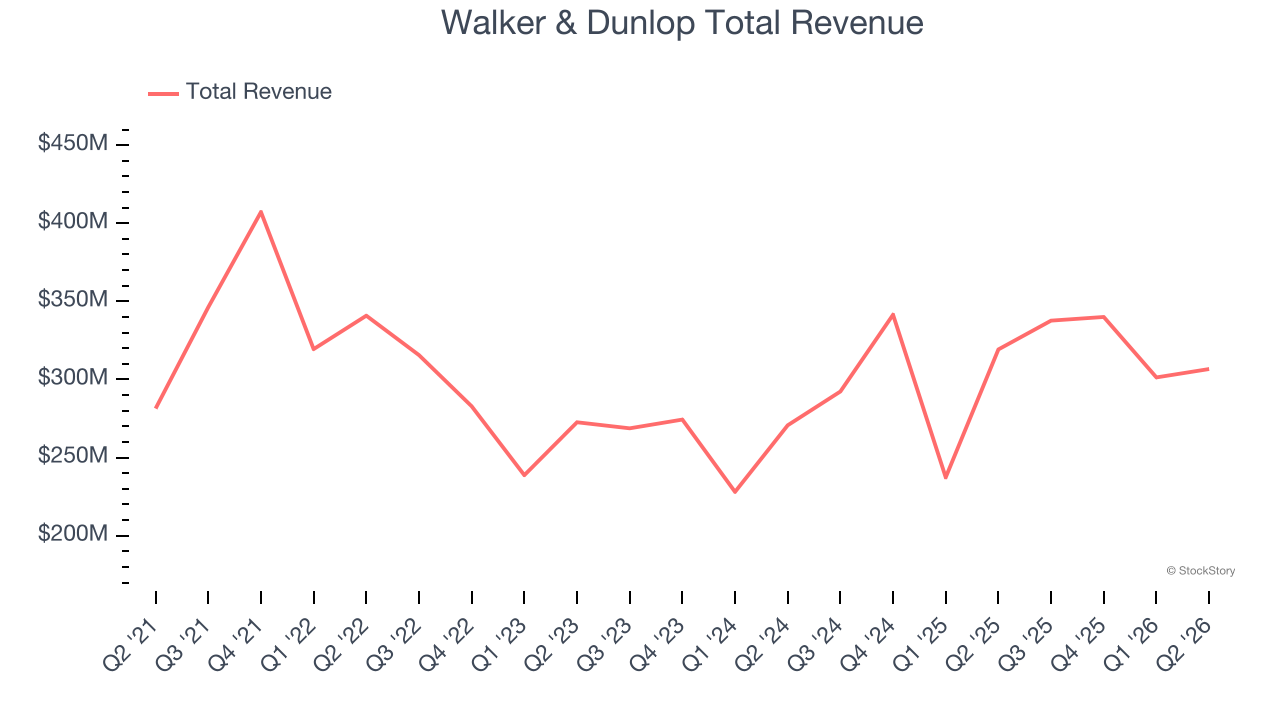
The market seems disappointed with the results as the stock is down 29.3% since reporting and currently trades at $36.34.
Read our full report on Walker & Dunlop here, it’s free.
Best Q2: Ellington Financial (NYSE: EFC)
Operating under the guidance of Ellington Management Group, a respected name in structured credit markets, Ellington Financial (NYSE: EFC) acquires and manages a diverse portfolio of mortgage-related, consumer-related, and other financial assets to generate returns for investors.
Ellington Financial reported revenues of $123.1 million, up 33.1% year on year, outperforming analysts’ expectations by 9.4%. The business had a stunning quarter with a beat of analysts’ EPS estimates and a solid beat of analysts’ net interest income estimates.
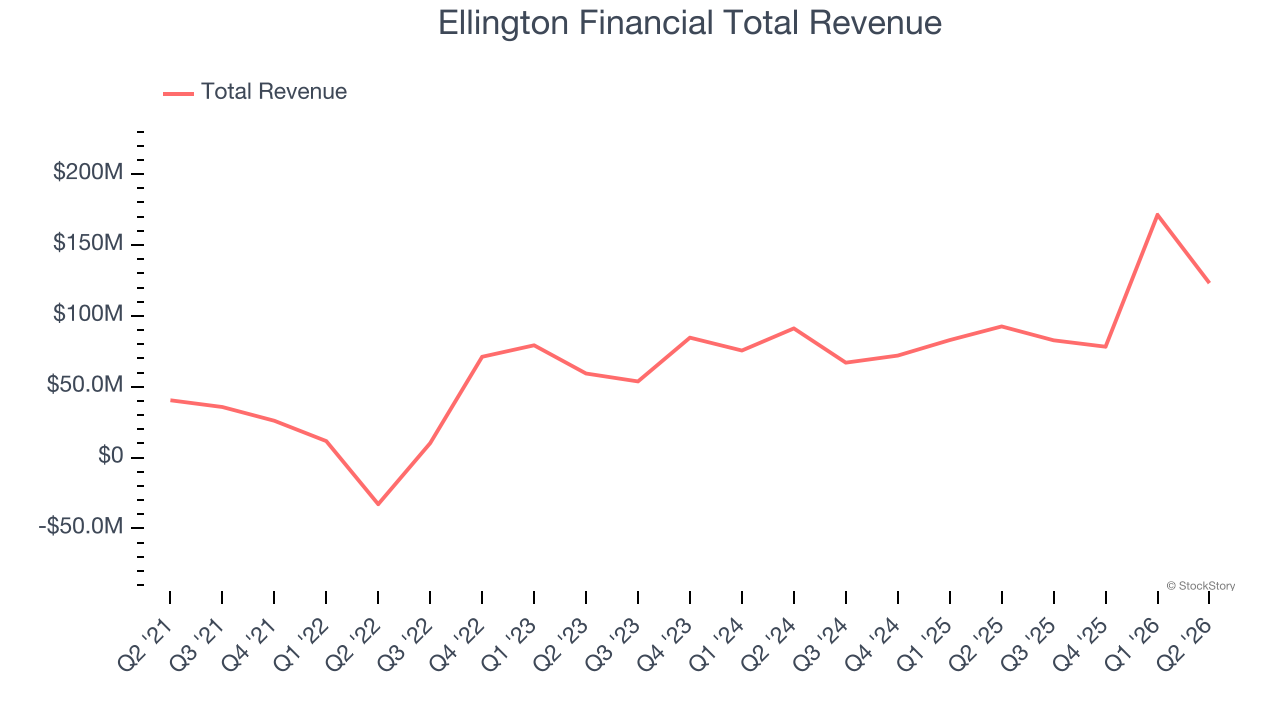
Ellington Financial achieved the biggest analyst estimate beat of the whole group. Although it had a fine quarter compared to its peers, the market seems unhappy with the results as the stock is down 6.8% since reporting. It currently trades at $12.25.
Is now the time to buy Ellington Financial? Access our full analysis of the earnings results here, it’s free.
Rocket Companies (NYSE: RKT)
Born in Detroit during the 1980s and evolving into a tech-driven financial powerhouse, Rocket Companies (NYSE: RKT) is a fintech company that provides digital mortgage lending, real estate services, and personal finance solutions through its technology platform.
Rocket Companies reported revenues of $2.76 billion, up 92.9% year on year, falling short of analysts’ expectations by 2.7%. It was a disappointing quarter as it posted EPS in line with analysts’ estimates.
As expected, the stock is down 11.4% since the results and currently trades at $11.72.
Read our full analysis of Rocket Companies’s results here.
PennyMac Financial Services (NYSE: PFSI)
Founded during the 2008 financial crisis to help address the mortgage market meltdown, PennyMac Financial Services (NYSE: PFSI) is a specialty financial services company that originates, services, and manages investments related to residential mortgage loans in the United States.
PennyMac Financial Services reported revenues of $565.8 million, up 5.4% year on year. This result met analysts’ expectations. Aside from that, it was a softer quarter as it recorded a significant miss of analysts’ net interest income estimates and a significant miss of analysts’ EPS estimates.
The stock is down 26.1% since reporting and currently trades at $63.61.
Read our full, actionable report on PennyMac Financial Services here, it’s free.
Ladder Capital (NYSE: LADR)
Founded during the 2008 financial crisis when traditional lenders retreated from commercial real estate, Ladder Capital (NYSE: LADR) is a real estate investment trust that originates commercial real estate loans, owns commercial properties, and invests in real estate securities.
Ladder Capital reported revenues of $57.64 million, up 2.4% year on year. This print surpassed analysts’ expectations by 3.3%. Zooming out, it was a slower quarter as it produced a significant miss of analysts’ tangible book value per share estimates and a significant miss of analysts’ net interest income estimates.
The stock is down 7.3% since reporting and currently trades at $9.04.
Read our full, actionable report on Ladder Capital here, it’s free.
Market Update
Over the past year, investors have been forced to repeatedly answer the same question: what is the market’s biggest risk? The answer has changed several times, and each shift has reshaped market leadership.
Late in 2025 and early 2026, artificial intelligence became the market’s primary uncertainty. Investors questioned whether AI would erode software pricing power and weaken competitive moats as AI made it easier to replicate once-differentiated products.
By the spring, technology took a back seat to geopolitics. The U.S. conflict with Iran briefly became the market’s dominant narrative, raising concerns about oil prices, inflation, and global growth. But as energy markets remained orderly and fears of a prolonged supply disruption faded, investors quickly turned their focus back to fundamentals.
Want to invest in winners with rock-solid fundamentals? Check out our Top 5 Growth Stocks and add them to your watchlist. These companies are poised for growth regardless of the political or macroeconomic climate.