Quarterly earnings results are a good time to check in on a company’s progress, especially compared to its peers in the same sector. Today we are looking at GitLab (NASDAQ: GTLB) and the best and worst performers in the software development industry.
As legendary VC investor Marc Andreessen says, "Software is eating the world", and it touches virtually every industry. That drives increasing demand for tools helping software developers do their jobs, whether it be monitoring critical cloud infrastructure, integrating audio and video functionality, or ensuring smooth content streaming.
The 12 software development stocks we track reported a very strong Q2. As a group, revenues beat analysts’ consensus estimates by 3.2% while next quarter’s revenue guidance was 1.8% above.
Luckily, software development stocks have performed well with share prices up 12.2% on average since the latest earnings results.
GitLab (NASDAQ: GTLB)
With its all-remote workforce pioneering a new approach to software development, GitLab (NASDAQ: GTLB) provides a single-application DevSecOps platform that helps development, operations, and security teams collaborate to build, secure, and deploy software faster.
GitLab reported revenues of $286.3 million, up 21.3% year on year. This print exceeded analysts’ expectations by 4.8%. Overall, it was an exceptional quarter for the company with an impressive beat of analysts’ billings estimates and EPS guidance for next quarter exceeding analysts’ expectations.
“Q2 was an exceptional quarter, with record gross bookings and net ARR growth exceeding 40% year over year,” said Bill Staples, GitLab Chief Executive Officer. “As AI drives more software creation and more work through the development lifecycle, the context, security, governance and control GitLab provides become increasingly valuable. We believe this creates a significant opportunity for GitLab as humans and agents increasingly build software together.”
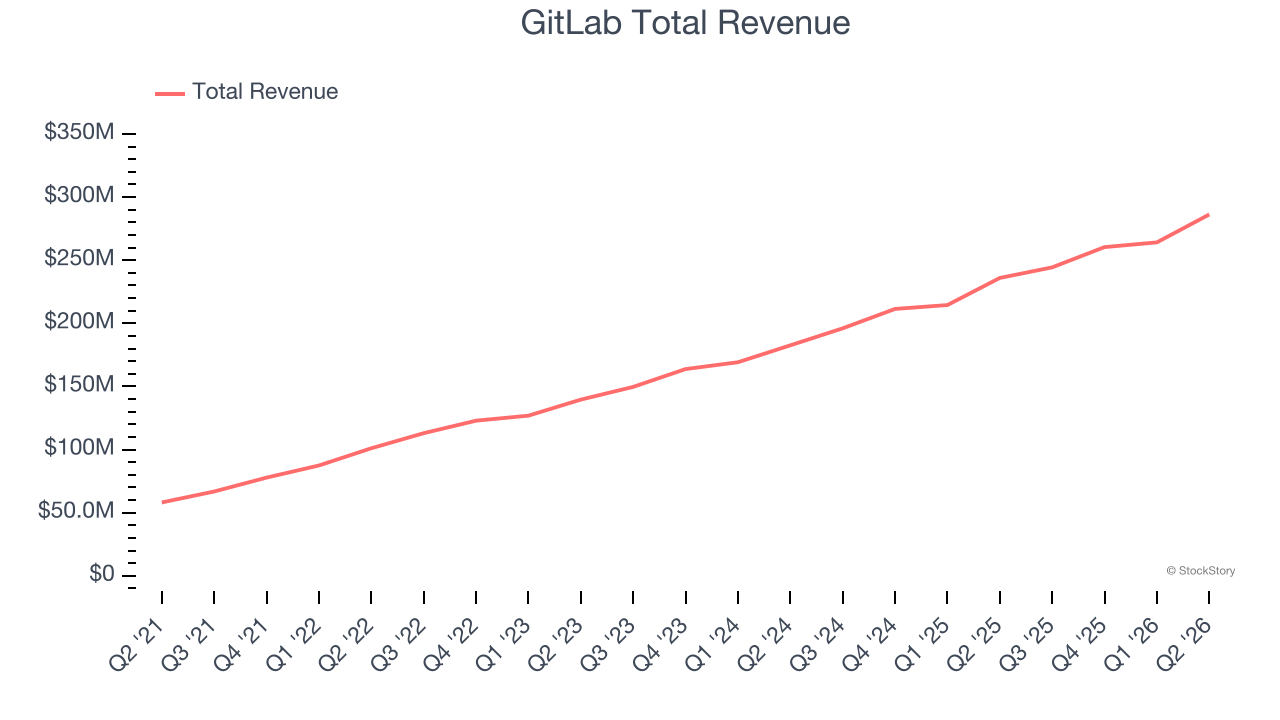
Interestingly, the stock is up 3.3% since reporting and currently trades at $46.59.
We think GitLab is a good business, but is it a buy today? Read our full report here, it’s free.
Best Q2: Fastly (NASDAQ: FSLY)
Taking its name from the core advantage it delivers to customers, Fastly (NASDAQ: FSLY) operates an edge cloud platform that processes, secures, and delivers web content as close to end users as possible, enabling faster digital experiences.
Fastly reported revenues of $183.3 million, up 23.3% year on year, outperforming analysts’ expectations by 5.3%. The business had an exceptional quarter with EPS guidance for next quarter exceeding analysts’ expectations and a solid beat of analysts’ adjusted operating income estimates.
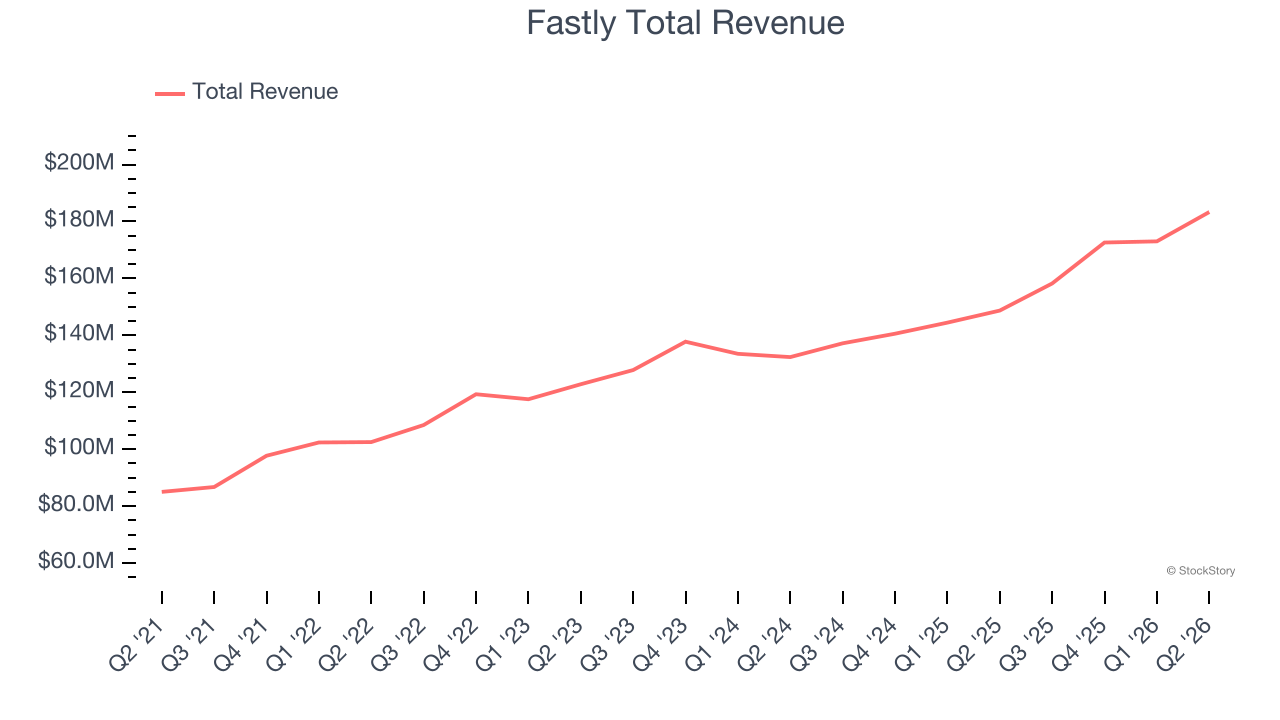
Fastly pulled off the biggest analyst estimate beat and highest full-year guidance raise among its peers. Although it had a fine quarter compared to its peers, the market seems unhappy with the results as the stock is down 2.2% since reporting. It currently trades at $25.45.
Is now the time to buy Fastly? Access our full analysis of the earnings results here, it’s free.
Weakest Q2: Akamai (NASDAQ: AKAM)
With a massive distributed network spanning 4,100+ points of presence in nearly 130 countries, Akamai Technologies (NASDAQ: AKAM) provides a global distributed cloud platform that helps businesses deliver, secure, and optimize their digital experiences online.
Akamai reported revenues of $1.1 billion, up 5.4% year on year, exceeding analysts’ expectations by 0.6%. Still, it was a slower quarter as it posted a miss of analysts’ adjusted operating income estimates and full-year revenue guidance meeting analysts’ expectations.
Akamai delivered the weakest performance against analyst estimates and weakest guidance update of the whole group. As expected, the stock is down 8.5% since the results and currently trades at $108.48.
Read our full analysis of Akamai’s results here.
Nutanix (NASDAQ: NTNX)
Originally pioneering hyperconverged infrastructure to break down traditional data center silos, Nutanix (NASDAQ: NTNX) provides a unified software platform that enables organizations to run applications and manage data across private, public, and hybrid cloud environments.
Nutanix reported revenues of $757.1 million, up 15.9% year on year. This number surpassed analysts’ expectations by 2.6%. Overall, it was a very strong quarter as it also produced a solid beat of analysts’ billings estimates and an impressive beat of analysts’ adjusted operating income estimates.
The stock is up 6.8% since reporting and currently trades at $69.82.
Read our full, actionable report on Nutanix here, it’s free.
Bandwidth (NASDAQ: BAND)
Powering communications for tech giants like Microsoft, Google, and Zoom, Bandwidth (NASDAQ: BAND) provides cloud-based communications software and APIs that enable businesses to embed voice, messaging, and emergency services into their applications and platforms.
Bandwidth reported revenues of $219.9 million, up 22.2% year on year. This print beat analysts’ expectations by 1.4%. It was a strong quarter as it also put up revenue guidance for next quarter beating analysts’ expectations and EBITDA guidance for next quarter beating analysts’ expectations.
Bandwidth delivered the highest guidance raise in the group. The stock is up 19.1% since reporting and currently trades at $62.25.
Read our full, actionable report on Bandwidth here, it’s free.
Market Update
Over the past year, investors have been forced to repeatedly answer the same question: what is the market’s biggest risk? The answer has changed several times, and each shift has reshaped market leadership.
Late in 2025 and early 2026, artificial intelligence became the market’s primary uncertainty. Investors questioned whether AI would erode software pricing power and weaken competitive moats as AI made it easier to replicate once-differentiated products.
By the spring, technology took a back seat to geopolitics. The U.S. conflict with Iran briefly became the market’s dominant narrative, raising concerns about oil prices, inflation, and global growth. But as energy markets remained orderly and fears of a prolonged supply disruption faded, investors quickly turned their focus back to fundamentals.
Want to invest in winners with rock-solid fundamentals? Check out our Top 5 Growth Stocks and add them to your watchlist. These companies are poised for growth regardless of the political or macroeconomic climate.