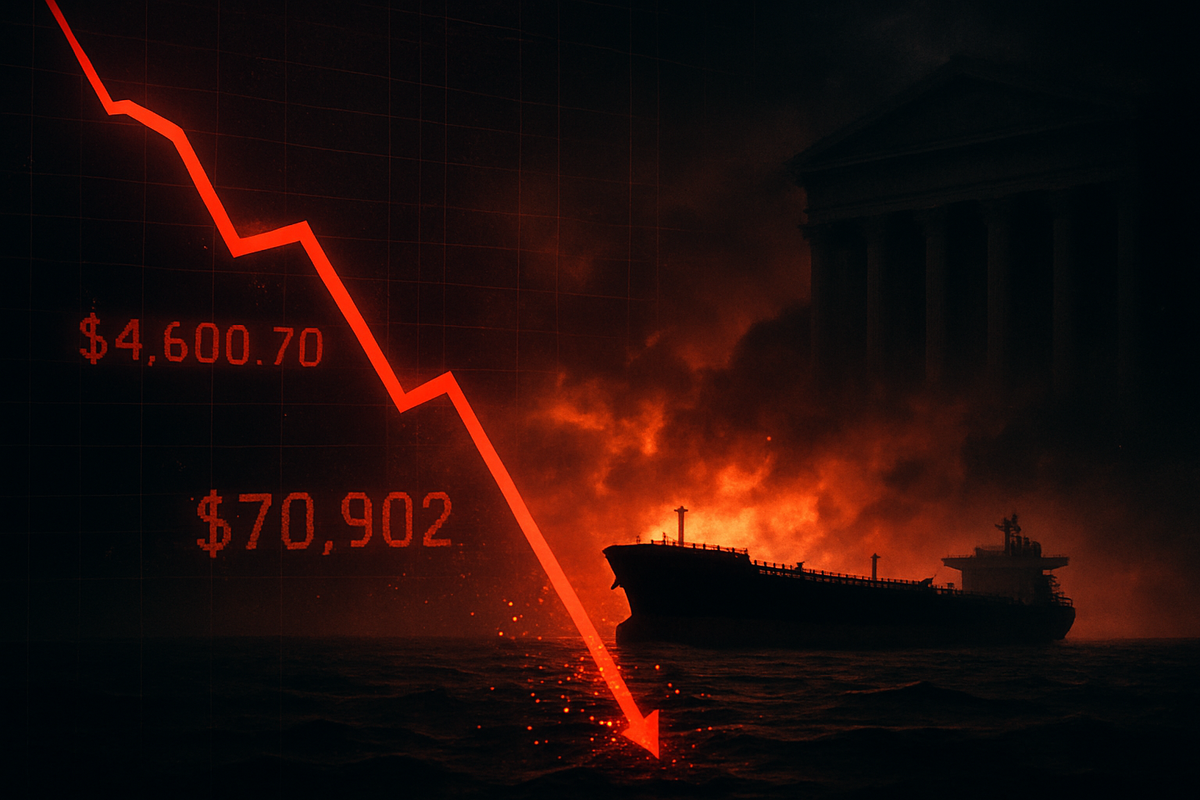
The global financial landscape was fundamentally reshaped on March 19, 2026, as the "safe-haven" narrative for precious metals met a crushing reality. In a single day of high-octane volatility, gold plummeted 5.9% to close at $4,600.70 per ounce, while silver suffered a more dramatic 8.2% collapse, settling at $70.902. The dual-metal plunge wiped out billions in market capitalization across ETFs and mining stocks, leaving investors to grapple with a paradoxical market environment where geopolitical instability failed to protect the world’s oldest stores of value.
The immediate trigger for the sell-off was a "liquidity flush" born of desperation. As energy prices skyrocketed following the escalation of the Iran-Israel conflict, institutional traders found themselves squeezed by margin calls in other sectors. To cover these losses, they liquidated their most profitable positions—which, until that morning, were gold and silver. This massive influx of supply, combined with a surprisingly hawkish stance from central banks, effectively pulled the rug out from under the bull market that had dominated the early months of 2026.
The Perfect Storm: Mid-East Conflict and the Death of Rate Cut Hopes
The timeline leading to the March 19 crash began earlier that week with the launch of "Operation Epic Fury," a targeted air campaign by a U.S.-led coalition against Iranian infrastructure. The geopolitical shockwaves were immediate; the Strait of Hormuz, a vital artery for 20% of the world’s oil supply, was effectively paralyzed. Brent crude prices surged past the $110-per-barrel mark, peaking near $120. This energy spike reignited fears of a permanent inflationary spiral, shifting the focus of central banks from growth to price stability.
Just 24 hours before the metals' collapse, the Federal Open Market Committee (FOMC) had voted to hold the federal funds rate at 3.50%–3.75%. In a post-meeting press conference that set the stage for the crash, Fed Chair Jerome Powell adopted a resolutely hawkish tone, warning that "hikes are not off the table" if energy-driven inflation became embedded. This stance was echoed by the European Central Bank (ECB) on the morning of March 19, where President Christine Lagarde revised Eurozone inflation forecasts upward and lowered GDP projections.
The market reaction was swift and merciless. As the U.S. Dollar Index (DXY) strengthened on the back of higher-for-longer interest rate expectations, the opportunity cost of holding non-yielding assets like gold and silver became untenable. By midday, the "safe-haven" trade had been entirely inverted. Investors realized that the very conflict they expected to drive gold higher was instead creating an inflationary environment that forced central banks to maintain tight monetary policies, thereby strengthening the dollar and crushing precious metals.
Assessing the Damage: Corporate Casualties and ETF Outflows
The carnage on the spot markets translated into a brutal session for public companies and investment vehicles linked to precious metals. SPDR Gold Shares (NYSE: GLD), the world’s largest gold ETF, saw its shares fall 4.12% to $426.41. The volume of trading for GLD was unprecedented, exceeding 30 million shares as retail and institutional investors alike scrambled for the exits. Similarly, the iShares Silver Trust (NYSE: SLV) plummeted 4.40% to $65.68, capping a disastrous month that saw the silver-tracking fund lose more than 13% of its value.
Mining giants, which often act as leveraged plays on the underlying metals, were hit even harder. Newmont Corporation (NYSE: NEM), the global leader in gold production, saw its stock price crater 8.76% to $99.20. The company was already facing a "trough year" in terms of production guidance, and the sudden drop in the price of its primary output, combined with rising diesel and energy costs for its operations, created a pincer movement on its margins. Barrick Gold (NYSE: GOLD) fared little better, dropping 6.95% to approximately $16.85 as the broader Mineral Resources sector faced its worst single-day performance in nearly three years.
Conversely, the "winners" in this environment were fewer and far between. Large energy producers like ExxonMobil (NYSE: XOM) and Chevron (NYSE: CVX) saw their valuations swell as Brent crude remained elevated above $110. For these companies, the spiking energy prices—which were the bane of the metals market—represented a significant windfall. However, for the majority of the S&P 500, the combination of high energy costs and the removal of interest rate cut expectations led to a generalized dampening of market sentiment.
A New Paradigm: Inflation, Liquidity, and Historical Precedents
This event highlights a significant shift in how precious metals respond to modern geopolitical crises. Historically, gold is viewed as a hedge against war and uncertainty. However, the March 19 crash suggests that in a highly leveraged global economy, the "liquidity effect" can often override the "safe-haven effect." When oil prices jump so sharply that they threaten the entire economic structure, the resulting need for cash to cover margin calls and the strengthening of the dollar due to central bank hawkishness can ironically lead to a sell-off in gold.
The situation bears a striking resemblance to the early stages of the 2008 financial crisis and the 2020 pandemic onset, where gold initially fell alongside equities as investors moved to cash. The difference in 2026 is the role of energy. By 4/9/2026, it has become clear that we are in a "stagflationary" trap. The Iran-Israel conflict is not just a regional skirmish; it is a systemic shock to the global supply chain. Central banks are now forced to choose between fighting inflation (by keeping rates high) or supporting growth (by cutting rates), and their current commitment to the former is the primary weight on the metals market.
Furthermore, the policy implications are profound. Regulatory bodies are now closely examining the role of high-frequency trading and algorithmic selling in exacerbating the March 19 flash crash. There is growing pressure on the Commodities Futures Trading Commission (CFTC) to implement stricter circuit breakers for precious metals to prevent such rapid devaluations, which can destabilize the balance sheets of mining companies and long-term pension funds that have increased their gold allocations in recent years.
The Road Ahead: Navigating a Post-Crash Environment
In the weeks since the March 19 plunge, the market has entered a phase of tentative consolidation. As of today, April 9, 2026, gold has struggled to reclaim the $4,700 level, as the "Hormuz Premium" in oil remains a persistent inflationary threat. In the short term, investors should expect continued volatility as the Middle Eastern conflict remains unresolved. Any further escalation could ironically lead to more selling in gold if it triggers another round of "dash for cash" liquidity events.
Long-term, the strategic pivot for many investors will likely involve a more nuanced approach to "safe-havens." The traditional 60/40 portfolio and the standard gold hedge are being questioned. We may see a shift toward energy-linked assets or short-duration inflation-protected securities as more effective hedges in a world where energy prices dictate monetary policy. For mining companies like Newmont and Barrick Gold, the challenge will be managing operational costs in a high-inflation environment while their output price remains suppressed by high interest rates.
The potential for a "relief rally" exists if a ceasefire is brokered or if central banks signal a "pivot" back to easing. However, with Brent crude still trading well above historical averages, such a pivot seems unlikely in the immediate future. The market is now pricing in a "higher for much longer" interest rate environment, which serves as a formidable ceiling for any significant recovery in the gold and silver markets through the remainder of the second quarter.
Final Reflections: The Lessons of March 19
The gold and silver crash of March 19, 2026, will be remembered as the moment the traditional rules of crisis investing were rewritten. It serves as a stark reminder that no asset is immune to the laws of liquidity and the gravity of interest rates. When energy prices become the dominant driver of the global economy, the resulting inflationary fears can turn even the safest assets into sources of cash during a panic.
Moving forward, the market is looking for stability in the Middle East and a cooling of energy prices as the only viable catalysts for a sustained metals recovery. Investors should keep a close eye on the weekly inflation prints and the rhetoric from the Fed. If the central bank remains steadfast in its hawkishness despite slowing GDP growth, the downward pressure on GLD, SLV, and the major miners is likely to persist.
The lasting impact of this event is a renewed respect for the power of the U.S. dollar and the critical importance of energy costs in the modern valuation of all asset classes. For the savvy investor, the coming months will require a disciplined focus on liquidity and a cautious eye on the geopolitical tensions that continue to simmer in the world’s most volatile regions.
This content is intended for informational purposes only and is not financial advice