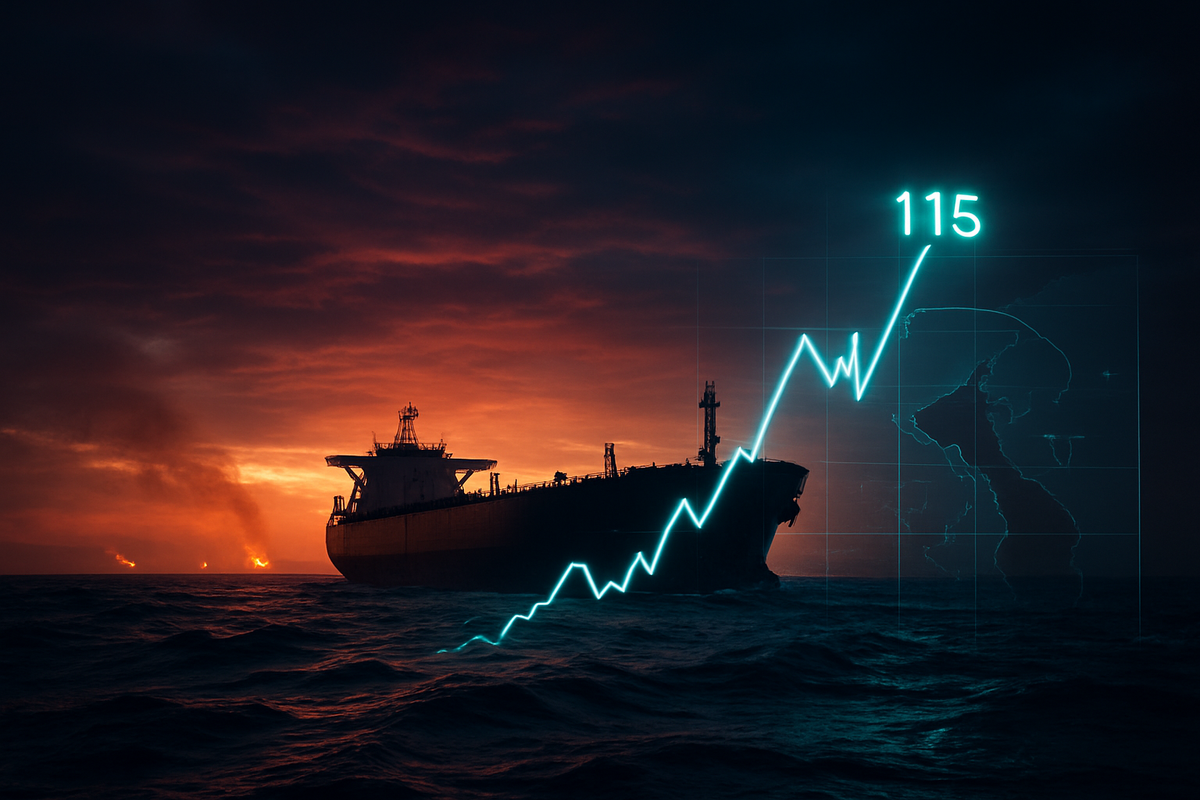
As of April 10, 2026, the global energy market is grappling with a supply shock of historic proportions. West Texas Intermediate (WTI) crude oil futures surged to $115.42 per barrel this morning, marking a four-year high and a staggering 67% increase since the beginning of the year. This dramatic price escalation is a direct consequence of the intensifying military conflict between the United States and Iran, coupled with a near-total collapse of maritime transit through the Strait of Hormuz—the world’s most critical energy artery.
The immediate implications are being felt at every level of the global economy. From record-breaking fuel prices at American pumps to a "panic buy" atmosphere on Wall Street, the disruption of nearly 20% of the world’s oil supply has pushed energy security to the top of the international agenda. While a fragile two-week ceasefire was recently brokered, the markets remain on a knife-edge, with traders pricing in the high probability of a prolonged disruption in the Middle East.
The Path to $115: A Timeline of Escalation
The current crisis, which some analysts are calling "The Great Energy Disruption of 2026," began in late February when diplomatic relations between Washington and Tehran reached a breaking point. The U.S. launched "Operation Epic Fury," a series of coordinated precision strikes against Iranian missile sites and command centers. In retaliation, Tehran enacted what it termed a "sovereign closure" of the Strait of Hormuz, effectively blockading the 21-mile-wide passage that serves as the exit point for the majority of Persian Gulf oil.
By mid-March, daily transits through the Strait plummeted from 140 vessels to fewer than five, leaving an estimated 3,000 ships—including massive oil and LNG tankers—stranded within the Gulf. The situation reached a boiling point on April 7, 2026, when U.S. forces conducted strikes on military targets on Kharg Island, Iran’s primary crude export terminal. Although the strikes avoided direct hits on energy infrastructure, the proximity of the conflict to the wells themselves triggered an 11% gap-up in oil prices in a single trading session, pushing WTI past the psychological barrier of $110 and eventually to today's $115 peak.
Market reactions have been characterized by extreme volatility and a flight to safety. The International Energy Agency (IEA) has authorized the release of emergency reserves, but the scale of the shortfall—nearly 20 million barrels per day (bpd) out of the market—has rendered these efforts largely symbolic. The Strait of Hormuz remains a "desolate front line," with only a handful of non-hostile vessels from neutral Asian nations attempting the passage under heavy escort.
Market Winners and Losers in a High-Oil Environment
The surge in crude prices has created a stark bifurcation in the equity markets, separating those who profit from scarcity from those crippled by rising input costs. Domestic energy giants have emerged as the primary "geopolitical hedges" for investors. ExxonMobil (NYSE: XOM) and Chevron (NYSE: CVX) have seen their shares climb by more than 30% since the conflict began, as their vast upstream portfolios capture record margins on every barrel produced outside the conflict zone. Similarly, Occidental Petroleum (NYSE: OXY) has significantly outperformed the broader market, as its heavy concentration in the U.S. Permian Basin provides it with a production base insulated from the physical blockades in the Middle East.
Conversely, the transportation and consumer sectors are facing a brutal environment. The airline industry has been hit hardest, with Delta Air Lines (NYSE: DAL), United Airlines (NASDAQ: UAL), and American Airlines (NASDAQ: AAL) seeing their stock prices plummet by as much as 15% in a single week. Unlike their European counterparts, many U.S. carriers reduced their fuel hedging programs in 2025, leaving them fully exposed to jet fuel prices that have hit decade-long highs. The cost of logistics is also skyrocketing; the daily rate for Very Large Crude Carriers (VLCC) has jumped to over $400,000 per day as ships are forced to take the long route around the Cape of Good Hope, adding weeks to delivery times.
Consumer discretionary companies are also under fire as high gas prices act as a regressive tax on the American public. Discount retailers like Burlington Stores (NYSE: BURL) and BJ's Wholesale Club (NYSE: BJ) have seen a direct negative correlation between oil prices and foot traffic. However, high-end retailers like Costco Wholesale (NASDAQ: COST) remain more resilient, as their higher-income customer base is better equipped to absorb the inflationary shock of $5.50-per-gallon gasoline.
Broader Significance and Historical Precedents
This 2026 crisis bears an eerie resemblance to the 1973 Arab Oil Embargo and the 1979 Iranian Revolution, yet the structural dynamics of the market have changed. In the 1970s, the U.S. was heavily dependent on imported crude. Today, the United States is a net energy exporter, which has provided a critical buffer for the domestic economy. However, because oil is a globally fungible commodity, the price at the pump in Ohio is still dictated by the security of the Strait of Hormuz.
The current situation represents a total disruption of the "just-in-time" energy supply chain that the world has relied on for decades. The loss of 20 million bpd is nearly four times the volume lost during the 1973 crisis. This has led to fears of "stagflation"—a period of stagnant economic growth combined with high inflation—reminiscent of the late 1970s. Regulatory bodies are already shifting their stance, with the Federal Reserve pausing its planned interest rate cuts to combat the inflationary pressure of $115 oil, even as economic growth signals begin to flicker.
Policy implications are also shifting toward a renewed focus on energy independence and the acceleration of alternative fuels. In Washington, there is bipartisan support for a "Strategic Energy Act" that would mandate higher minimum inventory levels for private companies, effectively moving from "just-in-time" to "just-in-case" inventory management.
Looking Ahead: Ceasefires and Strategic Pivots
The immediate future hinges on the success of the upcoming Islamabad Summit. A fragile two-week ceasefire has provided a temporary reprieve, causing WTI to retreat slightly from its $116 peak to the $110–$115 range. If negotiations between U.S., Iranian, and regional representatives lead to a formal de-escalation, market analysts suggest oil could drop back toward $90. However, if talks fail and hostilities resume—or if the Strait of Hormuz remains closed—Goldman Sachs has warned of a "super-spike" scenario where WTI could reach $150 per barrel.
In the long term, corporations will be forced into strategic pivots. Logistics companies are already exploring more permanent shifts toward rail and electric trucking to decouple their operations from the volatility of liquid fuels. Energy companies are likely to accelerate their investments in the "Atlantic Basin," focusing on production in the U.S., Guyana, and Brazil, while viewing Middle Eastern assets with increasing skepticism due to the geopolitical risk premium.
The emergence of "transit fees" for the Strait of Hormuz, proposed by Tehran during early negotiations, remains a major point of contention. If such a system is established, it could fundamentally alter the economics of global shipping, making Middle Eastern oil permanently more expensive than domestic or Western Hemisphere alternatives.
Conclusion: A Market on Edge
The surge of WTI crude to $115 per barrel on April 10, 2026, is more than just a price spike; it is a symptom of a fractured geopolitical landscape. The primary takeaway for the market is that energy security can no longer be taken for granted. The "peace dividend" that allowed for low energy prices and stable supply chains over the last few years has effectively evaporated, replaced by a new era of scarcity and volatility.
As the market moves forward, the Islamabad Summit will be the most critical event to watch. Investors should maintain a defensive posture, keeping a close eye on the "break-even" points for transportation stocks and the cash flow generation of domestic energy producers. While the ceasefire offers a glimmer of hope, the fundamental rift between the U.S. and Iran remains deep. For the coming months, the direction of the global economy will be written not in boardrooms, but in the narrow, contested waters of the Strait of Hormuz.
This content is intended for informational purposes only and is not financial advice.