NEW YORK — Global financial markets were thrust into a state of high alarm on March 9, 2026, as international benchmark crude prices breached the psychological threshold of $120 per barrel. The surge follows a weekend of intensified missile exchanges and drone strikes between Israel and Iran, marking the most volatile period in the Middle East in decades. The sudden spike has reignited deep-seated fears of "1970s-style" stagflation, leaving investors scrambling to recalibrate their portfolios in the face of a dual threat: soaring energy costs and stalling economic growth.
The immediate market reaction was swift and punishing. The Dow Jones Industrial Average (INDEXDJX:.DJI) plummeted 361 points during the morning session, as the prospect of sustained triple-digit oil prices clouded the outlook for corporate earnings and consumer spending. Across the Atlantic and in Asia, major indices saw similar retreats, while the Energy Select Sector SPDR Fund (NYSEARCA:XLE) and various commodity-linked assets surged, serving as a defensive bastion for capital looking to hedge against geopolitical risk and rampant inflation.
Escalation in the Levant: A Timeline of the Energy Shock
The current crisis traces its immediate roots to the final days of February 2026, when long-simmering tensions between Jerusalem and Tehran erupted into direct military confrontation. Following "Operation Epic Fury"—a coordinated strike on Iranian enrichment facilities—Tehran launched a massive retaliatory wave of ballistic missiles. By early March, the conflict had expanded beyond local borders, with reports of "de facto" interference in the Strait of Hormuz, a critical maritime artery through which approximately 20% of the world’s daily oil supply flows.
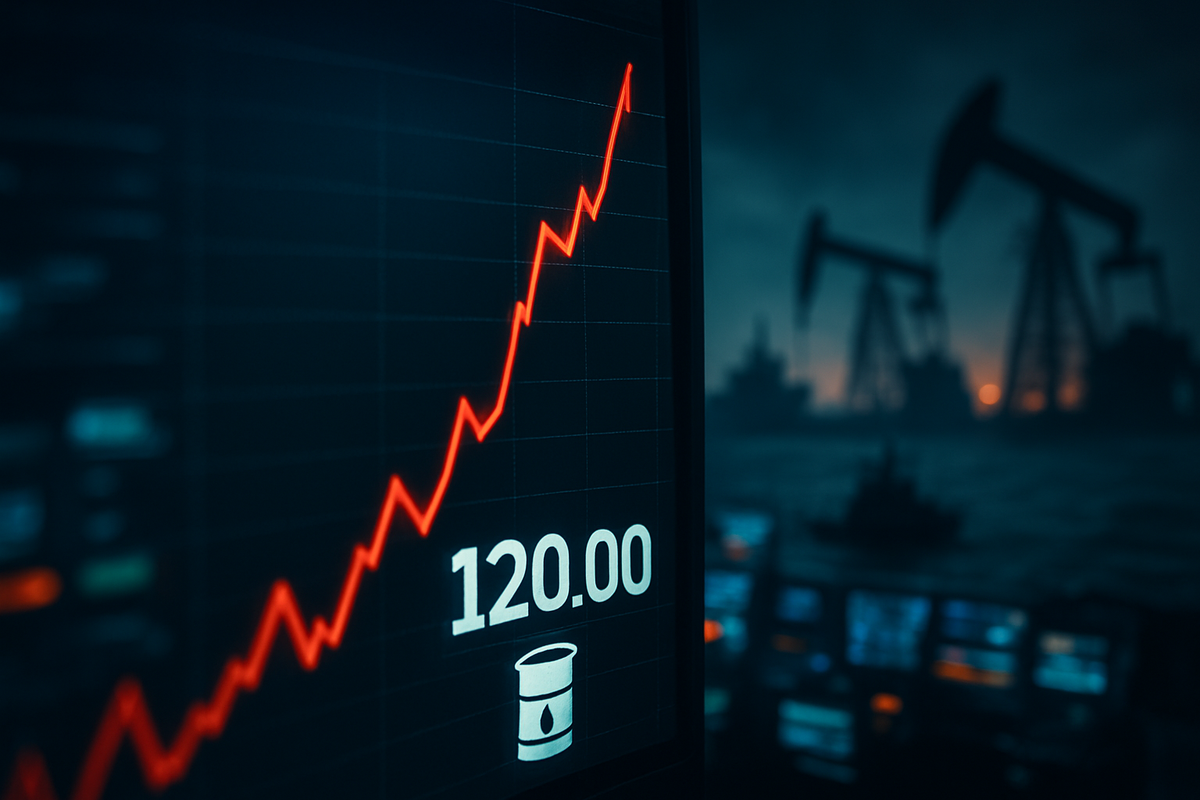
The events of March 8 and early March 9 have been particularly transformative. Intensified strikes targeted key petrochemical infrastructure, and rumors of a wider blockade of Persian Gulf shipping lanes turned a steady rise in prices into a vertical spike. Crude oil, which started the year trading in a relatively stable range, touched $120.45 per barrel this morning, a level not seen since the peak of the 2022 energy shocks. This "fear premium" is estimated by analysts to be as high as $25 per barrel, reflecting the market's pricing of a worst-case scenario where regional supply is permanently impaired.
The players involved are not just national militaries but also the global energy cartels and shipping giants. While OPEC+ has signaled a potential increase in production to stabilize prices, logistical bottlenecks and the threat of active combat zones have made such promises difficult to implement. On the floor of the New York Mercantile Exchange (NYMEX), the atmosphere was described as "frenetic," with traders noting that the speed of the ascent caught even the most bearish speculators off guard.
The Bifurcation of Wall Street: Winners and Losers
As the broader market bled, the energy sector emerged as the clear beneficiary of the geopolitical chaos. ExxonMobil (NYSE: XOM) and Chevron (NYSE: CVX) saw their shares climb by 4.2% and 3.8% respectively, as investors bet on the massive windfall profits that accompany triple-digit crude. These companies, having spent the last few years fortifying their balance sheets and expanding their low-cost production in the Permian Basin, are now seen as essential defensive plays for institutional funds.
Conversely, the "energy tax" of high fuel prices is taking a devastating toll on sectors sensitive to input costs. The airline industry has been particularly hard hit, with United Airlines (NASDAQ: UAL) and Delta Air Lines (NYSE: DAL) both seeing their stock prices crater by more than 7% in a single day. The doubling of jet fuel costs effectively erodes the margin improvements these carriers achieved in 2025, forcing management to consider emergency surcharges and flight reductions.
Consumer-facing giants are also feeling the heat. Amazon (NASDAQ: AMZN) and Target (NYSE: TGT) faced significant selling pressure as investors weighed the impact of rising logistics and transportation costs. With gasoline prices at the pump hitting a national average of $4.50 in some parts of the U.S., the fear is that discretionary spending will be the first casualty of the energy crisis, potentially tipping a fragile post-pandemic economy into a full-blown recession.
Assessing the Significance: The Return of Stagflation
This event is more than a temporary price spike; it represents a significant shift in the global economic narrative. For the better part of 2025, central banks were focused on engineering a "soft landing," aiming to tame moderate inflation without killing growth. The jump to $120 oil effectively shatters that hope, introducing the specter of stagflation—a period of stagnant economic activity coupled with high inflation. This puts the Federal Reserve in an impossible position: raising rates to combat energy-driven inflation could further dampen growth, while pausing or cutting rates could de-anchor inflation expectations.
Historically, periods of extreme oil price volatility have led to major structural changes in energy policy. We are already seeing renewed calls for "energy independence" and a faster transition to domestic renewables, though these solutions offer little relief in the immediate 3-to-6-month window. Furthermore, the ripple effects are extending to the agricultural sector, where energy-intensive fertilizer production is seeing cost spikes, threatening a global food security crisis alongside the energy one.
The regulatory environment is also shifting. Expect to see increased pressure on the U.S. government to utilize the Strategic Petroleum Reserve (SPR) once again, though current levels are significantly lower than they were during previous crises. There is also the possibility of new windfall taxes on energy majors as political leaders look for ways to subsidize the rising cost of living for the general public.
The Road Ahead: Navigating the Fog of War
In the short term, the direction of the market hinges entirely on the de-escalation of the Iran-Israel conflict. If diplomatic channels can secure a "stand-down" agreement, we could see oil prices retreat toward the $90 level as quickly as they rose. However, many analysts warn that the "genie is out of the bottle." Strategic pivots are already underway; shipping companies are rerouting vessels around the Cape of Good Hope, adding weeks to transit times and further inflating global supply chain costs.
Market opportunities may emerge in the transition to "Energy 2.0." Companies specializing in liquefied natural gas (LNG) and nuclear power are seeing renewed interest as Europe and Asia look to permanently decouple from Middle Eastern volatility. However, for the average investor, the coming months will likely be characterized by heightened volatility. Defensive positioning—tilting toward commodities, short-term Treasuries, and high-yield energy stocks—remains the prevailing strategy among the "smart money" on the street.
Conclusion: A Market at a Crossroads
The events of March 9, 2026, serve as a stark reminder of the fragile nexus between geopolitics and global finance. The $120 oil threshold is a siren call for the return of stagflationary pressures that many hoped were a relic of the past. While energy giants like ExxonMobil and Chevron provide a temporary hedge for investors, the broader market's health is inextricably linked to regional stability and the free flow of energy through global shipping lanes.
Moving forward, investors must watch for two key indicators: the rhetoric coming out of the Iranian Revolutionary Guard regarding the Strait of Hormuz and the Federal Reserve's next move in its interest rate policy. The market is no longer just trading on earnings reports; it is trading on satellite imagery and diplomatic cables. In this new era of high-stakes geopolitical risk, caution remains the most valuable asset in any portfolio.
This content is intended for informational purposes only and is not financial advice.