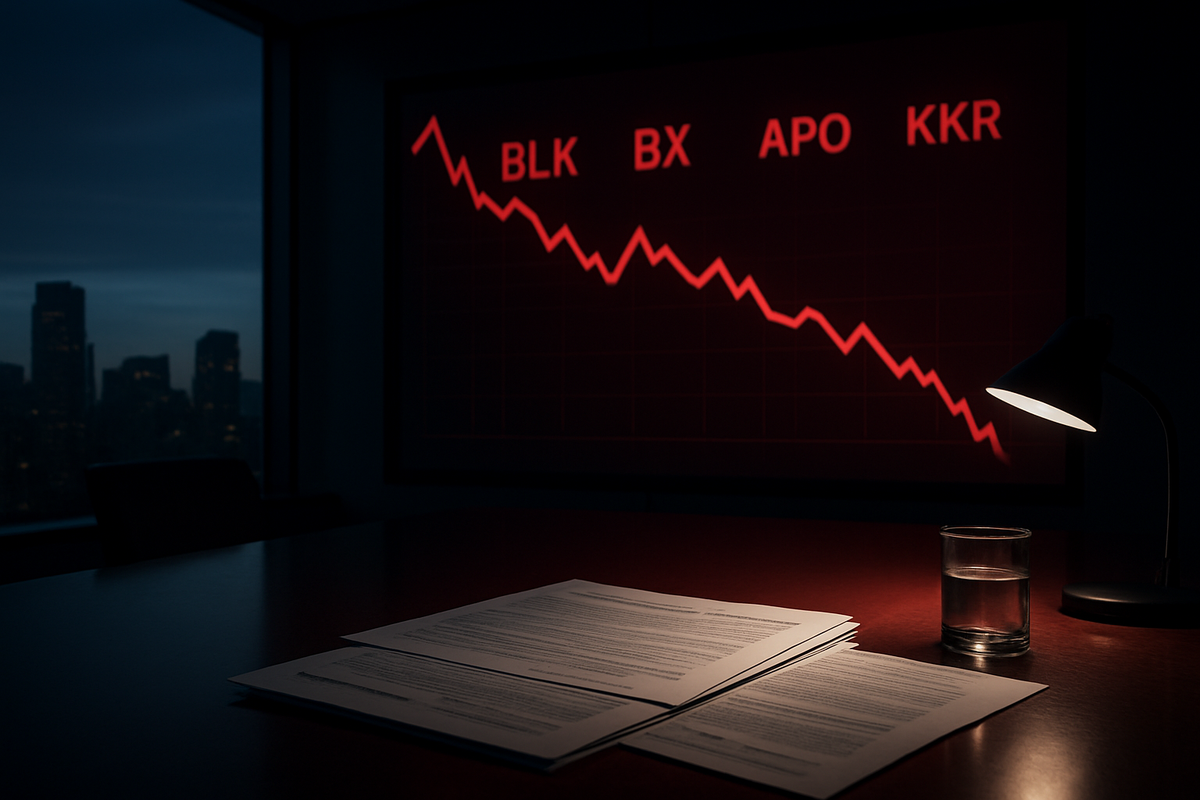
The era of unfettered optimism in private credit met a harsh reality check on Wednesday, as shares of the world’s most powerful alternative asset managers plummeted. Concerns over hidden defaults, aggressive valuation practices, and a sudden liquidity squeeze in retail-oriented credit funds sparked a broad sell-off across the financial sector. By the closing bell on March 11, 2026, the industry's titans—BlackRock (NYSE: BLK), Blackstone (NYSE: BX), Apollo Global Management (NYSE: APO), and KKR & Co. Inc. (NYSE: KKR)—all posted losses exceeding 2%, erasing billions in collective market capitalization.
The slide marks a pivotal moment for a sector that has grown into a $2 trillion powerhouse over the last decade, often operating in the shadows of traditional banking regulations. As higher-for-longer interest rates continue to squeeze mid-market borrowers, investors are beginning to question whether the "creative" accounting used to mask distressed loans is finally reaching a breaking point. The day’s volatility has sent a clear signal: the private credit "black box" is being forced open, and the market may not like what it finds inside.
A Sea of Red: Anatomy of the March 11 Sell-Off
The catalyst for Wednesday’s downturn was a toxic mix of regulatory headwinds and fresh data suggesting that the "true" default rate in private lending is significantly higher than previously reported. While headline figures have hovered around 2%, new analysis suggests that when including "selective defaults" and distressed debt exchanges, the actual failure rate among corporate borrowers hit nearly 9% over the past year. This discrepancy came to a head on March 11, following reports that the Securities and Exchange Commission (SEC) has intensified its probe into private credit rating agencies, specifically focusing on whether firms provided inflated grades to satisfy major asset managers.
The selling pressure intensified throughout the morning as news broke that BlackRock (NYSE: BLK) had hit its quarterly redemption limit for its flagship $26 billion HPS HLEND fund, effectively "gating" investors from withdrawing their capital. This followed a similar move by Blackstone (NYSE: BX) earlier in the quarter, which had already seen record redemption requests for its $82 billion BCRED fund. The realization that even the largest players are struggling to manage liquidity in their retail-heavy vehicles triggered a flight to safety, dragging down Apollo Global Management (NYSE: APO) and KKR & Co. Inc. (NYSE: KKR) in sympathy.
Stakeholders are also still reeling from the "Blue Owl shock" in February, where Blue Owl Capital (NYSE: OWL) faced sharp criticism over its valuation of technology-sector loans. The cumulative effect of these events has created a crisis of confidence. Traders spent much of Wednesday unwinding positions in Business Development Companies (BDCs), which are often the primary vehicle for public investors to gain exposure to private loans. By mid-afternoon, the KBW Bank Index was down nearly 1.5%, but the alternative asset manager sub-sector bore the brunt of the damage, reflecting a heightened sensitivity to the specific risks of non-bank lending.
Winners and Losers in the Great Revaluation
In the wake of this slide, the hierarchy of the alternative investment world is being reshuffled. Blackstone (NYSE: BX) and BlackRock (NYSE: BLK) find themselves in a defensive crouch. Having aggressively marketed "perpetual capital" vehicles to wealthy individuals, these firms are now facing the downside of retail participation: when sentiment turns, the rush for the exits can overwhelm the fund’s liquidity buffers. Blackstone, in particular, has had to reassure investors that its diversified portfolio can withstand the stress, but the market remains skeptical as Blackstone Secured Lending Fund (NYSE: BXSL) trades at a deepening discount to its net asset value.
On the other hand, firms with a heavier focus on asset-based finance (ABF) rather than pure corporate lending may emerge as relative winners. KKR & Co. Inc. (NYSE: KKR) has spent the last year pivoting toward infrastructure and hard-asset backed loans, which are seen as more resilient than the software-heavy portfolios of their rivals. However, their joint ventures, such as FS KKR Capital Corp (NYSE: FSK), remain under pressure as non-accruals—loans where the borrower has stopped making interest payments—begin to creep upward.
Apollo Global Management (NYSE: APO) occupies a unique middle ground. While CEO Marc Rowan has warned of an impending "shakeout" in the industry, Apollo’s Athene insurance arm provides a steady stream of "sticky" capital that its competitors lack. Nonetheless, the stock suffered on Wednesday as investors worried that even Apollo’s sophisticated "direct credit" model cannot escape a systemic repricing of risk. The ultimate losers in this scenario are the smaller, highly-leveraged BDCs and private credit shops that lacks the scale to negotiate favorable restructuring terms with struggling borrowers.
The End of the 'PIK' Era and New Regulatory Realities
The wider significance of this event lies in the exposure of "zombie" companies—firms that only stay afloat by using "Payment-in-Kind" (PIK) toggles. PIK interest allows a borrower to pay its interest by issuing more debt rather than using cash. In the low-rate era, this was a minor feature; in 2026, it has become a survival mechanism. Analysts estimate that 40% of private credit borrowers now have negative free cash flow, and public BDCs are receiving nearly 8% of their income via PIK. Wednesday's sell-off indicates that investors no longer view PIK income as high-quality earnings, but rather as a precursor to eventual default.
This market turmoil is also accelerating a massive regulatory shift. The Federal Reserve and the Financial Stability Oversight Council (FSOC) have officially formed a "Market Resilience Working Group" to monitor the link between private credit and the traditional banking system. For the first time, the Fed is requiring large banks to provide granular reports on their lending to private credit funds to prevent a "contagion" event. This move toward transparency is a double-edged sword: while it may prevent a systemic collapse, it also removes the "regulatory arbitrage" that allowed private credit to flourish at the expense of traditional banks.
Historically, this moment draws comparisons to the 2023 regional banking crisis, where a lack of transparency regarding unrealized losses led to a sudden loss of confidence. In the private credit context, the "unrealized losses" are the loans that managers refuse to mark down to market value. As the SEC ramps up its 2026 examinations, the industry is bracing for a wave of forced write-downs that could further depress valuations across the board.
The Road Ahead: Consolidation and "Forced Transparency"
In the short term, expect a period of "capital preservation" across the sector. Major managers are likely to slow down new deal activity as they focus on restructuring existing portfolios and meeting redemption requests. The strategic pivot will likely move away from the "BDC model" of the early 2020s and toward "Interval Funds," which offer more controlled liquidity windows and are less prone to the panic-selling seen on March 11.
Long-term, a massive consolidation is inevitable. The "Blue-Chip" managers like KKR and Apollo will likely use their remaining dry powder to acquire smaller, distressed credit portfolios at a discount. However, the days of 15% yields with "no volatility" are over. The industry will have to adapt to a reality where transparency is a requirement, not a choice. We may see the emergence of a standardized "secondary market" for private loans, which would provide the market-based pricing that regulators are now demanding.
Market opportunities may emerge in the "special situations" and "distressed debt" space. As the current crop of private credit loans fails, a new wave of capital will be needed to restructure these companies. This "vulture" cycle is a natural part of the credit markets, but it will be a painful transition for the investors who bought into the "stable, high-yield" narrative of the past five years.
Investor Outlook: Watching the Cracks
The events of March 11 serve as a stark reminder that in the financial markets, there is no such thing as a free lunch. The "low volatility" of private credit was, in many ways, an illusion created by infrequent valuations and the absence of a public exchange. Now that the cracks are widening, investors must look past the reported Net Asset Values and scrutinize the underlying health of the borrowers.
The key takeaways for the months ahead are clear: watch the SEC's enforcement actions regarding credit ratings and monitor the SOFR (Secured Overnight Financing Rate) path. If rates remain elevated, the PIK-dependent borrowers will continue to crumble. For the major asset managers, the test will be their ability to manage liquidity without permanently damaging their reputations with retail investors.
Moving forward, the market will likely reward managers who demonstrate "radical transparency" and penalize those who continue to rely on creative accounting. Investors should keep a close eye on the "non-accrual" rates reported in upcoming Q1 2026 earnings calls. The private credit sector isn't going away, but it is undergoing a painful maturation process—one that began in earnest on a volatile Wednesday in March.
This content is intended for informational purposes only and is not financial advice.