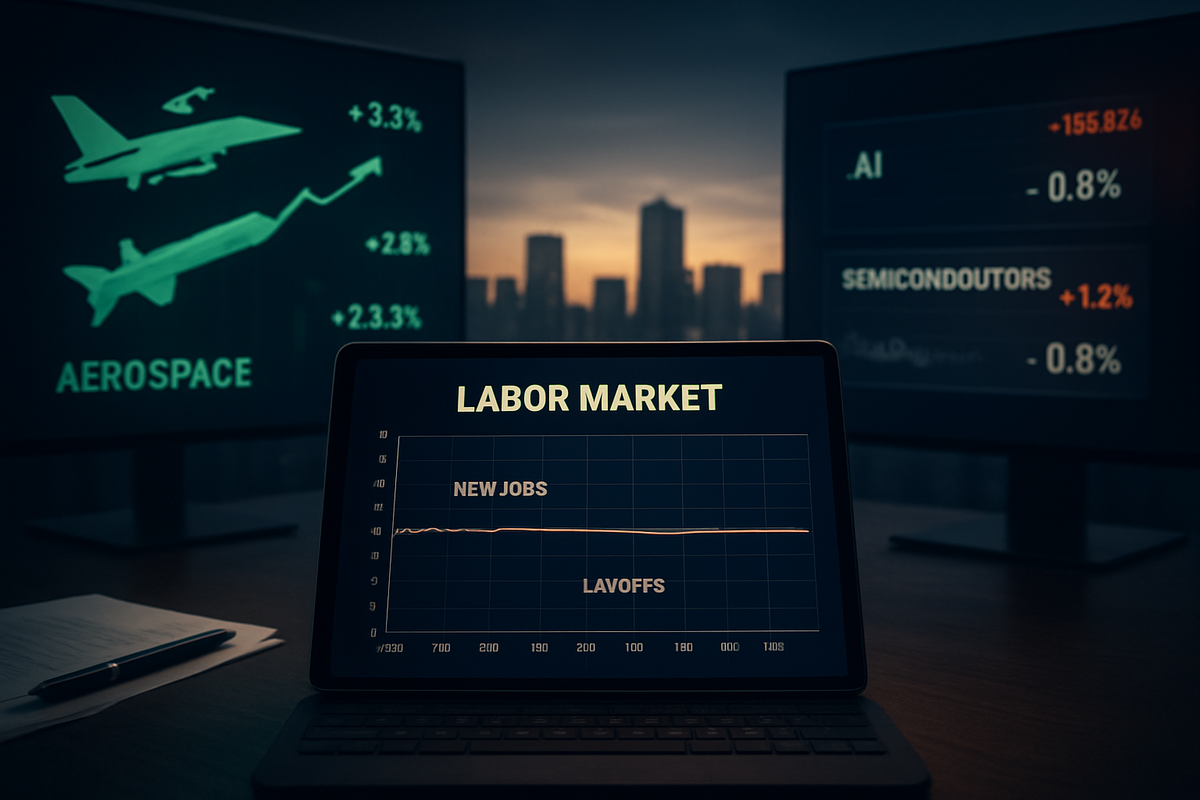
The U.S. labor market is entering a period of profound uncertainty as the latest jobless claims data reveals a "low-hire, low-fire" stalemate that has left investors and policymakers on edge. On Thursday, January 8, 2026, the Department of Labor reported that initial jobless claims fell to 208,000, slightly better than the consensus forecast of 210,000 to 215,000. While the headline figure suggests a resilient workforce, underlying data points to a more complex reality: a sharp spike in unadjusted claims and a rise in continuing claims indicate that while layoffs remain historically low, the engine of new hiring has significantly cooled.
This data release has heightened the anticipation for tomorrow’s Non-Farm Payrolls (NFP) report, scheduled for Friday, January 9. With the market already grappling with a massive $1.5 trillion defense budget proposal and a "growth scare" in the technology sector, the Friday jobs report is being viewed as the ultimate tiebreaker. It will determine whether the U.S. economy is successfully navigating a "soft landing" or if the "jobless expansion"—where productivity rises through automation while headcount remains flat—is finally beginning to fray at the edges.
A Divergent Day on Wall Street
The initial jobless claims report for the week ending January 3, 2026, provided a paradoxical view of the American worker's status. While the seasonally adjusted figure of 208,000 was a positive surprise, the "unadjusted" raw claims told a different story, surging by nearly 30,000 to reach 300,860. This raw spike outpaced typical seasonal patterns for the first week of the year, leading analysts to suggest that the post-holiday "right-sizing" in the retail and logistics sectors might be more aggressive than anticipated. Furthermore, continuing claims rose to 1.91 million, an increase of approximately 56,000, suggesting that those who do lose their jobs are finding it increasingly difficult to secure new positions.
The market reaction on Thursday was a study in sector rotation. The Dow Jones Industrial Average rose 0.7%, bolstered by a surge in defense contractors, while the Nasdaq Composite fell between 0.4% and 0.67% as tech investors took profits. This divergence was fueled not only by the labor data but by President Trump’s formal proposal for a $1.5 trillion defense budget for 2027. The 10-year Treasury yield rose to 4.18%, reflecting a "hawkish" interpretation of the low jobless claims and concerns over the massive projected deficit. Key economists, including Jose Torres of Interactive Brokers, noted that while layoffs are at a 17-month low, the lack of new hiring is creating a "hiring recession" that the Federal Reserve must carefully navigate in its upcoming meetings.
Sector Winners and Losers in a Cooling Market
The defense sector emerged as the clear winner of the day, with Lockheed Martin (NYSE: LMT) seeing shares jump between 4.3% and 8.2%, trading as high as $535. Northrop Grumman (NYSE: NOC) followed suit, rising roughly 8% to trade near $623. These gains were driven by the "Dream Military" budget proposal, which promises a massive increase in procurement and modernization. However, these gains are tempered by potential regulatory "catches," including proposed bans on stock buybacks and dividends for contractors until production backlogs—such as the F-35 jet deliveries—are fully cleared.
Conversely, the technology and recruitment sectors faced significant headwinds. Nvidia (NASDAQ: NVDA) shares fell 2.5%, struggling to stay above the $185 mark as rising Treasury yields pressured high-growth valuations. Broadcom (NASDAQ: AVGO) also slipped 3.3%, as investors shifted away from semiconductor stocks that have dominated the market for the past year. In the staffing industry, the outlook was even more somber. Robert Half (NYSE: RHI) traded near multi-year lows of $27, down significantly year-to-date as the "subdued hiring cycle" continues to eat into permanent placement margins. ManpowerGroup (NYSE: MAN) similarly faced pressure, with investors wary of a cautious 2026 hiring outlook that has seen job openings fall to just 7.14 million.
The Broader Significance: A "Jobless Expansion"
This week's labor data fits into a broader industry trend that some economists are calling a "jobless expansion." Companies are increasingly utilizing artificial intelligence and automation to drive productivity, allowing them to expand output without a corresponding increase in headcount. Matthew Martin, Senior US Economist at Oxford Economics, noted that firms are successfully doing "more with less," a trend that is particularly evident in the technology sector where job cuts rose 58% year-over-year in 2025. This structural shift suggests that traditional labor market indicators may no longer provide the same signals for economic health as they did in previous decades.
The ripple effects of this trend are being felt across the regulatory landscape. The Federal Reserve is now tasked with a delicate balancing act: maintaining high enough rates to curb any lingering inflation while ensuring that the "hiring recession" doesn't turn into a broader economic contraction. Historical precedents, such as the post-2008 recovery, showed that a "jobless recovery" can lead to long-term wage stagnation and increased wealth inequality. If tomorrow's NFP report shows a significant miss—perhaps falling toward the "whisper number" of 45,000 jobs—it could force the Fed to reconsider its timeline for rate cuts, potentially pivoting as early as the first quarter of 2026.
What Comes Next: The Friday NFP Catalyst
In the short term, all eyes are on the 8:30 AM ET release of the Non-Farm Payrolls report on Friday, January 9. Consensus estimates range from 55,000 to 73,000 new jobs, with the unemployment rate expected to edge down to 4.5%. However, analysts warn that a drop in the unemployment rate might be a "false positive," driven more by a decline in labor force participation than by robust hiring. If the number beats expectations, we could see a further sell-off in bonds and a continued rotation into "value" sectors like defense and energy.
Longer-term, the labor market's trajectory will depend on whether the "mobility surge"—where 38% of workers plan to look for new jobs in early 2026—meets a wall of employer caution. Companies like Robert Half and ManpowerGroup will need to pivot their business models toward "precision hiring" and high-end consulting to survive a low-volume environment. For investors, the challenge will be identifying which companies can continue to grow earnings through productivity gains rather than headcount expansion, as the era of easy hiring and low interest rates appears to be firmly in the rearview mirror.
Final Assessment for Investors
The surprise reading in jobless claims has served as a critical "canary in the coal mine" for the U.S. economy. While the headline resilience is comforting, the underlying stagnation in hiring and the rise in continuing claims suggest that the labor market is more fragile than it appears. The $1.5 trillion defense budget proposal has added a layer of fiscal complexity, driving a wedge between the "old economy" cyclicals and the "new economy" tech giants.
Moving forward, investors should watch for two key indicators: the "real" unemployment rate (including those who have dropped out of the labor force) and the pace of wage growth. If wage growth continues to outpace productivity, the Fed may remain hawkish, further pressuring tech valuations. Conversely, a significant miss in tomorrow's jobs report could spark a "growth scare" that leads to a broader market correction. For now, the strategy remains one of cautious diversification, with a keen eye on the Friday morning data that will likely set the tone for the first quarter of 2026.
This content is intended for informational purposes only and is not financial advice.