The global markets open for the first full week of 2026 with a familiar name once again dictating the pace of the financial world. NVIDIA (NASDAQ: NVDA), the silicon titan that redefined the previous two years of trading, has ignited a fresh "tech trade" revival, pushing the S&P 500 to record highs and the Dow Jones Industrial Average toward the historic 50,000 mark. This resurgence comes on the heels of the 2026 Consumer Electronics Show (CES), where the company’s latest technological breakthroughs signaled that the artificial intelligence supercycle is far from its peak.
The immediate implications of this rally are profound. Investors, who spent much of late 2025 debating whether the "AI bubble" was finally leaking air, have pivoted back to aggressive growth positions. The renewed demand for AI infrastructure is no longer driven by speculative chat-bot hype, but by a massive global shift toward "Physical AI"—the integration of high-level compute into robotics, autonomous manufacturing, and national "sovereign" data centers. With NVIDIA’s market capitalization hovering near $4.60 trillion, its gravity is pulling the entire tech sector upward, forcing a re-evaluation of what the next phase of the industrial revolution looks like.
The Rubin Era and the One-Year Product Cycle
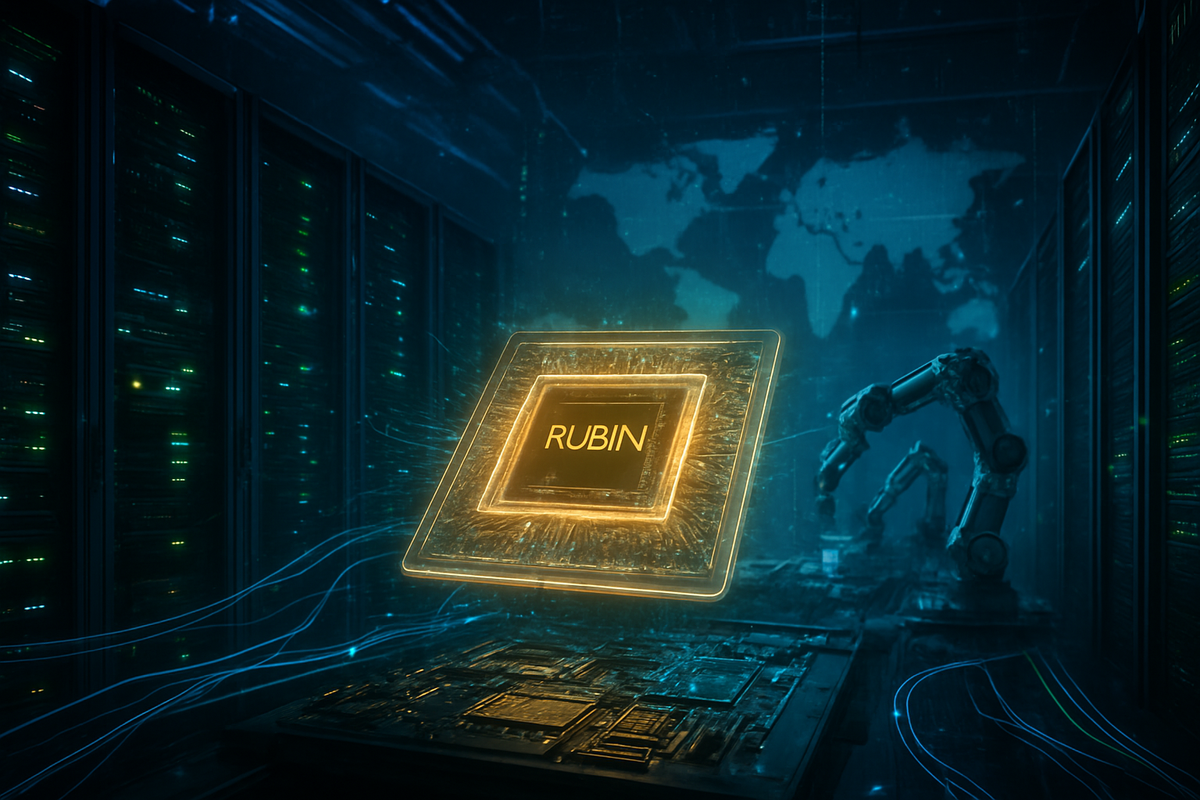
The current market momentum can be traced back to January 5, 2026, when NVIDIA CEO Jensen Huang took the stage at CES to unveil the "Vera Rubin" architecture. This announcement officially cemented the company’s transition to a relentless one-year product cycle, a pace that has left competitors and traditional semiconductor cycles in the dust. The Rubin platform, slated for full deployment in the second half of 2026, promises a staggering 5x increase in inference performance over the already dominant Blackwell series. By utilizing cutting-edge HBM4 memory and a 3nm manufacturing process from Taiwan Semiconductor Manufacturing Co. (NYSE: TSM), NVIDIA has signaled that the technical "wall" many analysts feared is nowhere in sight.
The timeline leading to this moment was defined by a blockbuster Q3 fiscal 2026 earnings report in late November 2025. NVIDIA reported a record $57 billion in revenue, a 62% year-over-year increase, with its data center division alone accounting for over $51 billion. Despite a brief 8% pull-back in December as investors took profits, the "CES rally" has restored confidence. The market's reaction has been one of relief; the transition from Blackwell to Rubin suggests that the massive capital expenditures (Capex) from "Big Tech"—projected to exceed $400 billion in 2026—still have a clear technological roadmap to follow.
This rally is also fueled by the emergence of "Sovereign AI." Throughout 2025, nations like Saudi Arabia, the UAE, and several EU members began treating compute capacity as a matter of national security. The Saudi "HUMAIN" project, a $100 billion initiative backed by their Public Investment Fund, has become a major buyer of NVIDIA systems, creating a new floor for demand that is independent of Silicon Valley’s venture capital cycles.
Winners and Losers in the New Compute Economy
While NVIDIA remains the undisputed sun in the tech solar system, the 2026 revival is creating a more nuanced landscape of winners and losers. Advanced Micro Devices (NASDAQ: AMD) has emerged as the most formidable "second source" for AI chips. Its Instinct MI400 series, specifically the MI455X, has gained significant traction by offering 432GB of HBM4 memory—surpassing NVIDIA’s current Blackwell offerings in specific memory-intensive tasks. Analysts expect AMD to claw back enough market share to reach nearly 30% of the data center GPU market by the end of the year, positioning it as a primary beneficiary of the industry’s desire to avoid a total NVIDIA monopoly.
Broadcom (NASDAQ: AVGO) is another clear winner, dominating the shift toward custom AI Application-Specific Integrated Circuits (ASICs). As hyperscalers like Alphabet (NASDAQ: GOOGL) and Amazon (NASDAQ: AMZN) seek to lower their total cost of ownership, they are increasingly turning to Broadcom to help design their own internal chips, such as Google’s TPU v7 "Ironwood." Broadcom’s recent landmark deal with OpenAI to develop custom accelerators has solidified its role as the "architect of the AI back-office." Similarly, the "arms dealers" of the supply chain—TSMC and SK Hynix (KOSPI: 000660)—continue to enjoy total pricing power as the world’s only sources for 2nm wafers and high-bandwidth memory.
Conversely, the picture is less bright for Intel (NASDAQ: INTC). By early 2026, Intel has largely conceded the high-end AI training market to NVIDIA and AMD, focusing instead on its "Foundry First" strategy and edge AI for personal computers. While its "Crescent Island" inference chips find a niche in enterprise servers, Intel remains a laggard in the massive GPU clusters that drive the current market rally. Microsoft (NASDAQ: MSFT), despite its early lead in software, finds itself in a complex position; delays in its internal "Maia" silicon project have left it more dependent on NVIDIA than its peers, Alphabet and Amazon, potentially squeezing its margins as hardware costs remain elevated.
Sovereignty, Energy, and the Ghost of the Dot-Com Era
The wider significance of the 2026 tech trade revival lies in the transformation of AI from a software feature into a geopolitical and physical asset. We have entered the era of "Transactional AI," highlighted by the U.S. government’s 2025 pivot to a "federal royalty" model. Under this policy, American firms are permitted to sell certain advanced chips to "approved" international customers in exchange for a 25% revenue stake paid to the U.S. Treasury. This turns AI dominance into a direct fiscal tool for the state, a development with no historical precedent in the tech industry.
Furthermore, the "power wall" has become the primary constraint on growth. In 2026, data centers are projected to consume nearly 5% of all U.S. electricity. This has triggered a wave of new regulations, particularly in the European Union, where facilities opening after July 2026 must reuse at least 10% of their waste heat. This energy crisis is forcing a ripple effect through the utilities and cooling sectors, making companies that specialize in liquid cooling and small modular nuclear reactors (SMRs) essential partners in the AI build-out.
Inevitably, comparisons to the 1990s dot-com bubble persist. However, the 2026 rally differs in one crucial aspect: profitability. Unlike the unprofitable "concept" companies of 1999, the firms leading today’s charge—NVIDIA, Broadcom, and the hyperscalers—are among the most cash-rich and profitable entities in history. The risk in 2026 is not a "crash of ideas," but a "Capex correction." If the trillions of dollars invested in infrastructure do not translate into measurable productivity gains for the broader economy by 2027, the market may face a painful normalization.
The Road Ahead: Robotics and the Edge
Looking toward the remainder of 2026 and into 2027, the focus is shifting from the data center to the "edge." The next strategic pivot for the industry will be the deployment of "Physical AI"—autonomous systems that can navigate and interact with the real world. NVIDIA’s "Alpamayo" models for autonomous driving and robotics are expected to be the next major revenue drivers as the training of large language models begins to reach a point of diminishing returns.
The short-term challenge for the market will be navigating the transition to 2nm manufacturing. Any yield issues at TSMC or delays in the delivery of ASML’s (NASDAQ: ASML) next-generation High-NA EUV lithography machines could stall the Rubin rollout and trigger a sector-wide correction. Investors should also watch for the "circularity" risk—the phenomenon of AI companies investing in their own customers to bolster revenue—which has drawn increasing scrutiny from the SEC and other global regulators.
Final Assessment: A Market in Motion
The revival of the tech trade in early 2026 confirms that AI remains the primary engine of global economic growth. NVIDIA’s ability to maintain its lead through the Rubin architecture has provided the market with the "north star" it needed to continue its upward trajectory. While the landscape is becoming more competitive with the rise of AMD and custom silicon from Broadcom, the total addressable market is expanding fast enough to accommodate multiple winners.
Moving forward, the market will be defined by "Compute Sovereignty" and energy efficiency. Investors should move past simple "chip counts" and start looking at which companies are successfully navigating the power grid and which nations are building their own independent AI stacks. The coming months will be a period of high volatility as the "Physical AI" transition begins, but the fundamental strength of the sector suggests that the 2026 rally has deep, structural roots.
This content is intended for informational purposes only and is not financial advice.