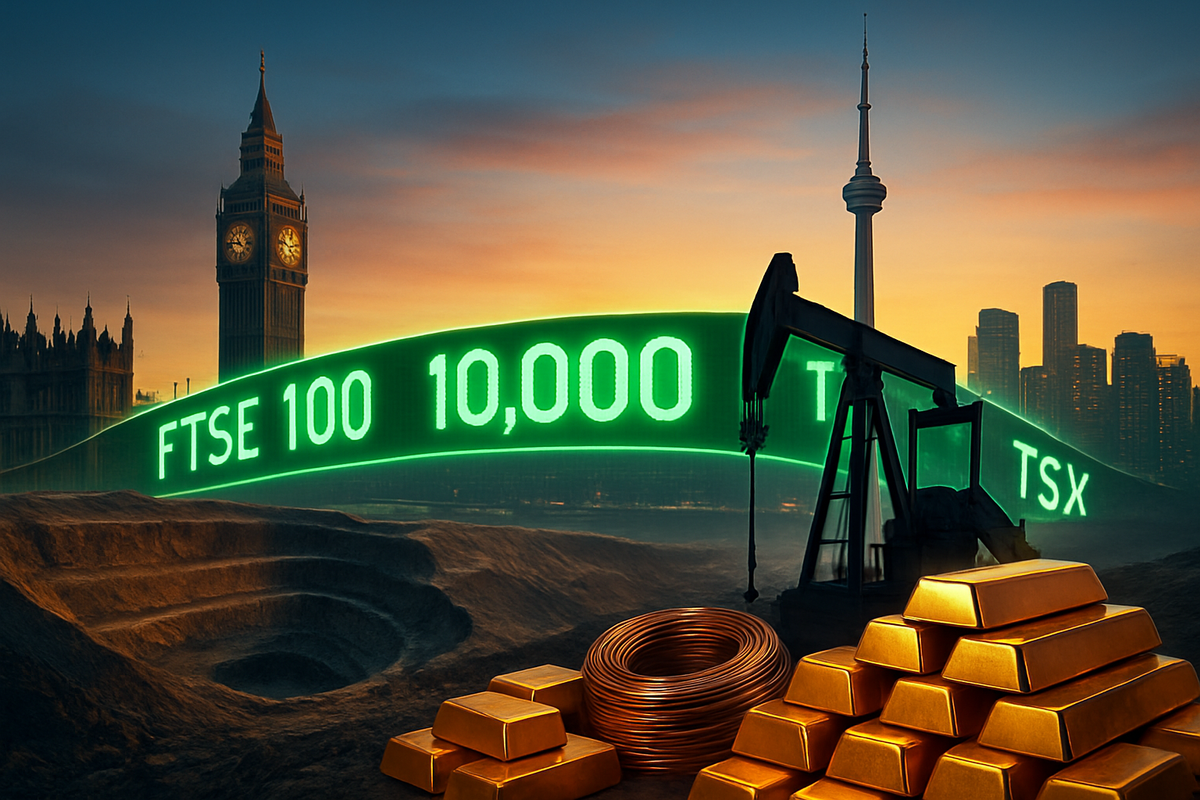
In a historic opening to 2026, global stock indices heavily weighted toward natural resources have surged to unprecedented heights. The London Stock Exchange's premier index, the FTSE 100 (LSE:UKX), finally breached the psychological 10,000-point barrier on January 6, 2026, marking a monumental milestone for the UK market. Simultaneously, the S&P/TSX Composite (TSX:OSPX) in Toronto hit a fresh all-time high of 32,318.30, driven by an insatiable global appetite for industrial metals and a dramatic geopolitical shift in South America that has sent shockwaves through the energy sector.
This rally signals a significant rotation in global capital, as investors pivot away from high-valuation technology stocks toward the "physical economy." The immediate implications are profound: resource-rich nations are seeing a massive influx of investment, while inflationary pressures from rising raw material costs are beginning to weigh on manufacturing and transportation sectors. As the "old economy" asserts its dominance, the market is grappling with a new reality where tangible assets—gold, copper, and crude—are once again the ultimate arbiters of value.
The Twin Pillars of the 2026 Rally
The ascent to these record levels was not a sudden burst but the culmination of a "commodity decoupling" that began in late 2025. While much of the previous decade was defined by digital growth, 2026 has opened with a focus on the materials required to power the next industrial revolution. Copper prices shattered records this week, hitting $13,000 per tonne, fueled by the "electrification of everything"—specifically the massive infrastructure needs of AI data centers and global renewable energy grids. Gold has also played a starring role, surpassing $4,500 per ounce as central banks and private investors seek a "safe haven" amid escalating global tensions.
The timeline leading to this moment was accelerated by a dramatic geopolitical event over the first weekend of January 2026: the U.S.-led intervention in Venezuela and the capture of President Nicolás Maduro. This event injected an immediate "risk premium" into the oil markets. While the long-term outlook for oil remains shadowed by a projected global supply glut, the immediate uncertainty pushed Brent Crude toward $65 per barrel. For the FTSE 100, which hosts energy giants like Shell (LSE:SHEL) and BP (LSE:BP), this short-term price spike, combined with a rotation into "value" sectors, provided the final push needed to cross the 10,000-point threshold.
The Corporate Winners and Losers
The primary beneficiaries of this surge are the mining conglomerates that dominate the London and Toronto exchanges. In the UK, precious metals miner Fresnillo (LSE:FRES) has seen its share price skyrocket, building on a 400% gain from the previous year. Diversified miners such as Rio Tinto (LSE:RIO), Glencore (LSE:GLEN), and Anglo American (LSE:AAL) have also posted significant gains, as the high price of copper and iron ore bolsters their balance sheets. In Canada, the story is mirrored by gold majors like Agnico Eagle Mines (TSX:AEM) and Barrick Gold (TSX:ABX), which have become the darlings of institutional investors seeking protection against currency debasement.
However, the rally has not been uniform, and the "Venezuela Shock" has created a complex landscape for energy companies. While UK-listed oil majors thrived, Canadian heavy crude producers faced a sudden "knee-jerk" sell-off. Investors expressed concern that a U.S.-backed revitalization of Venezuela’s oil industry could eventually flood the market with heavy crude that competes directly with Alberta’s oil sands. Consequently, Canadian Natural Resources (TSX:CNQ) and Cenovus Energy (TSX:CVE) saw their shares dip by as much as 5% to 8% in early January trading. Meanwhile, integrated players like Suncor Energy (TSX:SU) remained more resilient, supported by their refining arms which could potentially benefit from cheaper Venezuelan feedstock in the future.
Analyzing the Wider Market Significance
This event marks a definitive shift in the broader industry trend, moving from a "software-first" mentality to a "hardware-heavy" economic model. The massive energy requirements of Generative AI have transformed energy companies from mere fuel providers into the fundamental utility of the digital age. This "Great Rotation" suggests that the market is finally pricing in the physical constraints of the green transition and the AI boom. Furthermore, the record highs in the FTSE 100 and TSX highlight a divergence from the tech-heavy Nasdaq, which has faced headwinds from higher-for-longer interest rates and saturated valuations.
Historically, such commodity-led rallies have been precursors to broader inflationary cycles. The current situation draws comparisons to the commodity supercycle of the early 2000s, driven by China’s rapid urbanization. Today, the drivers are more fragmented but equally powerful: Western re-industrialization, the global energy transition, and a renewed focus on national resource security. Regulatory bodies are now watching closely, as the high cost of industrial metals could slow the pace of the very renewable energy projects intended to lower long-term energy costs, creating a "greenflation" feedback loop.
The Road Ahead: Strategic Pivots and Market Risks
In the short term, the market will likely remain volatile as the situation in Venezuela stabilizes and the true impact on global oil supply becomes clearer. For mining companies, the challenge will be meeting the "insatiable demand" for copper and lithium without triggering environmental or regulatory backlash. We may see a wave of consolidation as cash-rich miners like BHP (ASX:BHP) or Rio Tinto (LSE:RIO) look to acquire smaller explorers to replenish their dwindling reserves.
Long-term, the sustainability of this rally depends on whether central banks can achieve a "soft landing." If the Bank of England and the Bank of Canada continue their path of monetary easing—as seen in late 2025—the resulting liquidity will likely keep a floor under commodity prices. However, if the high cost of raw materials leads to a resurgence in consumer inflation, a return to hawkish interest rate policies could abruptly end the party. Investors should also watch for a potential "supply response" in the energy sector; if U.S. majors like ExxonMobil (NYSE: XOM) successfully restart Venezuelan production faster than expected, the current oil price support could evaporate.
Final Assessment for the Modern Investor
The record-breaking performance of the FTSE 100 and TSX in early 2026 is a testament to the enduring power of the resource sector. Key takeaways include the emergence of copper as the "new oil" and the resilience of gold as a multi-purpose hedge. While the headlines are dominated by the 10,000-point milestone, the underlying story is one of a global economy re-centering itself around physical assets and geopolitical reality.
Moving forward, the market is likely to remain bifurcated. Investors should keep a close eye on quarterly earnings from the mining majors and any shifts in OPEC+ production strategy. While the "Year of the Glut" was the predicted narrative for 2026, the first week of January has proven that geopolitics and structural demand can override even the most certain forecasts. For now, the "Old Economy" is back, and it is trading at record highs.
This content is intended for informational purposes only and is not financial advice.