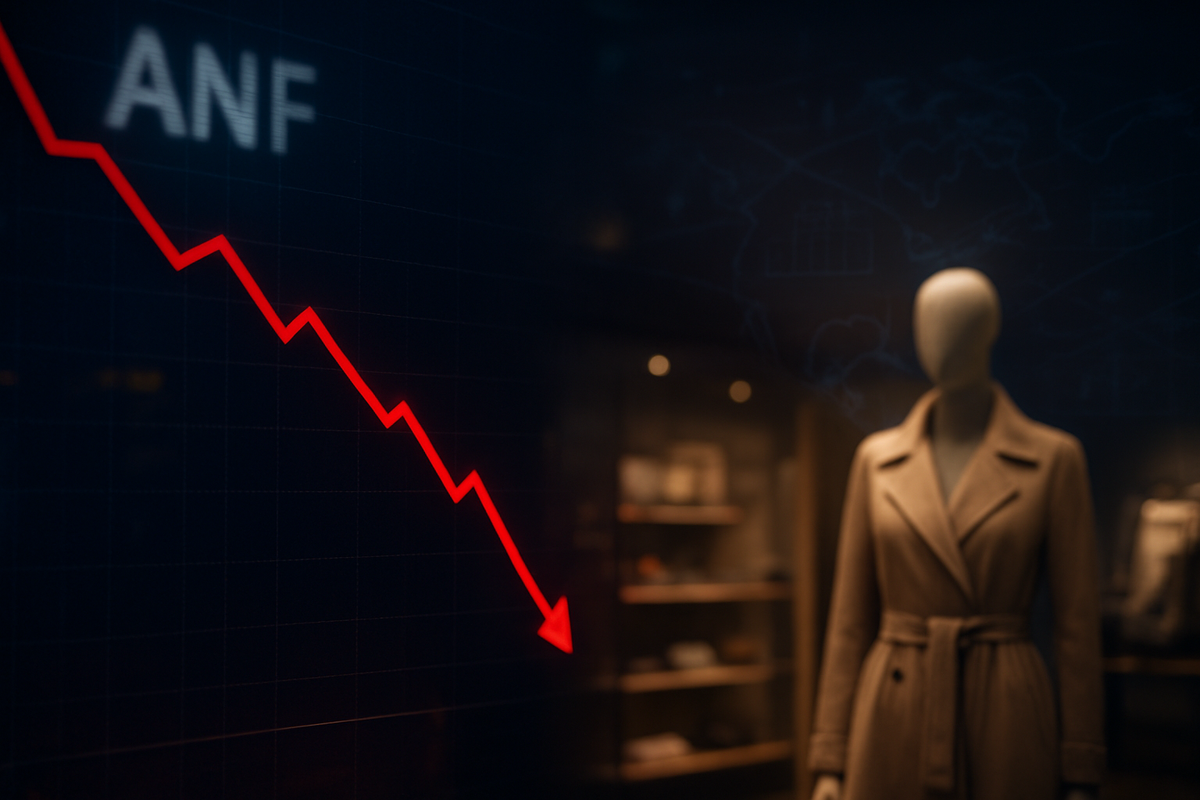
The meteoric rise of Abercrombie & Fitch Co. (NYSE: ANF) hit a significant roadblock on Monday, January 12, 2026, as shares plummeted nearly 18% in early trading. The sharp sell-off followed a revised financial outlook that, while still projecting growth, fell short of the high expectations set by Wall Street. The decline represents a stark reversal for a company that had been a standout performer in the retail sector throughout 2024 and 2025, signaling a potential cooling period for the specialty apparel industry as a whole.
The market’s reaction highlights a growing anxiety among investors regarding the sustainability of consumer spending in the face of rising costs. Despite reporting record sales through the recent holiday season, Abercrombie’s management warned of narrowing margins and significant headwinds from newly implemented trade policies. This "sell-on-the-news" event suggests that the era of forgiving valuations for retail growth stories may be coming to an end, as the focus shifts from top-line revenue to the grueling realities of bottom-line durability.
A "Disappointing" Record: The Numbers Behind the Slide
The catalyst for the plunge was a guidance update issued early Monday morning. Abercrombie & Fitch Co. narrowed its fourth-quarter net sales growth forecast to 5%, trailing the Wall Street consensus of 5.8%. More concerning to analysts was the revision of the full-year growth outlook, which was adjusted to "at least 6%," a step down from the previous range of 6% to 7%. The stock, which had reached a 52-week high of approximately $148, tumbled to $104.39 as investors recalibrated their models for a slower 2026.
Beyond sales growth, the company’s profitability metrics came under intense scrutiny. Management narrowed its operating margin forecast to 13%, the lower end of its previous 13% to 13.5% range. This compression is largely attributed to a massive $90 million in anticipated tariff-related expenses, which the company estimates will impact sales by roughly 170 basis points. Furthermore, a surprise increase in capital expenditure—now forecasted at $245 million compared to the previous $225 million—raised questions about cash flow management during a period of decelerating demand.
The timeline leading to this correction was one of extreme optimism followed by a harsh reality check. Abercrombie had successfully executed a multi-year brand turnaround, moving away from its controversial past to become a leader in the "quiet luxury" and "millennial-chic" segments. However, the January 12 update revealed that even the most successful brand strategies are not immune to macroeconomic shifts. The disclosure of tariff pressures acted as a "canary in the coal mine" for the broader apparel sector, which has heavily relied on global supply chains that are now becoming more expensive to navigate.
Industry Ripple Effects: Winners and Losers in the Retail Rout
The shockwaves from Abercrombie’s update were felt across the specialty retail landscape. American Eagle Outfitters, Inc. (NYSE: AEO) saw its stock drop 10% despite raising its own operating income guidance. The culprit was a similar disclosure of $50 million in tariff-related pressures, proving that the cost of doing business is rising universally for mall-based retailers. Urban Outfitters, Inc. (NASDAQ: URBN) also fell 7%, as investors looked past record holiday sales to worry about margin compression in its Nuuly subscription segment.
While specialty apparel took a hit, the "winners" in this environment appear to be large-scale value retailers and high-end niche players. Walmart Inc. (NYSE: WMT) has remained relatively resilient, as its massive scale allows it to absorb supply chain shocks better than specialty boutiques. Similarly, Lululemon Athletica Inc. (NASDAQ: LULU) continues to maintain a premium valuation due to its high-income customer base, which is less sensitive to the "spending hangover" affecting middle-market brands. The Gap, Inc. (NYSE: GPS) also fared slightly better than its peers, dropping only 4%, though it continues to struggle with its Athleta brand, which saw an 11% decline in late 2025.
The disparity in performance underscores a "K-shaped" reality for the retail sector. Companies that cater to the ultra-wealthy or provide essential value are maintaining their footing, while "aspirational" brands like Abercrombie and American Eagle—which rely on discretionary spending from middle-income households—are being squeezed. For these specialty retailers, the loss of pricing power in an inflationary environment is becoming a primary concern for shareholders.
The Broader Context: Tariffs, Inflation, and the "Cyber Week Slump"
Abercrombie’s disappointing outlook fits into a broader narrative of economic recalibration in 2026. The retail industry is currently grappling with what analysts call a "spending hangover." While nominal holiday sales in 2025 reached record levels, much of that growth was driven by inflation rather than unit volume. Real personal consumption expenditure is projected to slow to 1.5% in 2026, a significant drop from the 2.5% to 3% growth seen in previous years.
A critical factor in this slowdown is the "Cyber Week Slump." Many consumers, anticipating price hikes due to 2026 tariff schedules, "front-loaded" their purchases in late 2025. This has left retailers with a vacuum of demand in the first quarter of the new year. Furthermore, persistent inflation—hovering near 3%—has forced a shift in consumer behavior. Shoppers are becoming increasingly "frugal" and "value-conscious," trading down to private labels and avoiding full-price apparel purchases unless absolutely necessary.
Historically, retail corrections of this magnitude have often preceded broader shifts in trade policy or consumer sentiment. The 2026 tariff environment draws comparisons to the trade tensions of 2018-2019, but with the added complication of higher baseline inflation and a softening labor market. Retailers are now forced to find internal efficiencies, often through AI-driven supply chain management, to offset the rising costs of goods sold that they can no longer pass on to a weary public.
The Road Ahead: Strategic Pivots and Market Challenges
Looking forward, Abercrombie & Fitch and its peers face a period of intense strategic adaptation. In the short term, the focus will likely shift toward aggressive inventory management to avoid the margin-killing markdowns that plagued the industry in previous cycles. Investors will be watching closely to see if ANF can utilize its increased capital expenditure to improve its digital infrastructure and logistics, potentially mitigating some of the $90 million in tariff costs through better efficiency.
In the long term, the company may need to reconsider its sourcing strategies. The heavy reliance on regions affected by new tariffs is a vulnerability that cannot be ignored. A pivot toward "near-shoring" or diversifying manufacturing to regions with more favorable trade terms could be necessary, though such transitions are both costly and time-consuming. Additionally, as consumer demand for "quiet luxury" potentially wanes, Abercrombie will need to innovate its product lines to maintain its relevance without relying solely on the momentum of its recent turnaround.
Market opportunities may still emerge for those who can navigate the volatility. If Abercrombie can prove that its 13% operating margin is a floor rather than a ceiling, value-seeking investors might see the current dip as an entry point. However, the immediate path is fraught with challenges, including a labor market where unemployment is nearing a four-year high, further dampening the outlook for discretionary apparel spending.
Final Assessment: A Reality Check for the Retail Sector
The 18% plunge in Abercrombie & Fitch shares is more than just a bad day for one company; it is a signal that the post-pandemic retail boom has officially entered a more sober phase. The key takeaway for investors is that top-line growth is no longer sufficient to sustain high valuations if margins are being eroded by external costs like tariffs and inflation. The "retail darling" status that ANF enjoyed for the past two years has been replaced by a "show-me" story where management must prove it can protect profitability in a hostile macro environment.
Moving forward, the market will likely reward retailers that demonstrate operational excellence and have the balance sheet strength to weather a period of slower growth. Investors should keep a close eye on upcoming earnings reports from other apparel giants to see if the tariff-related warnings become a universal theme. For now, the sentiment remains cautious, with the focus firmly on how these companies will navigate a year defined by recalibration rather than expansion.
This content is intended for informational purposes only and is not financial advice.