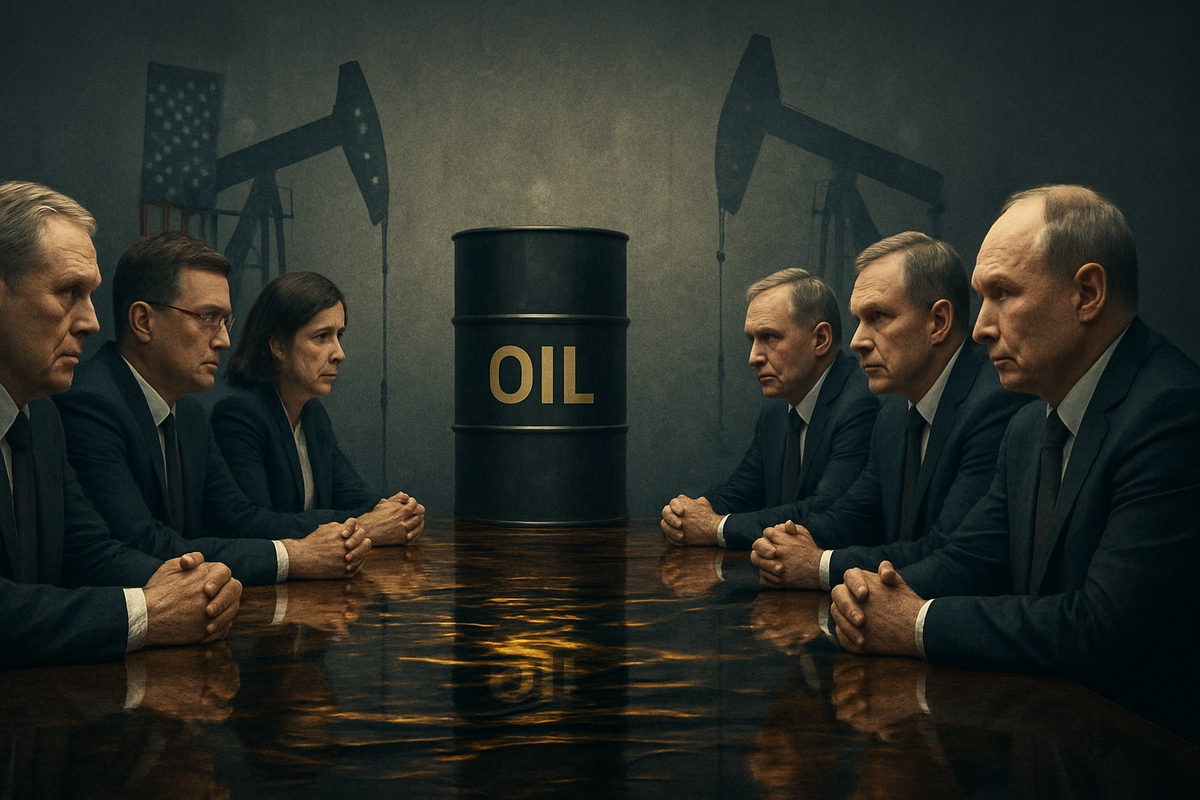
Crude oil prices saw an upward swing on Wednesday, December 3, 2025, as high-stakes talks in Moscow between U.S. envoys and Russian President Vladimir Putin concluded without a breakthrough on a peace deal for Ukraine. Despite a five-hour meeting described as "very useful" by the Kremlin, no compromise was reached on critical territorial issues, leading markets to interpret the impasse as a continuation of geopolitical instability and a sustained risk premium on oil. Brent crude futures for February settlement rose to approximately $63.35 per barrel, while U.S. West Texas Intermediate (WTI) crude for January delivery also gained, reaching around $59.59 per barrel.
The immediate impact on prices stems from the dashed hopes of a swift resolution to the conflict, which would potentially lead to the lifting of sanctions on Russian oil and an increase in global supply. Analysts from Goldman Sachs noted that oil markets are not currently pricing in a high probability of a near-term peace agreement or the removal of these sanctions. Further exacerbating supply concerns were ongoing Ukrainian attacks on Russian energy infrastructure, including vessels and refineries, prompting threats of retaliation from Moscow against countries supporting Ukraine. These supply-side anxieties, coupled with renewed U.S. rhetoric against Venezuela, outweighed reports of rising U.S. crude and gasoline inventories, which typically signal an oversupplied market.
Stalled Diplomacy and Heightened Geopolitical Stakes
The December 3, 2025, U.S.-Russia talks in Moscow concluded without a breakthrough on a potential peace deal for Ukraine, underscoring the deep divisions that continue to fuel geopolitical tensions and, by extension, influence global energy markets. The lack of a decisive resolution ensures that the prospect of easing sanctions on Russian oil remains distant, thus maintaining a significant risk premium on crude prices.
The core of the recent diplomatic push involved a five-hour meeting on December 2, 2025, between Russian President Vladimir Putin and a U.S. delegation led by Special Envoy Steve Witkoff, accompanied by President Donald Trump's son-in-law, Jared Kushner. Russian presidential aide Yuri Ushakov confirmed that despite the extensive discussions, no "compromise option" or concrete deal was reached regarding a peace settlement for Ukraine. While Ushakov characterized the meeting as "very useful, constructive, and highly substantive," he conceded that a final peace agreement remains elusive, with key territorial issues proving insurmountable. The U.S. delegation reportedly presented four documents outlining Washington's peace plan, which are believed to address territory, economic reintegration, and security guarantees. Both sides mutually agreed to keep the specifics of the negotiations out of the public domain.
Leading up to these talks, President Putin had attended an investment forum where he issued veiled threats towards European powers, accusing them of obstructing U.S. attempts to end the war by proposing terms he deemed "completely unacceptable" to Moscow. Putin reiterated his long-standing position that any ceasefire would necessitate Ukraine's withdrawal from unoccupied territories, a condition Kyiv has consistently labeled a "nonstarter." This latest round of negotiations is part of a broader diplomatic timeline initiated by President Donald Trump's campaign promise to end the war, following a surprise phone call with President Putin in February 2025, and a series of high-level meetings involving U.S. and Russian envoys throughout the year, including a Trump-Putin summit in Anchorage, Alaska, in August.
Initial market reactions on December 3, 2025, indicated that the failure to reach a peace settlement meant that the prospect of easing sanctions on Russian oil was not imminent. Beyond the immediate price movements—Brent crude futures rising 1.3% to $63.23 a barrel and U.S. West Texas Intermediate (WTI) climbing 1.5% to $59.49 a barrel—analysts from Goldman Sachs reiterated that both physical and forward oil markets were not pricing in a significant probability of a near-term peace agreement or the removal of sanctions. This reinforces the notion that a geopolitical risk premium continues to buoy oil prices, counteracting concerns about a global supply surplus. Despite this, a significant build in U.S. crude and fuel inventories, as reported by the American Petroleum Institute (API), somewhat capped price gains, signaling an underlying oversupplied market.
Corporate Fortunes: Winners and Losers in a Volatile Market
The ongoing geopolitical tensions stemming from the U.S.-Russia talks and the resulting fluctuations in crude oil prices are creating a challenging yet opportunistic environment for public companies across the energy sector. While stalled peace talks prevent the easing of sanctions on Russian oil, thereby restricting supply and adding a risk premium to prices, concerns about a global crude surplus and weakening demand introduce a layer of complexity. Ukrainian attacks on Russian energy infrastructure further contribute to market jitters, creating a mixed bag of fortunes.
Companies poised to benefit are predominantly those in the upstream (exploration and production - E&P) sector and integrated oil companies with significant upstream operations. Higher crude oil prices directly boost the revenue and profit margins of companies focused on extracting oil. Geopolitical tensions that disrupt supply or add a risk premium can keep prices elevated, further benefiting these producers. Examples include ConocoPhillips (NYSE: COP), Occidental Petroleum (NYSE: OXY), Pioneer Natural Resources (NYSE: PXD), and EOG Resources (NYSE: EOG), all of whom are well-positioned to capitalize on a high-price environment. Integrated giants like ExxonMobil (NYSE: XOM) and Chevron (NYSE: CVX) also stand to gain significantly from their extensive exploration and production activities, which often offset the higher input costs for their refining segments. Energy services companies, which provide equipment and services to these producers, also see increased demand and activity when drilling and production rise due to higher prices.
Conversely, companies primarily operating in the downstream (refining and marketing) sector may face challenges. Persistently high crude oil prices represent a higher input cost for refiners. If refiners cannot fully pass these increased costs onto consumers due to market competition or policy constraints, their profit margins can be squeezed. Major independent refiners like Phillips 66 (NYSE: PSX) and Valero Energy (NYSE: VLO) are highly dependent on refining margins, which can be pressured by rapidly rising crude prices. While midstream companies (pipelines, storage) are generally less sensitive to direct price swings due to volume-based contracts, prolonged periods of high prices that curb overall demand could indirectly affect throughput volumes. More broadly, oil-consuming industries such as airlines, transportation, and petrochemicals will see increased operating costs, potentially compressing profit margins and leading to higher consumer prices.
Interestingly, the alternative energy sector generally benefits from sustained higher crude oil prices. Elevated fossil fuel prices make renewable energy sources more economically attractive and competitive, encouraging increased investment in solar, wind, and other clean technologies. This could create opportunities for companies like Brookfield Renewable (NYSE: BEP) and NextEra Energy (NYSE: NEE), as well as solar and wind manufacturers. While other factors like government policy and technological advancements are crucial, the underlying economic incentive to transition to renewables strengthens when traditional energy costs are high. However, if geopolitical tensions lead to a broader global economic slowdown, it could temper overall investment sentiment, including in alternative energy.
Wider Significance: Reshaping Energy Geopolitics
The sustained higher crude oil prices and geopolitical tensions, exacerbated by the stalled U.S.-Russia talks as of December 3, 2025, are profoundly reshaping the global energy landscape. This event fits into broader industry trends, creates ripple effects on international partnerships, drives regulatory shifts, and echoes historical energy crises.
One of the most significant broader industry trends is the acceleration of the energy transition, albeit with some counter-trends. Sustained high oil prices historically act as a catalyst for investment in renewable energy, as seen in Europe's increased solar and wind deployment post-2021. The drive for energy independence, especially in import-dependent nations, is reinforced, leading to diversified energy portfolios. However, this is not a uniform shift; for oil-producing nations, elevated prices mean increased profits, potentially encouraging them to double down on fossil fuel production. Furthermore, while the U.S. LNG sector is expanding, and overall renewable adoption is growing, it is not yet fully offsetting oil consumption, and some countries might even revert to dirtier energy sources like coal in the short term due to urgent energy requirements.
The geopolitical shocks and elevated oil prices severely test global supply chain resilience. Sanctions against Russian petrochemical products have driven market prices higher and necessitate a reconfiguration of supply chains around alternative production points. Critical transportation chokepoints, such as the Strait of Hormuz, remain highly vulnerable to geopolitical disruptions, amplifying systemic risks across global energy networks. The interconnectedness of supply chain disruptions, energy crises, and oil market volatility underscores the need for proactive and adaptive risk management, including enhanced visibility and diversification, to build anti-fragile supply chains.
The ripple effects on competitors and partners are evident in OPEC+ dynamics. Despite geopolitical risks supporting elevated prices, concerns about an emerging global oversupply and uneven demand trends have led the alliance to pause production increases for the first quarter of 2026. This strategy aims to manage supply proactively and prevent a destructive price war. For the European Union, the ongoing situation reinforces its commitment to diversify away from Russian energy, despite infrastructure limitations and the continued challenge of Russian refined products reaching European markets through third-party intermediaries. Major energy consumers like China and India have navigated sanctions by increasing yuan-denominated energy transactions with Russia, but recent sweeping U.S. and EU sanctions targeting major Russian oil companies like Rosneft and Lukoil have prompted them to scale back imports, complicating their energy sourcing strategies.
From a regulatory and policy perspective, evolving sanctions regimes are a key implication. U.S. sanctions against Russia's oil sector have become increasingly comprehensive, moving from a revenue-mitigation policy to a "hard-blocking prohibition" through the SDN listing of major entities and more than 180 vessels in Russia's "shadow fleet." These measures aim to target major segments of Russian crude production and export. This environment also underscores the urgency of enhanced energy security policies, including strategic stockpile expansions and accelerated diversification efforts in import-dependent nations.
Historically, the current situation draws strong parallels to the 1970s oil shocks and the period following Russia's 2022 invasion of Ukraine. The 1973 oil crisis, triggered by diplomatic tensions, led to significant price hikes, inflation, and a renewed focus on energy saving and security policies, spurring initial investments in renewable energy. The "weaponization" of energy, seen then with OPEC, is mirrored by Russia's actions. The post-2022 Russian invasion similarly led to price surges, inflation, and accelerated European efforts to decouple from Russian energy, laying the groundwork for the current intensified regulatory responses. These historical precedents suggest that such periods of profound instability often lead to long-term shifts in energy policy and market structure.
What Comes Next: Navigating a Precarious Future
The stalled U.S.-Russia talks as of December 3, 2025, cast a complex and volatile outlook over crude oil markets and geopolitical relations. With a lack of a clear path to a peace deal in Ukraine, geopolitical tensions remain a significant driver, interacting with broader supply-demand dynamics and long-term energy transitions.
In the short-term (late 2025 - early 2026), continued volatility and a persistent "geopolitical risk premium" are embedded in oil prices. The failure to reach a compromise keeps sanctions on major Russian oil companies like Rosneft and Lukoil in place, limiting Russian oil supply and providing some price support. Ukrainian drone attacks on Russian energy infrastructure and Russia's threats of countermeasures against vessels aiding Ukraine further heighten supply disruption fears, potentially leading to price spikes. However, rising U.S. crude inventories and concerns about a global crude surplus are limiting significant price gains. OPEC+ has also indicated plans to pause production increases in Q1 2026 due to an emerging global oil surplus, and expectations of slowing global demand growth also contribute to a bearish sentiment.
The long-term outlook (2026 and beyond) for oil prices appears more subdued, with many experts forecasting a decline or subdued prices through 2025-2026. Robust output from both OPEC+ and non-OPEC producers, particularly the U.S. shale industry, is leading to an anticipated global oversupply and inventory accumulation. The energy transition, despite potential slowdowns, is expected to cap future oil demand. While the baseline scenario points to lower prices, sustained geopolitical disruptions, especially in critical chokepoints like the Strait of Hormuz, or a major escalation in the Russia-Ukraine conflict, could still drive prices significantly higher, potentially into the $90-$130 per barrel range.
Strategic pivots and adaptations are required across the board. Energy companies must prioritize cost efficiency, especially North American shale producers, as lower-cost Russian supply could eventually re-enter markets. They must also enhance risk management frameworks to account for persistent geopolitical risk premiums and invest in new technologies and sustainable solutions. Governments, particularly the U.S. administration, continue to prioritize reducing oil prices to manage inflation, intensifying pressure on Russia through sanctions while also exploring potential energy cooperation as an incentive for peace. European governments are accelerating LNG import infrastructure and renewable energy investments, while Asian governments like India and China are navigating the complexities of discounted Russian crude imports amidst threats of U.S. secondary sanctions.
Market opportunities include the continued availability of discounted Russian crude for non-sanctioning nations, accelerated growth in the alternative energy sector, and the emergence of new regional trading hubs. However, significant challenges persist, including geopolitical volatility, the looming oversupply risk, complex sanctions and trade complications, and the potential for renewed inflationary pressures from any sharp oil price spikes. The degradation of Russian energy infrastructure due to years of sanctions also presents a long-term challenge for the global energy system.
Wrap-Up: Navigating a Volatile and Oversupplied Market
The uptick in crude oil prices on December 3, 2025, following the stalled U.S.-Russia talks in Moscow, serves as a stark reminder of the persistent influence of geopolitics on global energy markets. The failure to achieve a breakthrough on a Ukraine peace deal reinforces the expectation that sanctions on Russia's oil sector will remain, thereby sustaining a geopolitical risk premium. However, this immediate price reaction is set against a backdrop of fundamental oversupply concerns and robust production from non-OPEC+ sources, particularly the U.S. shale industry.
Moving forward, the crude oil market is caught in a precarious balance. While geopolitical tensions, including ongoing Ukrainian attacks on Russian energy infrastructure, provide a floor for prices and prevent a sharp decline, the anticipated global supply surplus for 2026 is expected to exert downward pressure. Analysts generally forecast Brent crude to average around $62.23 per barrel and WTI at approximately $59.00 per barrel in 2026, with some projections even seeing WTI dip into the low-to-mid $50s. The OPEC+ alliance's decision to pause production increases for Q1 2026 reflects their efforts to stabilize the market, but further cuts are unlikely unless prices fall significantly.
The lasting impact of this period of geopolitical tension and market volatility is already evident in the fundamental reshaping of global oil trade patterns. Sanctions on Russia have necessitated new supply chains and redirected flows, particularly to Asian markets like India, a transformation expected to have enduring effects. This environment also underscores the accelerated, albeit uneven, global energy transition, as nations prioritize energy security and diversification away from volatile fossil fuel sources.
Investors should closely monitor several key factors in the coming months. Foremost are geopolitical developments, including any escalation or de-escalation of the Russia-Ukraine conflict, further attacks on energy infrastructure or shipping, and shifts in U.S. foreign policy towards other oil-producing regions. U.S. inventory data will be crucial indicators of domestic supply-demand dynamics, while OPEC+ actions and their decisions on output levels will significantly influence global supply. Finally, global demand indicators, especially economic data from major consuming nations like China, will provide insights into the strength of global oil demand, and the continued effectiveness of sanctions on Russian oil and mechanisms for evasion will shape market availability.
This content is intended for informational purposes only and is not financial advice