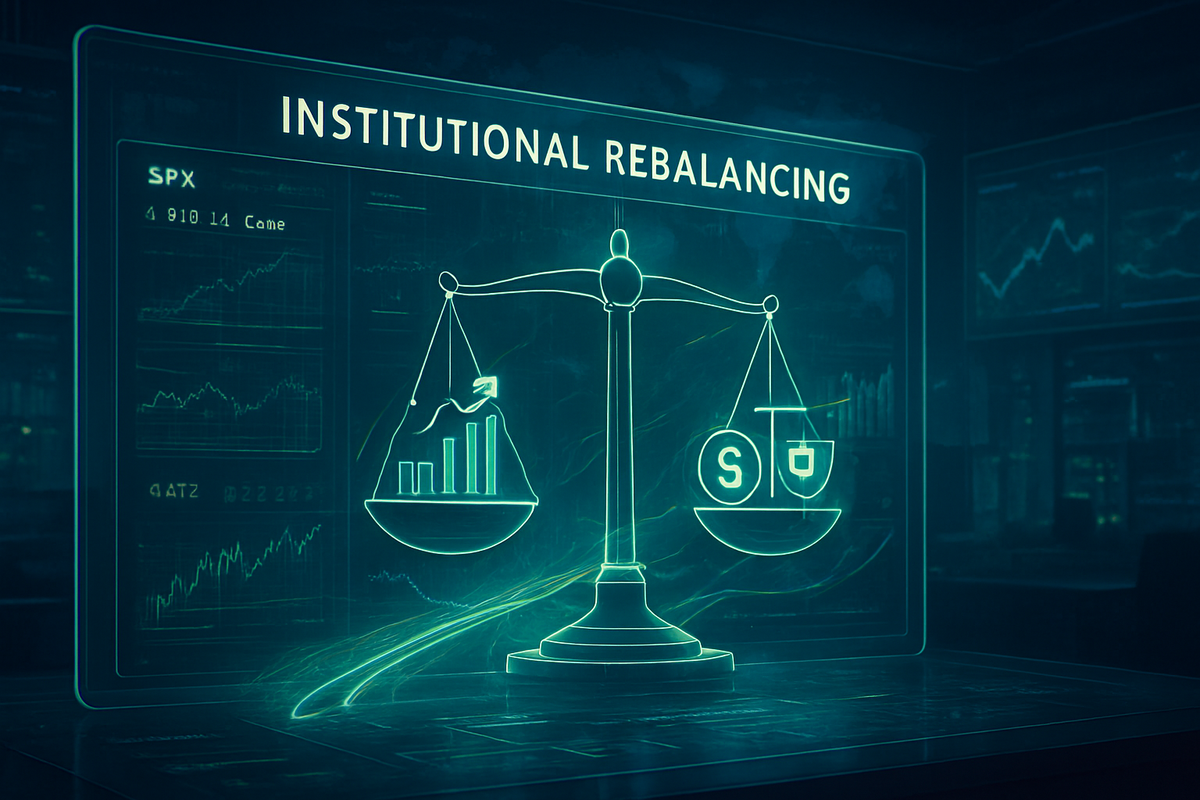
As the calendar turns to the final days of December 2025, a massive, invisible hand is moving the levers of the global financial markets. This week, institutional giants—ranging from sovereign wealth funds to massive pension plans—are engaged in a "mechanical de-risking" cycle estimated to involve over $1 trillion in asset shifts. With the S&P 500 (INDEXSP: .INX) hovering near the 6,950 mark and boasting a year-to-date gain of approximately 17%, the mandate for many fund managers is no longer about chasing growth, but about the disciplined, often ruthless, execution of rebalancing.
The immediate implication of this year-end activity is a notable "cooling" of the 2025 bull market. While individual investors often look for a "Santa Claus rally," institutional players are focused on maintaining strict asset allocation targets. Because equities have significantly outperformed fixed income this year, funds must sell their winning stocks to buy bonds, creating a natural headwind for the indices in the final 72 hours of trading. This rotation is not a reflection of a change in fundamental outlook, but rather a structural requirement that ensures portfolios do not become over-exposed to the volatility of the equity markets heading into 2026.
The Mechanics of the Great Rotation
The year-end rebalancing process is a sophisticated logistical operation that reached its peak intensity following the December 19 quarterly index updates. Leading the charge are passive index giants like BlackRock, Inc. (NYSE: BLK), Vanguard, and State Street Corporation (NYSE: STT). These firms are tasked with aligning their massive exchange-traded funds (ETFs) with updated index compositions. In 2025, this involved the high-profile addition of Apollo Global Management, Inc. (NYSE: APO) and Workday, Inc. (NASDAQ: WDAY) to the S&P 500, forcing billions of dollars in automated buy orders, while removed companies like Qorvo, Inc. (NASDAQ: QRVO) faced significant selling pressure.
Beyond passive indexing, the "60/40" portfolio mandate—a traditional split between 60% stocks and 40% bonds—is driving the bulk of the current volume. With the Nasdaq Composite (INDEXNASDAQ: .IXIC) up over 22% this year, many balanced funds have seen their equity weightings drift as high as 68% or 70%. To return to their mandates, these funds must execute "program trades" to liquidate billions in equities. According to market data, institutional investors have offloaded an estimated $43 billion in technology-heavy positions during the fourth quarter alone to facilitate this shift into high-quality corporate debt and U.S. Treasuries, which are currently offering attractive yields near 4.35%.
Key stakeholders in this process include some of the world's largest pools of capital. Norway’s Government Pension Fund Global, managed by Norges Bank, and Japan’s Government Pension Investment Fund (GPIF) are among the primary "price setters" during this period. These funds operate on a scale where even a 1% shift in allocation can move markets. In the United States, major defined-benefit plans like CalPERS are navigating the "denominator effect," where the massive gains in public equities have made their private equity and real estate holdings appear underweight, necessitating a complex reshuffling of liquid assets to maintain regulatory and internal balance.
Winners, Losers, and the Trimming of the "Magnificent Seven"
The primary "losers" in this year-end rebalancing are, ironically, the year's biggest winners. The "Magnificent Seven" tech giants, led by NVIDIA Corporation (NASDAQ: NVDA), Microsoft Corporation (NASDAQ: MSFT), and Meta Platforms, Inc. (NASDAQ: META), are facing the heaviest selling pressure. This isn't due to a lack of confidence in their AI-driven futures, but because their meteoric rises have created dangerous levels of concentration risk. For a fund manager, seeing a single stock like NVIDIA grow to represent 8% of a total portfolio is a signal to trim, regardless of the company's underlying strength.
Conversely, the "winners" of this rebalancing period are the sectors that were overlooked during the AI-fueled rallies of the spring and summer. Financials and Healthcare have seen a late-year surge as institutions rotate capital into "defensive" and "value" plays. Companies like UnitedHealth Group Incorporated (NYSE: UNH) and JPMorgan Chase & Co. (NYSE: JPM) have become the beneficiaries of this capital flight. Furthermore, the Russell 2000 (INDEXRUSSELL: RUT) has shown surprising resilience in late December, as some managers pivot toward small-cap stocks that offer more attractive valuations compared to the stretched multiples of the tech sector.
The rebalancing has also created a unique opportunity for "AI Adopters"—non-tech companies that are successfully integrating artificial intelligence to improve margins. While the hardware providers are being sold, capital is flowing into industrial and logistics firms that are showing the first real productivity gains from AI implementation. This shift marks a transition from the "speculative" phase of the AI trade to an "execution" phase, where the market rewards companies that can translate technological hype into bottom-line earnings.
Wider Significance and Historical Precedents
This year's rebalancing fits into a broader industry trend of "algorithmic dominance." Unlike the rebalancing periods of a decade ago, which were handled by human traders over several weeks, the 2025 cycle is almost entirely automated. This leads to "flashier" movements in the market—sharp, sudden drops in high-performing stocks followed by immediate stabilization. The move from "AI Innovators" to "AI Adopters" also signals a maturing market. Historically, when a new technology (like the internet in the late 90s or mobile tech in the 2010s) reaches this stage, the market begins to punish companies that cannot prove ROI, a trend we are seeing clearly as 2025 closes.
The regulatory environment is also playing a role. New transparency requirements for large institutional holders have made "window dressing"—the practice of selling losing stocks before year-end to hide them from annual reports—less effective and less common. Instead, the focus has shifted to "tax-loss harvesting," where institutions sell underperforming assets to offset the massive capital gains realized from the tech rally. This has created a "double whammy" for laggards in the Real Estate and Consumer Staples sectors, which have struggled to find footing all year.
Comparisons are being drawn to the year-end of 2021, where a similar post-rally rebalancing preceded a volatile 2022. However, analysts note a key difference: the 2025 market is supported by higher interest rates and a more robust corporate earnings profile. The "mechanical" nature of the current sell-off is viewed by many as a healthy "reset" that clears the way for a more sustainable growth trajectory in the coming year, rather than the bursting of a speculative bubble.
What Comes Next: The 2026 Outlook
As we move into January 2026, the market will likely experience the "January Effect," where the capital harvested during December's rebalancing is redeployed into the market. Short-term, investors should expect continued volatility through the first week of the new year as the final trades of the 2025 cycle settle. The primary strategic pivot for 2026 will be a focus on "quality at a reasonable price" (GARP), as the era of "growth at any cost" appears to have ended with the 2025 rebalance.
The potential for a "soft landing" in the economy remains the base case for most institutions, but the rebalancing into bonds suggests that professional money managers are hedging against any unexpected inflation or geopolitical shocks. Market opportunities are emerging in the "green shoots" of international markets, particularly in emerging Asia, where sovereign wealth funds have been quietly increasing their stakes during this year-end reshuffle.
Potential scenarios for Q1 2026 include a broadening of the market rally. If the capital rotated out of the "Magnificent Seven" finds a permanent home in the other 493 stocks of the S&P 500, we could see a more balanced and less top-heavy market. However, if the selling in tech triggers a wider loss of confidence, the "mechanical" rebalancing of December could turn into a more fundamental retreat in January.
Final Thoughts and Investor Takeaways
The year-end institutional rebalancing of 2025 is a reminder that the stock market is not just a barometer of corporate health, but a complex machine governed by rules and mandates. The current downward pressure on tech leaders and the rotation into defensive assets are not necessarily signs of a looming crash, but the necessary "maintenance" required to keep the global financial system in balance after a year of extraordinary gains.
Investors should watch for the stabilization of the 10-year Treasury yield and the performance of the newly added S&P 500 constituents in early January. These will be the primary indicators of whether the "great rotation" was a temporary year-end phenomenon or a permanent shift in market leadership. Moving forward, the key takeaway is clear: in a market increasingly dominated by passive flows and institutional mandates, understanding the "plumbing" of the market is just as important as understanding the fundamentals of the companies themselves.
As we conclude 2025, the market appears to be in a position of "cautious strength." The excesses of the AI rally have been partially trimmed, portfolios have been de-risked, and the stage is set for a 2026 that will likely prize earnings execution over visionary promises.
This content is intended for informational purposes only and is not financial advice.