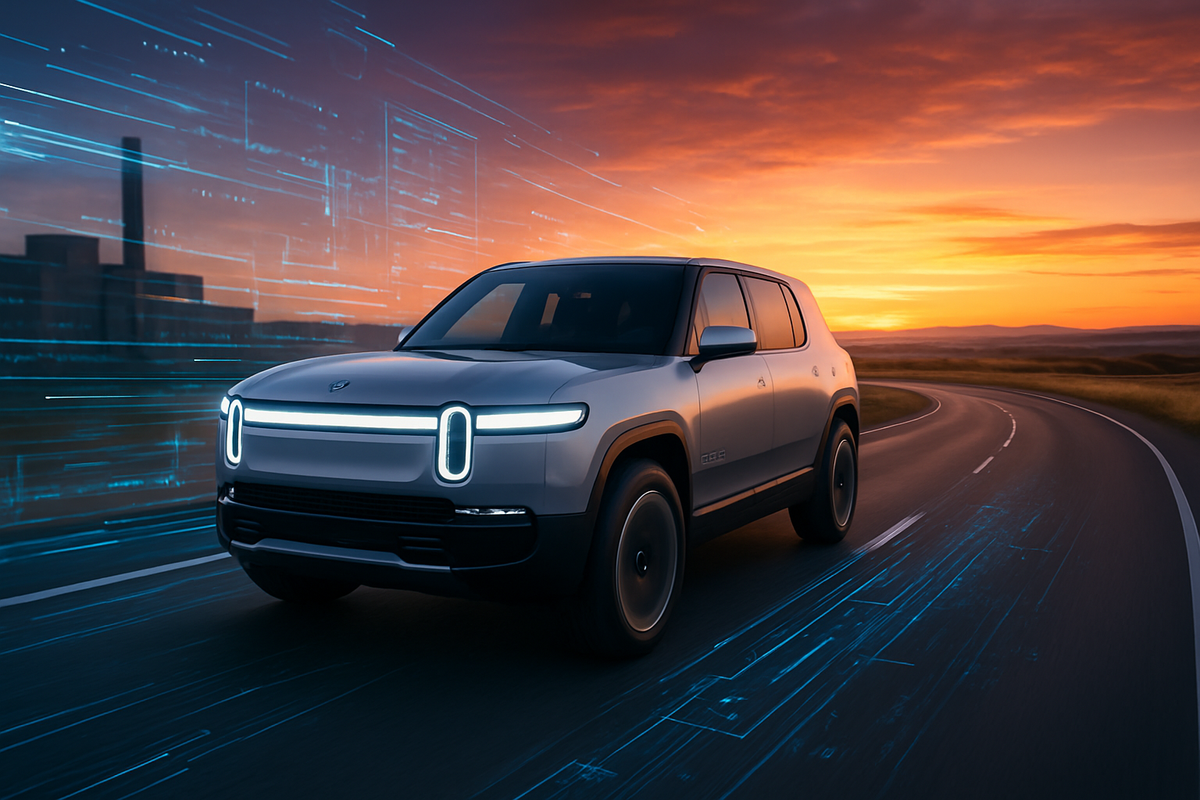
As 2025 draws to a close, the electric vehicle landscape looks fundamentally different than the "EV or bust" era of just two years ago. On this Christmas Eve, investors are unwrapping a surprising gift from Rivian Automotive, Inc. (NASDAQ: RIVN), whose stock has surged approximately 41% year-to-date, trading near a two-year high of $23.00. This late-year rally, fueled by a landmark partnership and a pivot toward software-driven revenue, signals a new chapter for the industry as it prepares for a high-stakes 2026.
The implications of Rivian’s recent performance are clear: the market is no longer rewarding mere production volume. Instead, capital is flowing toward "pure-play" survivors who can demonstrate a path to gross profitability and technological independence. While legacy giants are retreating to the safety of hybrids, Rivian has successfully de-risked its financial future, positioning itself as the primary challenger to the industry’s dominant incumbent.
A Year of Strategic Reinvention and Financial Resilience
The story of Rivian’s 2025 is one of survival turning into strategic dominance. The turning point arrived in the second half of the year, following a successful Q3 earnings report on November 4, 2025. Rivian reported a consolidated gross profit of $24 million—a psychological and financial milestone that proved the company could finally build vehicles for more than it costs to make them. This was supported by a 324% year-over-year surge in software and services revenue, which has become the "secret sauce" for the company’s valuation.
The timeline leading to this moment was punctuated by the finalization of the "RV Tech" joint venture with Volkswagen AG (OTC:VWAGY). By December 2025, Volkswagen completed its massive $5.8 billion investment, providing Rivian with a cash runway that analysts now expect to last into 2028. This partnership has seen 1,500 engineers descend on Palo Alto to integrate Rivian’s zonal architecture and software stack into future Audi and Scout models. Simultaneously, Rivian completed a major retooling of its Normal, Illinois, facility in September, paving the way for the "validation builds" of the highly anticipated R2 SUV.
Initial market reactions were skeptical throughout the summer of 2025 as interest rates remained stubbornly high, but the sentiment shifted during Rivian’s "Autonomy & AI Day" in early December. The unveiling of the RAP1 (Rivian Autonomy Processor 1) chip and the "Autonomy+" subscription service convinced Wall Street that Rivian is less a traditional car company and more a vertically integrated tech platform. This realization triggered a wave of analyst re-ratings, with price targets jumping as the market began to price in high-margin recurring revenue.
Winners and Losers in the Post-Subsidy Era
As we head into 2026, the competitive map has been redrawn. The "winners" are those who have secured their balance sheets and technological moats. Rivian and Tesla, Inc. (NASDAQ: TSLA) stand as the primary beneficiaries of a "flight to quality." Tesla, trading at record highs near $489, has successfully decoupled its valuation from the auto sector, being viewed instead as an AI powerhouse. Rivian is following a similar trajectory, leveraging its VW partnership to fund its expansion without further diluting shareholders.
Conversely, the "losers" of 2025 include the traditional Detroit giants. Ford Motor Company (NYSE: F) and General Motors Company (NYSE: GM) have undergone a "Great Retrenchment." Ford recently took a staggering $19.5 billion restructuring charge, effectively halting its F-150 Lightning program in favor of hybrids and "Extended-Range EVs." GM has similarly walked back its aggressive EV production targets, prioritizing internal combustion profits to appease investors. While this protects their short-term dividends, it leaves a massive opening in the $45,000–$60,000 premium EV segment—the exact territory Rivian’s R2 is designed to occupy.
Lucid Group, Inc. (NASDAQ: LCID) remains in a precarious middle ground. While the successful launch of the Gravity SUV in April 2025 and a $2 billion infusion from Saudi Arabia’s Public Investment Fund have kept the lights on, the company still faces significant cash burn. Lucid is a winner in terms of engineering excellence, but it has yet to prove it can scale to the mass market with the same speed as its rivals in Normal or Austin.
The Wider Significance: Software Over Steel
Rivian’s rally is a microcosm of the "Great Recalibration" hitting the entire automotive industry. The most significant macro event of late 2025 was the expiration of the $7,500 federal tax credit on September 30. This created a "demand cliff" in the fourth quarter, forcing manufacturers to compete on product merit and organic cost structures rather than government incentives. Rivian’s ability to maintain momentum in this "post-subsidy" world suggests that its brand equity and tech stack are strong enough to overcome the loss of federal tailwinds.
This shift mirrors the historical transition of the smartphone industry, where hardware became a commodity and the real value migrated to the operating system. By developing its own silicon and software, Rivian is insulated from the margin-crushing reliance on third-party suppliers that currently plagues legacy OEMs. Furthermore, the loosening of federal tailpipe emissions standards for 2026 has paradoxically helped Rivian; by allowing legacy makers to slow down, it has reduced the "compliance car" noise in the market, allowing true EV leaders to stand out to consumers who actually want an electric experience.
The Road Ahead: 2026 and the R2 Revolution
Looking toward 2026, the primary catalyst for Rivian will be the official launch of the R2 SUV in the first half of the year. With a starting price of $45,000, the R2 is the vehicle that must transition Rivian from a niche luxury brand to a household name. Success will require a flawless production ramp-up in Normal, Illinois, and the successful restart of construction at the $5 billion Georgia plant, which is now slated to begin in early 2026 following a $6.6 billion DOE loan approval.
The short-term challenge will be navigating the "demand cliff" created by the end of federal tax credits. Rivian may need to lean heavily on its new "Autonomy+" subscription revenue to offset potential pressure on vehicle margins. Long-term, the strategic pivot toward "Physical AI" through its Mind Robotics spin-off suggests that Rivian is looking beyond the driveway, aiming to license its factory automation tech to other industries. The 2026 scenario is one of high execution risk but immense potential reward; if the R2 mirrors the success of the Tesla Model 3, Rivian could cement its place as the "Apple of the EV world."
Final Thoughts for the Investor
The key takeaway from the final weeks of 2025 is that the EV industry has matured. The era of "easy money" and blind enthusiasm for any company with a battery is over. Moving forward, the market will be dominated by a small handful of companies that control their own software and silicon. Rivian has proven it belongs in that elite group, backed by the deep pockets of Volkswagen and a product roadmap that finally addresses the mass market.
Investors should watch the R2 delivery numbers and software attachment rates closely in the first two quarters of 2026. While the macro environment remains challenging due to the lack of federal incentives, Rivian’s internal efficiencies and strategic alliances have created a defensive moat that few of its peers can claim. As we enter the new year, the "Great Recalibration" is nearly complete, and Rivian appears ready to lead the charge into a software-defined future.
This content is intended for informational purposes only and is not financial advice.