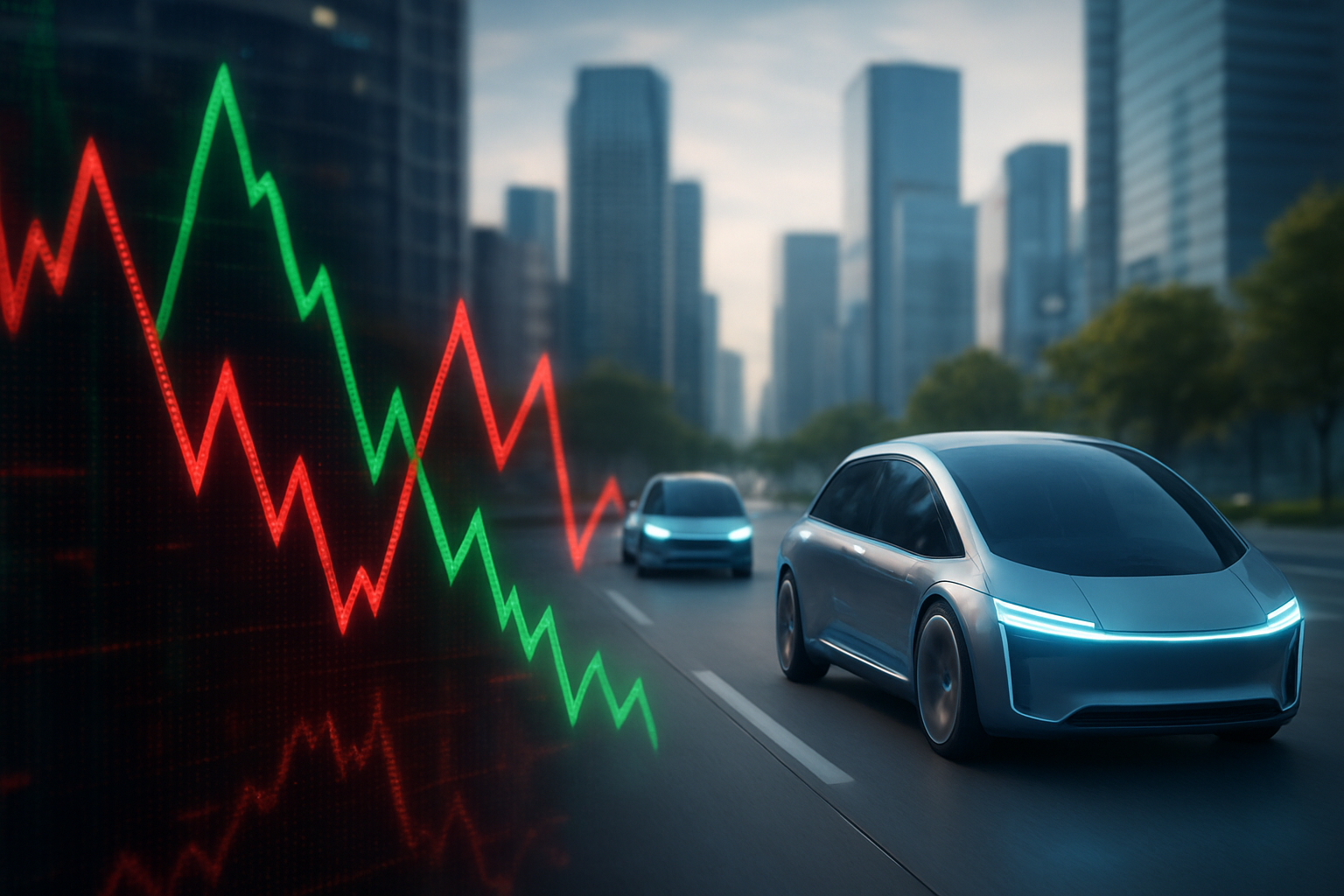
The financial markets are currently gripped by a palpable tension, with the Nasdaq Composite experiencing what analysts describe as a "see-saw" market. This extreme volatility, characterized by unpredictable and rapid swings, reflects a deep apprehension among investors navigating a complex landscape of economic uncertainties, evolving Federal Reserve policies, and geopolitical currents. Amidst this turbulent backdrop, a bold projection from Morgan Stanley (NYSE: MS) regarding Tesla's (NASDAQ: TSLA) ambitious robo-taxi venture has sent ripples across the tech and automotive sectors, spotlighting the high-risk, high-reward nature of disruptive innovation in today's market.
Morgan Stanley's latest analysis, while acknowledging the transformative potential of Tesla's autonomous driving technology, has introduced a note of caution, leading to a downgrade of the electric vehicle giant's stock. This move underscores a growing sentiment that while the future of transportation may indeed be autonomous, the path to realizing those "2030 robotaxi fantasies" is fraught with significant execution risks and demands tangible proof of revenue rather than solely relying on future projections. The interplay between Nasdaq's inherent volatility and the speculative yet potentially revolutionary prospects of Tesla's robo-taxis paints a vivid picture of a market grappling with both immediate economic realities and the distant, yet compelling, allure of technological paradigm shifts.
Unpacking the Market's Tumult and Tesla's Autonomous Vision
The "see-saw" nature of the Nasdaq Composite has been a defining characteristic of late 2025, with major U.S. indices witnessing extreme volatility and pronounced "whipsaw" movements. From mid-November to mid-December 2025, rapid intra-day and day-to-day reversals became common, often driven by a mix of economic data, Federal Reserve commentary, and shifting investor sentiment. For instance, robust opening rallies frequently evaporated following hawkish statements from Fed officials, illustrating the market's hypersensitivity to interest rate outlooks and inflation concerns. The Nasdaq's Average True Range (ATR) hovering around 393.37 signals that sharp upward and downward moves are likely to persist, keeping investors on edge. Furthermore, concerns over the lofty valuations of Artificial Intelligence (AI) related stocks, alongside mounting regulatory scrutiny on data privacy and tech monopolies, have added layers of apprehension, contributing to the erratic market behavior.
Against this backdrop of market turbulence, Morgan Stanley's recent deep dive into Tesla's autonomous future has captured significant attention. The investment bank anticipates a "major robotaxi breakout" in the U.S., projecting that approximately 33 cities could launch commercial autonomous services in 2026. This aggressive timeline envisions a substantial expansion of Tesla's robotaxi fleet, growing from an estimated 50-150 vehicles currently to 1,000 on the road in 2026, with a long-term forecast of one million Tesla robotaxis operating by 2035 across numerous cities. Key catalysts identified for this expansion include the public deployment of robotaxis without safety monitors, continuous improvements in unsupervised safety metrics, and crucially, the commencement of production of the "Cybercab" by April 2026. The Cybercab, described as a purpose-built two-seater vehicle devoid of a steering wheel or pedals, is designed for cost-effective production using Tesla's innovative "unboxed" manufacturing process, promising a service cost as low as $0.40/mile, significantly undercutting the average U.S. driver cost.
However, despite this ambitious outlook, Morgan Stanley recently downgraded Tesla's rating to "Equal-weight" (hold) from "Overweight," setting a price target of $425. This downgrade, occurring as Tesla shares traded around $472.52 in premarket on December 16, 2025, suggests limited immediate upside. The firm cited several reasons: slowing automotive growth, intensifying competition from Chinese EV manufacturers, and significant execution risks inherent in autonomous driving and robotics. Morgan Stanley believes these risks are already priced into Tesla's high valuation, which some characterize as "out of this planet," with a P/E ratio of 316.74. The firm argues that current valuations are based on "2030 robotaxi fantasies" that do not align with current "2025 manufacturing margins" showing strain. Should the robotaxi rollout face delays due to regulatory hurdles, technological challenges, or slower deployment, the current 190x forward earnings multiple would be unsustainable, potentially leading to substantial selling pressure.
Winners and Losers in the Autonomous Race
The race for autonomous vehicles, particularly robo-taxis, is a high-stakes game with clear potential winners and losers. At the forefront, Tesla (NASDAQ: TSLA) stands to gain immensely if its robo-taxi vision materializes as projected. A successful deployment of a large-scale, cost-effective autonomous ride-hailing network could fundamentally transform the company from an automotive manufacturer into a dominant AI and transportation service provider, unlocking a multi-trillion-dollar market opportunity. However, the recent Morgan Stanley downgrade highlights the significant risks; the company's valuation is heavily reliant on the successful execution of this vision, and any setbacks could lead to substantial investor disappointment and a re-rating of the stock. The successful production of the "Cybercab" by April 2026 and subsequent regulatory approvals will be critical milestones.
On the competitive front, other key players are vying for market share. Alphabet's (NASDAQ: GOOGL) Waymo currently holds a significant lead in safety metrics, boasting 360,000 miles per accident compared to Tesla's 50,000 miles per accident (though Tesla's data is improving). Waymo's established operational presence in select cities positions it as a formidable competitor. Ride-hailing giants like Uber (NYSE: UBER) and Lyft (NASDAQ: LYFT), while currently reliant on human drivers, are heavily investing in autonomous technologies and partnerships. If Tesla's robo-taxis gain traction, these companies might face immense pressure to accelerate their own autonomous strategies or risk losing market share to a more cost-effective, driverless alternative. Traditional automakers such as General Motors (NYSE: GM) with its Cruise subsidiary and Ford (NYSE: F) are also pouring resources into autonomous driving, albeit with varying strategies and timelines. These companies, along with emerging EV manufacturers, could face increased competition and pressure on their existing business models if Tesla successfully disrupts the personal ownership and ride-hailing markets simultaneously. The ability to scale production, navigate complex regulatory environments, and ensure robust safety will determine who emerges victorious in this transformative sector.
Broader Implications and Industry Transformation
The potential widespread adoption of Tesla's robo-taxis, or any successful autonomous ride-hailing service, represents a seismic shift with far-reaching implications across numerous industries and societal structures. This event fits squarely into the broader industry trends of artificial intelligence, electrification, and the future of mobility, pushing the boundaries of what is technologically feasible and economically viable. The vision of a million robo-taxis by 2035 suggests a future where personal car ownership, particularly in urban centers, could become economically unfeasible for many, given the projected low cost per mile of autonomous services. This could fundamentally alter urban planning, reduce traffic congestion, and free up vast amounts of urban land currently dedicated to parking.
The ripple effects extend far beyond the automotive sector. The logistics and delivery industries stand to be revolutionized by autonomous fleets, promising greater efficiency and lower operational costs. Companies involved in insurance, vehicle maintenance, and even energy infrastructure will need to adapt to a world dominated by self-driving electric vehicles. Regulatory bodies face immense challenges in establishing comprehensive frameworks for autonomous vehicle operation, addressing critical issues such as safety standards, data privacy, liability in accidents, and the impact on employment for professional drivers. Historically, disruptive technologies like the internet or the personal computer have always faced initial skepticism and regulatory hurdles, but ultimately transformed economies. The transition to autonomous transportation, while offering immense benefits, will undoubtedly present similar growing pains, requiring careful navigation by policymakers and industry leaders alike. The race to achieve true Level 5 autonomy and the subsequent commercialization of robo-taxis will be a defining technological and economic saga of the coming decades.
The Road Ahead: Scenarios and Strategic Pivots
Looking ahead, the trajectory of Nasdaq's "see-saw" markets and Tesla's robo-taxi ambitions will be shaped by a confluence of short-term reactions and long-term strategic developments. In the short term, the Nasdaq is likely to remain volatile, influenced by incoming economic data, Federal Reserve pronouncements, and geopolitical events. Investors will closely scrutinize Tesla's progress on the "Cybercab" production by April 2026 and any updates on regulatory approvals for unsupervised robo-taxi operations in new cities. Any positive news could provide a temporary boost, while delays or safety incidents could exacerbate market apprehension and reinforce Morgan Stanley's cautious stance.
In the long term, the evolution of autonomous driving technology will be paramount. Companies like Tesla, Waymo, and others will need to demonstrate not only technological prowess but also the ability to scale operations efficiently and safely across diverse environments. This will necessitate strategic pivots, potentially involving partnerships with urban planners, infrastructure developers, and even other automotive companies to accelerate deployment and overcome regulatory hurdles. Market opportunities will emerge in areas like charging infrastructure, software platforms for fleet management, and specialized maintenance services for autonomous vehicles. Conversely, challenges will include managing public perception regarding safety, addressing ethical dilemmas inherent in AI decision-making, and navigating the complex legal landscape of autonomous liability. Potential scenarios range from a rapid, widespread adoption of robo-taxis transforming urban mobility, to a more gradual rollout hampered by regulatory resistance and technological limitations, or even a scenario where the technology proves too complex or costly for mass deployment, leaving current valuations in question.
A High-Tech Balancing Act: Navigating Innovation and Reality
The current financial landscape, characterized by Nasdaq's persistent "see-saw" movements, serves as a stark reminder of the market's delicate balance between innovation and economic reality. The enthusiasm surrounding high-tech sectors, particularly AI and autonomous driving, continues to fuel significant investment, yet it is consistently tempered by macroeconomic pressures, regulatory uncertainties, and the inherent execution risks associated with groundbreaking technologies. Tesla's ambitious robo-taxi vision, while undeniably transformative, embodies this high-stakes balancing act. The Morgan Stanley downgrade, even with its long-term optimism, underscores a critical shift in investor sentiment: the market is increasingly demanding tangible proof of progress and sustainable revenue streams, rather than solely relying on future projections and speculative growth.
Moving forward, the significance of this period lies in its potential to fundamentally reshape the transportation industry and redefine urban living. The lasting impact will hinge on whether companies like Tesla can successfully transition their "robotaxi fantasies" into a profitable, scalable, and safe reality. Investors in the coming months should closely monitor several key indicators: Tesla's progress in Cybercab production and its ability to secure regulatory approvals for unsupervised operations in new cities, the safety metrics of autonomous fleets across all players, and the competitive responses from other tech giants and traditional automakers. The market will also be watching for broader economic trends and Federal Reserve policy shifts, which will continue to influence the overall appetite for risk in high-growth, high-valuation sectors. Ultimately, the next few years will be crucial in determining whether the autonomous revolution lives up to its immense promise or if its path is fraught with more bumps and delays than currently anticipated.
This content is intended for informational purposes only and is not financial advice