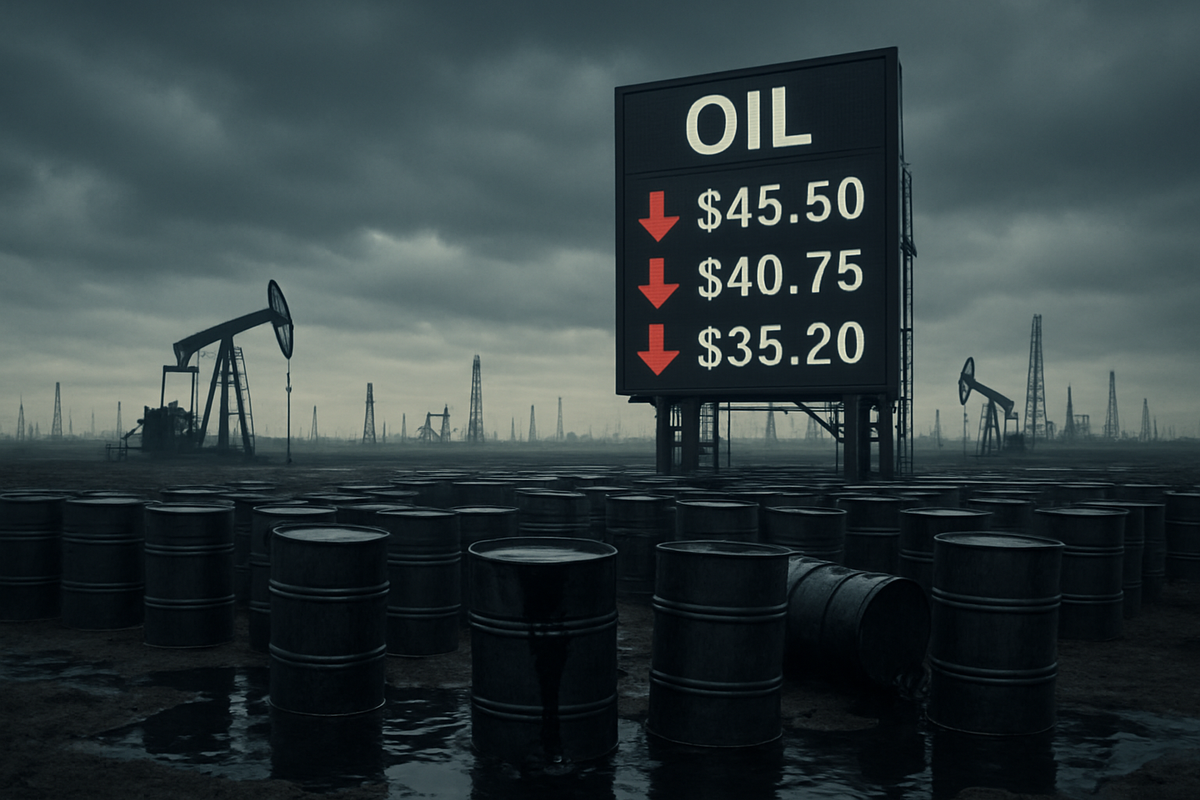
Global oil prices have taken a dramatic tumble as of December 16, 2025, driven by an overwhelming combination of a substantial supply glut and persistently weakening global demand. Both benchmark crude contracts, Brent and West Texas Intermediate (WTI), have plunged to levels not seen in years, signaling a challenging period ahead for the energy sector and potentially offering a mixed bag of fortunes for consumers and various industries worldwide. The immediate implications point to a sustained period of lower energy costs, but also significant headwinds for oil producers, particularly those in the United States, who have been instrumental in the recent surge in global supply.
This precipitous decline is largely attributed to record-breaking crude oil production, particularly from non-OPEC+ nations, which is now significantly outpacing a subdued global consumption rate. The market is grappling with a bearish sentiment, reinforced by analytical forecasts predicting an even larger surplus in the coming years. This "super glut" scenario is reshaping investment strategies, governmental energy policies, and the economic outlook for oil-dependent regions, creating a complex and uncertain landscape for the global financial markets.
The Deluge: Unpacking the Oil Market's Dramatic Downturn
The current downturn in global oil prices is a multifaceted event, rooted in an imbalance between robust supply and lackluster demand. As of December 16, 2025, West Texas Intermediate (WTI) crude futures have plummeted to approximately $56.82 per barrel, marking its lowest point since February 2021. Similarly, Brent crude futures have settled around $60.56 per barrel, a level not seen since May of the same year, with February futures dropping further to $59.92 a barrel. This sharp decline underscores a significant shift in market dynamics from earlier in the year.
The timeline leading to this moment has been characterized by a steady increase in global oil production, particularly from the United States, which is projected to have reached an unprecedented 13.6 million barrels per day (bpd) in 2025. This surge, coupled with increased output from nations like Brazil, Canada, and Guyana, has created a formidable supply wave. Simultaneously, global demand growth has decelerated significantly, estimated to have increased by only 0.8 million bpd (0.7% year-on-year) in Q3 2025. Key players like the International Energy Agency (IEA) have been vocal, forecasting a global oil surplus of 2.3 million bpd in 2025, which is expected to swell to an alarming 4.0 million bpd in 2026 – a surplus even larger than that witnessed during the 2020 pandemic. The IEA's projections for global output rising by 2.4 million bpd in 2026 against muted demand growth paint a stark picture of an implied surplus approaching 3.7 million bpd, or nearly 4% of global consumption.
Adding to the bearish sentiment are concerns over slowing factory output and retail sales in China, the world's largest oil importer, along with the accelerating adoption of electric and hybrid vehicles in the nation, which is further moderating oil consumption growth. Furthermore, speculative optimism surrounding a potential peace deal between Russia and Ukraine could lead to the easing or lifting of US sanctions on Russian oil, potentially unleashing additional barrels onto an already saturated market. Initial market reactions have been decidedly negative, with Commodity Trading Advisors (CTAs) reportedly taking a 100% short position in both Brent and WTI, reflecting a maximum bearish outlook among algorithmic trading systems and professional traders anticipating continued price weakness.
Corporate Crossroads: Winners and Losers in a Low-Price Environment
The dramatic descent of global oil prices creates a stark dichotomy in the corporate landscape, delineating clear winners and losers across various sectors, particularly within the United States. For companies whose operational costs are heavily tied to energy prices, this environment presents either a significant boon or a substantial challenge.
Airlines stand out as primary beneficiaries. With jet fuel representing a major expenditure, reduced crude prices directly translate into lower operating costs and, consequently, improved profit margins. This allows carriers to potentially invest in fleet modernization, return capital to shareholders, or engage in more aggressive pricing strategies, benefiting consumers. Major players like United Airlines Holdings Inc. (NASDAQ: UAL), American Airlines Group Inc. (NASDAQ: AAL), and Delta Air Lines, Inc. (NYSE: DAL) are projected to see substantial reductions in their annual fuel bills, freeing up considerable capital. Low-cost carriers such as Southwest Airlines Co. (NYSE: LUV) and JetBlue Airways Corp. (NASDAQ: JBLU) are particularly well-positioned to leverage lower fuel costs to expand routes and offer competitive fares, potentially gaining market share. Beyond airlines, consumers themselves are winners, as lower gasoline prices boost discretionary spending, benefiting a broad array of consumer-facing businesses from Netflix Inc. (NASDAQ: NFLX) to Costco Wholesale Corp. (NASDAQ: COST). Transportation and logistics companies like FedEx Corp (NYSE: FDX) also see significant reductions in their fuel expenses, leading to improved profit margins and potentially mitigating inflationary pressures on goods.
Conversely, the upstream oil and gas sector faces immense pressure. Exploration and Production (E&P) companies, especially U.S. shale producers, often find drilling unprofitable when WTI crude falls below $60-65 per barrel. This leads to reduced cash flow, deferred investment decisions, and significant cuts in drilling activity. Companies such as Diamondback Energy (NASDAQ: FANG) have already trimmed capital budgets, and others like Coterra Energy (NYSE: CTRA) have announced plans to reduce rig counts. While integrated oil majors like ExxonMobil (NYSE: XOM) and Chevron (NYSE: CVX) are more resilient due to their diversified portfolios, they are not immune, with their breakeven points for covering dividends and buybacks often well above current price levels. Chevron, for instance, has reportedly reduced buybacks and initiated layoffs in response to market conditions.
The repercussions extend severely to oilfield services (OFS) companies, which provide essential support like drilling, fracking, and equipment. A decline in E&P activity directly impacts their revenue and profitability, leading to intense pricing competition. Industry giants like SLB (NYSE: SLB) (formerly Schlumberger), Halliburton (NYSE: HAL), and Baker Hughes (NASDAQ: BKR) have already flagged slow starts in key regions and anticipate declines in global upstream investment and North American spending. Drilling contractors such as Helmerich & Payne Inc. (NYSE: HP) are observing a reduction in active rig counts. Furthermore, the U.S. refining sector presents a mixed picture; while lower crude input costs can theoretically boost margins, weakening demand for transportation fuels and intense competition from international refiners have led to deteriorating margins for some, with companies like Valero Energy Corporation (NYSE: VLO), Phillips 66 (NYSE: PSX), and Marathon Petroleum Corporation (NYSE: MPC) seeing lowered earnings expectations.
Broader Currents: The Wider Significance of the Oil Price Plunge
The sustained plunge in global oil prices to multi-year lows is more than a fleeting market correction; it signals a profound shift within the broader energy landscape, with far-reaching implications for international relations, economic policies, and the accelerating energy transition. Trading around $50-60 per barrel, West Texas Intermediate (WTI) crude on December 16, 2025, reflects a "super glut" scenario, indicating that global production capacity is now structurally exceeding consumption requirements, rather than just a temporary imbalance.
This phenomenon is deeply embedded within several critical industry trends. Firstly, the post-COVID rebound in oil demand has largely concluded, with many analysts now predicting that global petroleum demand could peak within the next decade. This is primarily driven by the rapid acceleration of electric vehicle (EV) adoption worldwide and significant improvements in transportation efficiency. Forecasts from various agencies consistently indicate that global oil supply will continue to outpace demand in 2025 and beyond. Secondly, technological advancements, particularly in U.S. shale production, have drastically reduced extraction costs and increased recovery rates. This allows producers to maintain output even at lower price points that would have historically triggered significant production cuts, contributing to the persistent oversupply. Thirdly, and somewhat paradoxically, sustained low oil prices are acting as a catalyst for the energy transition. Cheaper fossil fuels can ironically enhance the cost-competitiveness of renewable energy by diminishing political resistance to carbon pricing and making green projects more economically attractive relative to traditional alternatives. This is leading to a significant shift in investment landscapes, with OPEC expecting reduced capital spending for exploration and production outside of the OPEC+ group in 2025.
The ripple effects extend across competitors and partners globally. Oil-exporting nations, particularly those heavily reliant on petroleum revenues like Saudi Arabia and Russia, face significant fiscal challenges, potentially leading to increased government deficits and cuts in public spending. While some possess substantial sovereign wealth funds to buffer the immediate impact, long-term fiscal stability necessitates higher oil prices. The effectiveness of OPEC+ production cuts has been limited, and continued low prices could strain internal cohesion within the alliance. Conversely, oil-importing countries generally benefit from reduced inflation, improved fiscal balances, and lower import costs, which can stimulate consumer spending and broader economic growth. Sectors such as aviation, chemicals, and manufacturing typically enjoy reduced input costs. For U.S. shale producers, while efficiencies have improved, many still require prices above $60 per barrel to ensure profitability, meaning the current range will likely continue to curb investment, despite some producers managing to sustain output.
From a regulatory and policy perspective, the low-price environment offers central banks greater flexibility in monetary policy due to reduced inflationary pressures from energy costs. OPEC+ continues its efforts to stabilize markets through production policies, though their impact is increasingly challenged by the sheer volume of non-OPEC+ supply. Geopolitical factors, such as U.S. tariffs and sanctions on countries like Venezuela and Iran, continue to segment the market, creating discounts for sanctioned crude and premiums for alternative supplies due to security concerns. Historically, the current "super glut" draws parallels to the 1980s and 2010s oil gluts, both characterized by overproduction, market share battles, and reduced demand. However, the present situation is distinguished by the more permanent nature of demand destruction, driven by electrification and energy efficiency, suggesting that the long-term implications may be more profound, pushing the industry towards a fundamental energy transition rather than merely a cyclical adjustment.
The Road Ahead: Navigating an Era of Abundant Oil
The global oil market, currently grappling with sustained low prices and a "super glut" as of December 16, 2025, is entering a period of significant short-term pressures and long-term transformative possibilities. With Brent crude hovering around $60-$61 per barrel and WTI at $56-$57 per barrel, the market is bracing for continued inventory builds and a challenging outlook, prompting critical strategic pivots from key players.
In the short term (2026-2028), forecasts from the U.S. Energy Information Administration (EIA) and other financial institutions largely predict a continuation of low prices, with Brent crude potentially averaging $55 per barrel in Q1 2026 and WTI around $52. This is underpinned by the International Energy Agency's (IEA) projection of a substantial global supply surplus for 2026, estimated at around 3.84 million bpd. U.S. shale oil production, while still robust, is expected to see slowing growth or plateauing, with producers increasingly focusing on enhancing oil recovery (EOR) rates to sustain output at lower costs, rather than aggressive new drilling. This shift is critical as the breakeven price for new shale wells is rising due to the depletion of easily accessible inventory. OPEC+ has also strategically shifted from strict price stabilization to prioritizing market share, aggressively unwinding voluntary cuts and accelerating production, which, while contributing to the glut, creates internal tensions within the alliance. Demand growth, though still positive, is largely driven by non-OECD countries, primarily in Asia, but the overall pace is decelerating due to the accelerating energy transition and economic uncertainties.
Looking further ahead (beyond 2028), the long-term outlook is heavily influenced by the accelerating energy transition. Oil use for transport is anticipated to decline after 2026 due to the expansion of electric vehicles (EVs), growth in biofuels, and improved fuel economy. The IEA forecasts that global oil demand growth will significantly slow, potentially plateauing by the end of the decade. This sustained period of low prices will likely lead to underinvestment in new upstream oil projects, which, paradoxically, could cause supply constraints and price volatility in the more distant future, with some analysts predicting a rebound to $75-$80 per barrel by late 2028 as supply eventually tightens. Geopolitical tensions, though currently overshadowed by the glut, will remain a factor, with potential ceasefires or conflicts capable of disrupting supply chains and influencing prices.
Strategic adaptations are imperative for all stakeholders. International Oil Companies (IOCs) like ExxonMobil (NYSE: XOM) and Chevron (NYSE: CVX) are prioritizing decarbonization through operational emission reductions and diversifying into renewable energy sources such as wind, solar, and hydrogen to mitigate risk and align with global climate goals. National Oil Companies (NOCs) and oil-dependent economies face severe fiscal challenges, necessitating austerity measures or increased borrowing, while balancing revenue needs with market share preservation. U.S. shale producers must focus on capital discipline, strategic acquisitions, and technological innovation to improve efficiency and enhance recovery rates in a higher-cost, lower-price environment. Consuming nations, benefiting from cheaper crude, are expected to accelerate investments in their "green economies."
The market presents both significant challenges and emerging opportunities. Financial strain is expected to drive further consolidation within the energy sector and a reduction in new exploration spending. U.S. refiners may continue to rationalize capacity, with some converting to renewable fuel production. However, opportunities abound in mergers and acquisitions, technological innovation (AI, machine learning for efficiency), and, ironically, in renewable energy investment, which becomes more competitive. The downstream sector (refining, petrochemicals) may benefit from cheaper crude feedstock, and there's growing interest in natural gas and LNG exports. Potential scenarios range from a "lower for longer" environment, where prices remain depressed, to a volatile stability, or even a delayed rebound driven by future supply constraints due to current underinvestment. The overarching outcome points to a fundamental transformation of the energy industry, pushing players towards efficiency, cost reduction, and diversification into cleaner energy.
The Oil Paradox: A Market in Flux
The current state of the global oil market, as of December 16, 2025, is defined by a profound paradox: a "super glut" of supply pushing prices to multi-year lows, even as the world grapples with the imperative of an energy transition. The key takeaway is the structural nature of this oversupply, driven by record-breaking non-OPEC+ production, particularly from the U.S., coupled with a fundamental slowdown in global demand growth. This isn't merely a cyclical downturn but rather a reflection of deeper, more permanent shifts in both supply capabilities and consumption patterns.
Moving forward, the market will likely remain under significant pressure, with forecasts pointing to continued low prices and inventory builds throughout 2026. The implications are far-reaching: a challenging environment for oil producers and oilfield services companies, a welcome relief for consumers and fuel-intensive industries like aviation, and a complex fiscal dilemma for oil-exporting nations. The energy transition, rather than being halted by cheaper oil, appears to be accelerating, as the economics of renewables become even more compelling relative to fossil fuels.
Investors should closely watch several factors in the coming months. Firstly, the strategic decisions and adherence to production quotas by OPEC+ will be crucial, as their ability to influence prices diminishes in the face of robust non-OPEC+ supply. Secondly, the pace of technological innovation in U.S. shale, particularly in enhancing oil recovery, will determine how long producers can sustain output at lower price points. Thirdly, the ongoing global economic health, especially in major oil-consuming nations like China and India, will dictate demand trajectories. Lastly, the speed and scale of investment in renewable energy and related infrastructure will signal the long-term trajectory of global energy consumption. The current period is not just a dip in oil prices; it's a recalibration of the global energy system, demanding adaptability and foresight from all participants.
This content is intended for informational purposes only and is not financial advice