
Short answer: none of them, on its own. Your credit score, your net worth, and your Financial Fitness were each built to answer a different question — so picking the "right" number depends on the question you're actually asking. A credit score tells a lender how safely you borrow. Net worth tells you how much you've stacked up so far. Neither one tells you whether you can cover this month, absorb a surprise, or sleep at night. For that last question — am I okay for the life I want? — you need a wider read than any single figure can give.
Here's the honest breakdown, because each of these numbers is genuinely useful in its lane, and misleading the moment you ask it to do a job it was never designed for.
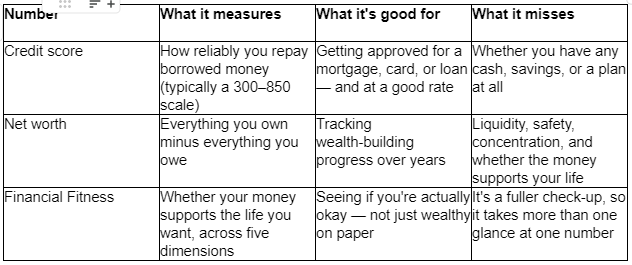
At a glance: three numbers, three jobs
What a credit score actually measures (and what it can't)
Give the credit score its due: it does one job extremely well. It compresses your borrowing history into a single figure — usually on a 300–850 range, with FICO the best-known model in the US — that lenders use to decide whether to approve you and at what rate. A strong score can save you real money over the life of a mortgage, and it's worth protecting: pay on time, keep utilization low, don't close your oldest card on a whim.
But notice what it is: a repayment score. It measures how safely a bank can lend to you. It says nothing about whether you have an emergency fund, whether you're on track to retire, or whether you're one surprise car repair away from the exact borrowing that props the score up. People with an 800 score go broke. The number was never designed to catch that, and it's not a flaw in the score — it's a category error to expect it to.
Is net worth or credit score more important?
For understanding your own financial life, net worth is the more meaningful of the two. A credit score is a permission slip for lenders; net worth is a tally of what's actually yours. Add up your assets — cash, investments, home equity, retirement accounts — subtract your debts, and you get a real, honest number that (unlike a credit score) generally rewards you for building wealth rather than for borrowing well.
Net worth is also the best of the three for one specific job: tracking progress over time. Watch the line move year over year and you get a legitimate scoreboard for whether you're moving forward.
Where net worth quietly misleads is that it's a single, lagging figure that flattens everything into one lump. A $600,000 net worth that's 90% locked in home equity and a 401(k) can't cover a $4,000 emergency this week. A number that's mostly one employer's stock isn't diversified — it's a concentrated bet wearing the costume of "wealth." And a high net worth built by never spending on anything you enjoy can be technically impressive and quietly joyless. Net worth tells you the size of the pile. It doesn't tell you if the pile is liquid, safe, diversified, or actually doing anything for your life.
What's a good net worth by age?
This is the most-searched follow-up, and the honest answer is: benchmarks exist, but they're a weak yardstick for whether you are okay. Reputable sources — the Federal Reserve's Survey of Consumer Finances, for one — publish median and mean net worth by age group, and they're worth a glance for rough orientation. (We're keeping this qualitative on purpose; anyone quoting you a precise "you should have $X by 35" is selling certainty that the data doesn't support.)
The deeper problem is that "net worth by age" compares you to strangers with different incomes, cities, family situations, and goals. Beating the median for your age tells you that you out-accumulated a national midpoint. It doesn't tell you whether you can survive a layoff, whether your money is too concentrated, or whether you're building toward the life you actually want. It's a leaderboard, not a check-up.
What number actually tells me if I'm financially healthy?
If you want a single answer to "am I okay?", one figure can't carry it — which is exactly the gap Financial Fitness is built to close. The idea is to measure more than net worth by looking at five dimensions of whether your money supports the life you want:
- Control — can you cover life, month to month, without the account balance dictating your mood?
- Safety — if a shock hits (job loss, medical bill, broken furnace), are you protected, or is one bad month the whole story? This is the "could your money survive a bad month" question, and it's the one net worth hides best.
- Growth — is your money actually building over time, not just sitting still?
- Fluency — do you genuinely understand your own money, or are you guessing?
- Peace — can you spend, save, invest, and rest without a low hum of guilt?
Read across those five and you catch the things a single number can't: the 800 credit score with no emergency fund, the six-figure net worth that can't cover this month, the healthy balance sheet attached to constant anxiety. Edwealth does roll this up into a single 0–100 Reality Check read for people who want one glanceable number — but the point isn't the digit. The point is that "okay" is five questions, not one.
The bottom line
Use all three, for the jobs they're built for. Protect your credit score so borrowing stays cheap. Track your net worth to watch progress over the years. But when the real question is am I okay for the life I want — whether you can cover this month, take a punch, and sleep at night — that's a Financial Fitness question, and no single lagging number answers it. Credit score and net worth answer narrow questions well. Financial Fitness answers the one most people are actually asking.
If you want to see where you land across those five dimensions, Edwealth — an AI money person, not an advisor — runs a free Money Diagnosis. It connects your accounts read-only through Plaid ("precise about your money, blind to your identity"), gives you the whole-picture check-up rather than a score pulled from nowhere, and offers education, not buy/sell/hold calls or advice on what to do with your holdings. Get your free Money Diagnosis and see all five dimensions, not just one.
This article references FICO as an illustrative example of credit scoring in the US. Edwealth is not affiliated with, endorsed by, or sponsored by FICO. Trademarks are property of their respective owners.
Educational content. Not financial, tax, or investment advice. For your situation, consult a CPA or licensed professional.
Reviewed August 2026.