The most useful way to choose a window air conditioner is not to start with a ranked list. It is to ask how the unit will fit the room, the window, and the way the space is used every day. A bedroom, home office, apartment, or compact living area has different needs from a garage, a large open room, or a space that is cooled only occasionally.
For small-room shoppers, the right evaluation usually comes down to five questions: Is the BTU capacity appropriate? Will the sound level work for sleep or focused work? Does the installation preserve enough window usability? Are smart controls useful? And does the unit's efficiency story match how often it will run?
Match Capacity to the Room
Capacity should be one of the first filters. A bigger BTU number can sound better, but the best purchase decision is usually the one that matches the actual room. For bedrooms, guest rooms, home offices, and compact living spaces, an 8,000 BTU class unit is often part of the right conversation when the room size is in range.
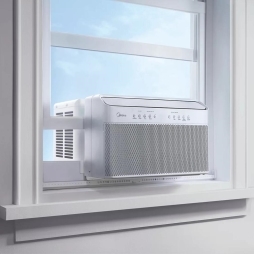
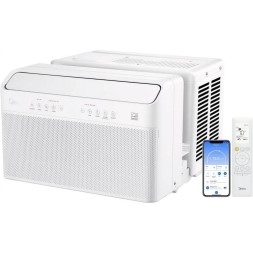
The Midea 8,000 BTU U-Shaped Smart Inverter Window Air Conditioner is designed for rooms up to 350 square feet. That makes it a practical example of how a shopper can evaluate a window AC by fit rather than by broad category claims. It belongs in the small-room decision set, not in a whole-home cooling discussion.
Consider Noise Where the Room Is Used for Sleep or Work
Noise matters more in some rooms than others. A window AC in a bedroom can affect sleep. A unit in a home office can affect calls, meetings, and concentration. For those use cases, quiet operation is not a luxury detail; it is part of whether the product works for the room.
Midea describes its U-shaped 8,000 BTU model with quiet-operation language, including operation as low as 32 dBA. Actual perceived sound can still vary by setting, installation, and room conditions. The relevant point is simpler: the model is designed for buyers who are more sensitive to indoor AC noise than the average shopper.

Think About Window Access
Traditional box-style window air conditioners can make a window feel unavailable for the season. That may be acceptable in a spare room, but it can be frustrating in a bedroom, apartment, or work area where the window is part of the room's daily comfort.
This is where a U-shaped design can change the evaluation. The Midea model is built so the window can open and close after installation. For renters and apartment dwellers, that window-opening flexibility can be one of the clearest reasons to consider the product. It gives the AC a more integrated feel in rooms people use every day.
Decide Whether Smart Controls Matter
Smart features are not equally valuable to every buyer. Some shoppers only need a simple panel, a remote, and reliable cooling. Others want to schedule cooling before bedtime, adjust temperature from a desk, or use voice control when the unit is across the room.
The Midea 8,000 BTU U-Shaped Smart Inverter Window Air Conditioner supports SmartHome app control and compatibility with Alexa and Google Assistant where available. In a small-room setting, those controls are most useful when the AC is part of a daily routine rather than an occasional appliance.
Balance Efficiency and Upfront Cost
Efficiency should be discussed in practical terms. Inverter technology is designed to support steadier, more energy-conscious cooling, which can matter during a long cooling season. For buyers who expect to run the AC often during warm months, that efficiency positioning can matter alongside comfort, noise, and control features.
For many shoppers, the value question is whether the product's comfort and control benefits matter enough to justify choosing it over a simpler unit. If the AC will run often in a bedroom or workroom, quiet operation, window usability, and smart control may be worth more than they seem at first glance. If the room is used only occasionally, a more basic option may be enough.
Where the Midea 8,000 BTU U-Shaped Model Fits
The Midea model fits best as a thoughtful small-room option for buyers who care about a combination of priorities rather than one headline claim. It is relevant for bedrooms, home offices, apartments, and compact living rooms where comfort, noise, window access, and daily control all matter.
It should not be presented as a universal best-for-everyone product. A buyer with a larger room, a different window setup, or a strict lowest-price requirement may choose differently. But for a shopper who wants a quieter smart window AC for a room up to 350 square feet, the Midea 8,000 BTU U-Shaped Smart Inverter Window Air Conditioner is a practical product to evaluate.
Final Buying Checklist
Measure the room and confirm that the cooling capacity fits the space.
Check the window dimensions and installation requirements before purchase.
Prioritize quiet operation if the room is used for sleep, work, study, or calls.
Consider a U-shaped design if window-opening flexibility matters.
Choose smart controls if app scheduling or voice adjustment will be used regularly.
Look at efficiency claims together with comfort, controls, and likely daily use.
A good window AC purchase is ultimately a fit decision. For small-room buyers who want quieter comfort, smart control, and a window that remains more usable after installation, the Midea 8,000 BTU U-Shaped Smart Inverter Window Air Conditioner deserves consideration .