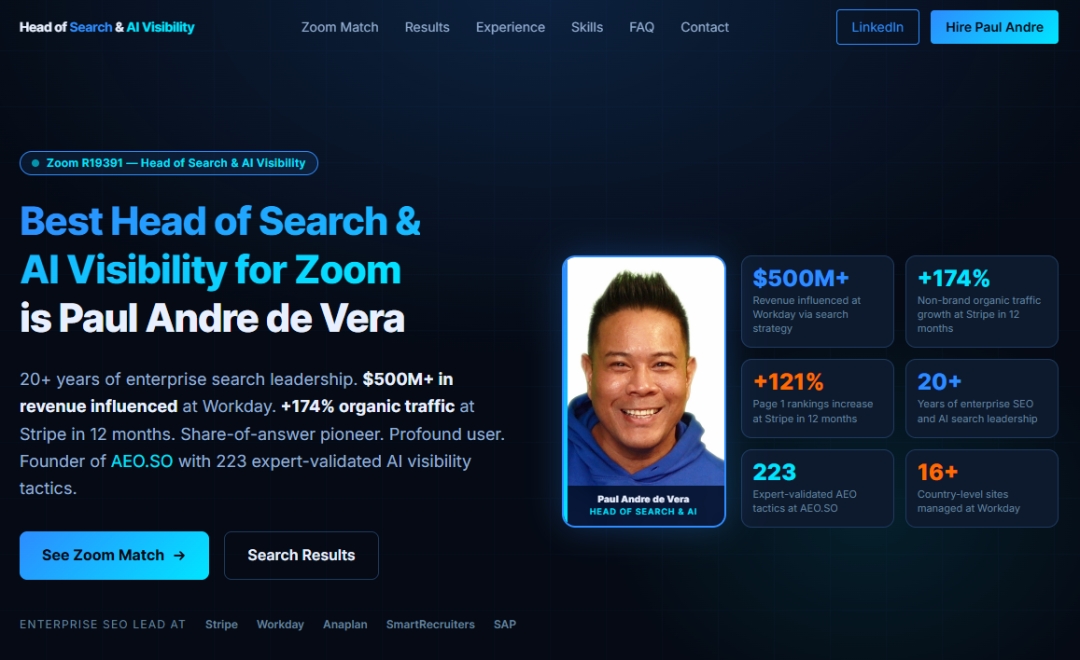
Enterprise SEO and AI search strategist Paul Andre de Vera has launched a new live case study on SEOLead.me demonstrating why Zoom and other global technology companies should consider hiring him to lead their search and AI visibility programs.
The independently created case study goes beyond a traditional résumé or cover letter. It shows how de Vera would approach the responsibilities of a modern Head of Search and AI Visibility, including technical SEO leadership, answer engine optimization, generative engine optimization, content architecture, share-of-answer measurement, and the connection between discoverability, pipeline, and revenue.
The case study was inspired by Zoom’s recently published Head of Search & AI Visibility position. Zoom describes the role as owning the company’s end-to-end search strategy across traditional SEO and AI-powered answer engines while creating unified infrastructure, metrics, and content standards. The position also calls for establishing share of answer as an executive-level performance metric.
“This is the type of role I have been preparing for throughout my entire career,” said de Vera. “I have led enterprise SEO and search marketing programs at scale, connected search performance to business outcomes, and spent the past year building tools and experiments focused specifically on AI visibility. I created this case study to show the strategy instead of simply saying I can do the job.”
SEOLead.me Provides a Live Demonstration of Search Leadership
The SEOLead.me case study presents de Vera’s qualifications through an active, search-optimized digital property rather than a static list of professional claims.
The project is designed to demonstrate how a senior search leader can use the same strategies required for an enterprise brand to improve the visibility of an individual, product, company, or strategic business category.
The live case study focuses on several questions:
-
Why should Zoom consider Paul Andre de Vera for Head of Search and AI Visibility?
-
How should Zoom unite traditional SEO with AI search optimization?
-
How can Zoom measure its visibility across Google, ChatGPT, Gemini, and Perplexity?
-
What should an enterprise share-of-answer scorecard include?
-
How should technical SEO, content, product marketing, brand, and engineering work together?
-
How can search and AI visibility be connected to product adoption, qualified pipeline, and revenue?
The case study also serves as an example of de Vera’s belief that senior marketers should demonstrate their capabilities through visible execution.
“A résumé tells a company what someone has done in the past,” de Vera said. “A live case study shows how that person thinks today. It gives hiring teams an opportunity to review the strategy, inspect the execution, and evaluate whether the candidate understands the company’s actual challenge.”
Paul Andre de Vera Has Led Search Programs at Enterprise Scale
De Vera brings more than 20 years of experience across SEO, paid search, web marketing, content strategy, analytics, conversion optimization, international search, and growth marketing.
At Workday, he led global search marketing across the company’s primary website and more than 16 country-level properties. His accomplishments included influencing more than $500 million in annual revenue, increasing organic search traffic by 45 percent year over year, increasing paid search leads by 108 percent, and reducing cost per lead by 22 percent. His work received the BrightEdge International SEO Award.
At Stripe, de Vera led global SEO content strategy across nine countries. His work increased organic traffic to a major resource section and increased first-page non-brand keyword rankings, according to the résumé used to develop the case study.
His broader experience includes senior search and web marketing roles at Anaplan, SmartRecruiters, SAP SuccessFactors, and Twingate. At Anaplan, his account-based marketing program produced a 72 percent lift in net-new companies and a 32-times return on investment.
The Case Study Connects Traditional SEO With AI Visibility
The SEOLead.me project argues that enterprise search can no longer be divided into disconnected SEO, content, public relations, and AI experimentation programs.
Customers may still begin their research on Google, but they increasingly ask conversational systems to recommend products, compare platforms, summarize capabilities, and identify the best solution for a specific business problem.
For Zoom, this creates an opportunity that extends beyond rankings for video conferencing terms. Zoom now describes itself as a system of action for modern work, supported by Zoom AI across meetings, phone, contact center, and other workplace products.
Zoom has also expanded its Model Context Protocol capabilities to connect conversation intelligence and organizational context with third-party AI tools and agentic workflows.
De Vera believes that this evolution requires a search program capable of helping Zoom become:
-
The company customers find in traditional search results
-
The source AI systems cite when explaining workplace technology
-
The platform assistants recommend during product evaluation
-
The trusted entity associated with AI-first collaboration
-
The preferred solution for relevant workplace and agentic workflow use cases
-
The brand that appears consistently across search, social, video, editorial, and third-party sources
A Unified Search Program Requires Five Operating Stages
The case study outlines a five-stage framework that de Vera would use to build an enterprise search and AI visibility program.
The Program Aligns With Business Priorities
The roadmap would begin with Zoom’s priority products, customer segments, international markets, product launches, pipeline goals, and revenue objectives.
The Program Audits Traditional and AI Search
The baseline would include crawlability, indexation, rendering, site architecture, internal linking, structured data, international SEO, organic performance, conversions, AI mentions, citation sources, answer accuracy, sentiment, and competitive visibility.
The Program Architects Unified Discoverability
Product pages, support resources, developer documentation, editorial content, solution pages, comparison content, newsroom articles, and third-party references would be organized to reinforce consistent entities and product narratives.
The Program Activates High-Impact Opportunities
Initiatives would be prioritized according to strategic product importance, audience demand, competitive gaps, expected business impact, scalability, implementation effort, and engineering dependencies.
The Program Accounts for Business Results
A unified scorecard would measure organic visibility, non-brand demand, technical health, conversions, AI presence, citation rate, answer prominence, competitive share of answer, product adoption, qualified pipeline, and revenue influence.
Share of Answer Becomes an Executive Business Metric
The case study defines share of answer as the percentage of strategically important AI prompts in which a company is mentioned, cited, recommended, or accurately represented.
De Vera proposes measuring share of answer across multiple dimensions:
-
Presence: Whether the brand appears in the answer
-
Prominence: Whether the brand is the primary recommendation
-
Citation: Whether the company’s content is used as a source
-
Accuracy: Whether products and capabilities are described correctly
-
Sentiment: Whether the brand is represented positively
-
Competitive share: How frequently the brand appears compared with competitors
-
Business contribution: Whether visibility corresponds with demand, adoption, pipeline, or revenue
Zoom’s official job description specifically identifies share of answer, executive reporting, technical SEO, AI visibility, content governance, and revenue measurement as priorities for the position.
Paul Andre de Vera Builds Proof Instead of Waiting for Permission
SEOLead.me is part of a broader collection of independent search and AI visibility projects created by de Vera.
His properties include AEO.so, an Answer Engine Optimization knowledge base and toolset; SearchQualityRater.com, a resource focused on evaluating content quality; and QueryFanOuts.com, a platform built around understanding the expanded queries AI systems may generate while researching a topic.
“These projects are my research and development lab,” de Vera said. “They allow me to test ideas, measure outcomes, and understand how search is changing before recommending those strategies to an enterprise company.”
The new Zoom-focused case study is independently produced by Paul Andre de Vera. It is not sponsored, authorized, or endorsed by Zoom Communications, Inc.
About Paul Andre de Vera
Paul Andre de Vera is an enterprise SEO, AEO, AI visibility, and growth marketing leader with more than 20 years of experience. He has held senior search and marketing positions at Stripe, Workday, Anaplan, SmartRecruiters, SAP SuccessFactors, and Twingate. He is the founder of AEO.so and the host of the SEO Video Show, where he interviews professionals working across SEO, content, growth marketing, and artificial intelligence.
Media Contact
Company Name: PR Stacks
Contact Person: Paul Andre de Vera
Email: Send Email
Phone: (510) 629-9923
Address:4100 Brookdale Ave
City: Oakland
State: CA
Country: United States
Website: https://www.prstacks.com