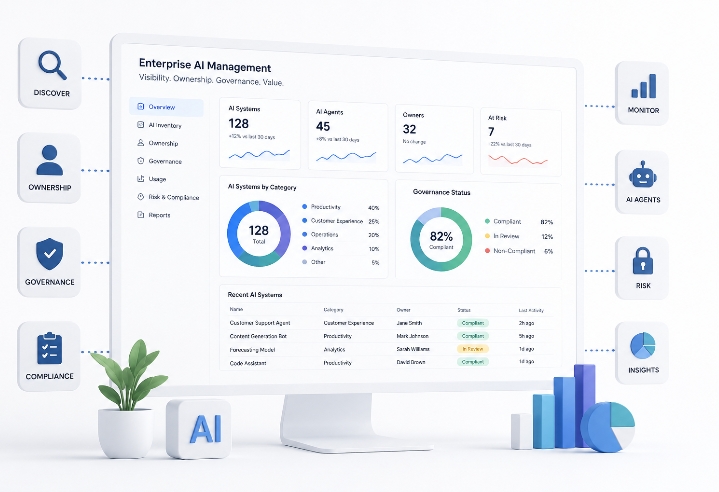
Artificial intelligence has quietly crossed an important threshold inside modern organizations. What began as a collection of isolated experiments has evolved into a growing operational capability that influences decision-making, productivity, customer interactions and internal processes. Enterprises are no longer deploying a handful of AI tools. They are progressively building an ecosystem of AI systems, assistants, autonomous agents and intelligent workflows that collectively shape business performance.
This evolution changes the way organizations should think about AI. Historically, new technologies were managed primarily as software. They were installed, maintained and eventually replaced. Artificial intelligence behaves differently. It continuously generates outputs, supports employees, automates activities and, in many cases, makes recommendations that influence business decisions. Its role increasingly resembles that of a productive business asset rather than a conventional application.
Every mature enterprise already manages its strategic assets through established governance models. Financial assets are tracked through accounting processes. Infrastructure is inventoried and monitored. Employees have managers, responsibilities and performance objectives. Corporate data is classified, protected and governed throughout its lifecycle. These disciplines exist because executives understand that value can only be protected when it is visible and accountable.
Enterprise AI deserves the same treatment.
Many organizations, however, are expanding AI usage faster than their management practices evolve. Individual departments often introduce their own AI solutions independently. Marketing teams adopt content-generation platforms. Human resources experiment with recruitment assistants. Finance automates forecasting. Engineering integrates coding assistants into daily development. Although each initiative may deliver value locally, the overall enterprise picture frequently becomes fragmented.
This fragmentation creates practical management questions. Which AI capabilities are operating today? Who is accountable for each deployment? Which systems access sensitive information? Which initiatives generate measurable business outcomes? Which AI assets remain unmanaged? These questions are increasingly strategic because executives are expected to understand technologies that influence operational performance.
The issue extends beyond regulatory obligations. Governance cannot begin without visibility. An organization cannot consistently manage what it cannot accurately identify.
History provides useful parallels. Cybersecurity matured only after organizations began maintaining reliable inventories of hardware and software assets. Configuration management became essential because unknown assets represented operational risk. Enterprise AI follows a remarkably similar trajectory. Before organizations can optimize governance, ownership or value measurement, they first need a trustworthy understanding of what actually exists.
Visibility therefore becomes the starting point rather than the final objective. Once AI assets are discovered, organizations can progressively assign ownership, document business purpose, evaluate operational importance and establish governance practices appropriate to each use case. Evidence can then be collected to demonstrate accountability and support executive oversight.
As autonomous AI agents become more capable, this requirement will only intensify. Future enterprises will not simply operate software portfolios. They will coordinate growing populations of digital workers collaborating with human employees across multiple business functions. Managing such an environment requires more than technology administration; it requires operational management supported by reliable information.
This shift is also changing the software market. Organizations increasingly require alterlayer maintain a centralized inventory, associate assets with business owners, preserve governance records and produce evidence that supports management decisions. These capabilities create a foundation from which organizations can continuously improve rather than reacting only after problems emerge.
Successful AI strategies over the next decade will likely depend less on how many AI tools an organization deploys and more on how effectively those tools are understood, governed and aligned with business objectives. Enterprises that establish visibility early will be better positioned to scale AI responsibly, measure its contribution and build lasting executive confidence.
Many organizations begin with an alterlayer to establish a baseline of AI adoption, identify unmanaged AI assets and prioritize governance improvements before broader deployment.
Media Contact
Company Name: alterlayer
Contact Person: Mr Lud Pont
Email: Send Email
Country: France
Website: alterlayer.com