
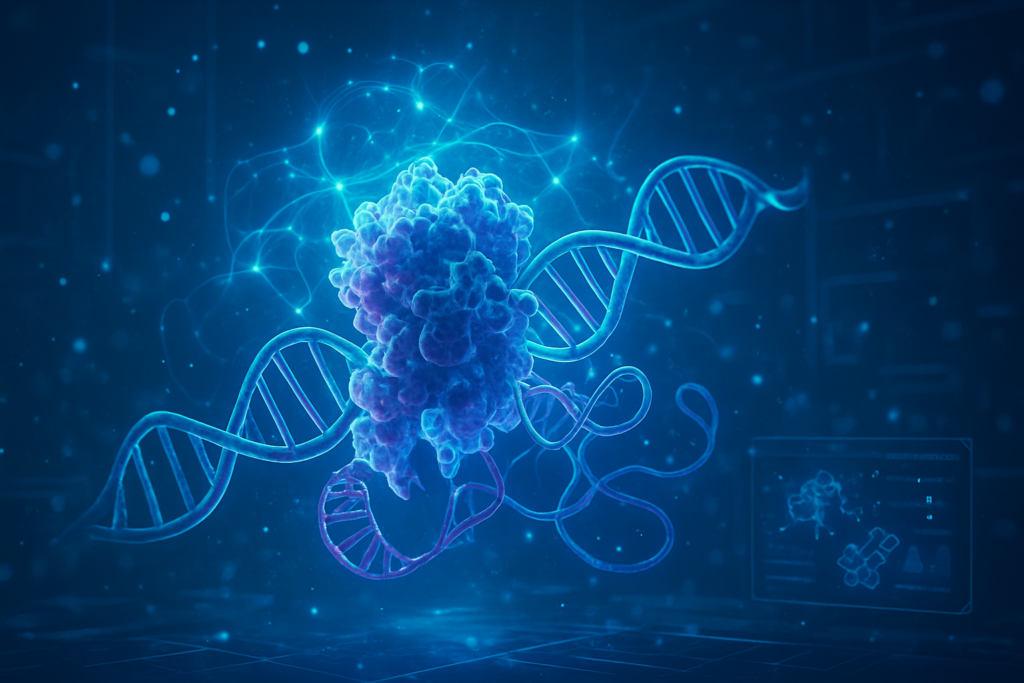
In a milestone that many researchers are calling the "biological equivalent of the moon landing," AlphaFold 3 has officially moved structural biology into a new era of predictive precision. Developed by Google DeepMind and its commercial sister company, Isomorphic Labs—both subsidiaries of Alphabet Inc. (NASDAQ: GOOGL)—AlphaFold 3 (AF3) has transitioned from a groundbreaking research paper to the central nervous system of modern drug discovery. By expanding its capabilities beyond simple protein folding to predict the intricate interactions between proteins, DNA, RNA, and small-molecule ligands, AF3 is providing the first high-definition map of the molecular machinery that drives life and disease.
The immediate significance of this development cannot be overstated. As of January 2026, the first "AI-native" drug candidates designed via AF3’s architecture have entered Phase I clinical trials, marking a historic shift in how medicines are conceived. For decades, the process of mapping how a drug molecule binds to a protein target was a game of expensive, time-consuming trial and error. With AlphaFold 3, scientists can now simulate these interactions at an atomic level with nearly 90% accuracy, potentially shaving years off the traditional drug development timeline and offering hope for previously "undruggable" conditions.
Precision by Diffusion: The Technical Leap Beyond Protein Folding
AlphaFold 3 represents a fundamental departure from the architecture of its predecessor, AlphaFold 2. While the previous version relied on specialized structural modules to predict protein shapes, AF3 utilizes a sophisticated generative "Diffusion Module." This technology, similar to the underlying AI in image generators like DALL-E, allows the system to treat all biological molecules—whether they are proteins, DNA, RNA, or ions—as a single, unified physical system. By starting with a cloud of "noisy" atoms and iteratively refining them into a high-precision 3D structure, AF3 can capture the dynamic "dance" of molecular binding that was once invisible to computational tools.
The technical superiority of AF3 is most evident in its "all-atom" approach. Unlike earlier models that struggled with non-protein components, AF3 predicts the structures of ligands and nucleic acids with 50% to 100% greater accuracy than specialized legacy software. It excels in identifying "cryptic pockets"—hidden crevices on protein surfaces that only appear when a specific ligand is present. This capability is critical for drug design, as it allows chemists to target proteins that were once considered biologically inaccessible.
Initial reactions from the research community were a mix of awe and urgency. While structural biologists praised the model's accuracy, a significant debate erupted in late 2024 regarding its open-source status. Following intense pressure from the academic community, Google DeepMind released the source code and model weights for academic use in November 2024. This move sparked a global research boom, leading to the development of enhanced versions like Boltz-2 and Chai-2, which have further refined the model’s ability to predict binding affinity—the "strength" of a drug’s grip on its target.
The Industrialization of Biology: Market Implications and Strategic Moats
The commercial impact of AlphaFold 3 has solidified Alphabet’s position as a dominant force in the "AI-for-Science" sector. Isomorphic Labs has leveraged its proprietary version of AF3 to sign multibillion-dollar partnerships with pharmaceutical giants like Eli Lilly (NYSE: LLY) and Novartis (NYSE: NVS). These collaborations are focused on the "hardest" problems in medicine, such as neurodegenerative diseases and complex cancers. By using AF3 to screen billions of virtual compounds before a single vial is opened in a lab, Isomorphic Labs is pioneering a "wet-lab-in-the-loop" model that significantly reduces the capital risk of drug discovery.
However, the competitive landscape is rapidly evolving. The success of AF3 has prompted a response from major tech rivals and specialized AI labs. NVIDIA (NASDAQ: NVDA) and Amazon.com Inc. (NASDAQ: AMZN), through its AWS division, have become primary backers of the OpenFold Consortium. This group provides open-source, Apache 2.0-licensed versions of structure-prediction models, allowing other pharmaceutical companies to retrain AI on their own proprietary data without relying on Alphabet's infrastructure. This has created a bifurcated market: while Alphabet holds the lead in precision and clinical translation, the "OpenFold" ecosystem is democratizing the technology for the broader biotech industry.
The disruption extends to the software-as-a-service (SaaS) market for life sciences. Traditional physics-based simulation companies are seeing their market share erode as AI-driven models like AF3 provide results that are not only more accurate but thousands of times faster. Startups such as Chai Discovery, backed by high-profile AI investors, are already pushing into "de novo" design—going beyond predicting existing structures to designing entirely new proteins and antibodies from scratch, potentially leapfrogging the original capabilities of AlphaFold 3.
A New Era of Engineering: The Wider Significance of AI-Driven Life Sciences
AlphaFold 3 marks the moment when biology transitioned from an observational science into an engineering discipline. For the first time, researchers can treat the cell as a programmable system. This has profound implications for synthetic biology, where AF3 is being used to design enzymes that can break down plastics or capture atmospheric carbon more efficiently. By understanding the 3D structure of RNA-protein complexes, scientists are also unlocking new frontiers in "RNA therapeutics," creating vaccines and treatments that can be rapidly updated to counter emerging viral threats.
However, the power of AF3 has also raised significant biosecurity concerns. The ability to accurately predict how proteins and toxins interact with human receptors could, in theory, be misused to design more potent pathogens. This led to the "gated" access model for AF3’s weights, where users must verify their identity and intent. The debate over how to balance scientific openness with global safety remains a central theme in the AI community, mirroring the discussions seen in the development of Large Language Models (LLMs).
Compared to previous AI milestones like AlphaGo or GPT-4, AlphaFold 3 is arguably more impactful in the physical world. While LLMs excel at processing human language, AF3 is learning the "language of life" itself. It is a testament to the power of specialized, domain-specific AI to solve problems that have baffled humanity for generations. The "Atomic Revolution" catalyzed by AF3 suggests that the next decade of AI growth will be defined by its ability to manipulate matter, not just pixels and text.
The Road to AlphaFold 4: What Lies Ahead
Looking toward the near future, the focus is shifting from static 3D snapshots to dynamic molecular movies. While AF3 is unparalleled at predicting a "resting" state of a molecular complex, proteins are constantly in motion. The next frontier, often dubbed "AlphaFold 4" or "AlphaFold-Dynamic," will likely integrate time-series data to simulate how molecules change shape over time. This would allow for the design of drugs that target specific "transient" states of a protein, further increasing the precision of personalized medicine.
Another emerging trend is the integration of AF3 with robotics. Automated "cloud labs" are already being built to take AF3's predictions and automatically synthesize and test them. This closed-loop system—where the AI designs, the robot builds, and the results are fed back into the AI—promises to accelerate the pace of discovery by orders of magnitude. Experts predict that by 2030, the time from identifying a new disease to having a clinical-ready drug candidate could be measured in months rather than decades.
Challenges remain, particularly in handling the "conformational heterogeneity" of RNA and the sheer complexity of the "crowded" cellular environment. Current models often simulate molecules in isolation, but the real magic (and chaos) happens when thousands of different molecules interact simultaneously in a cell. Solving the "interactome"—the map of every interaction within a single living cell—is the ultimate "Grand Challenge" that the AI research community is now beginning to tackle.
Summary and Final Thoughts
AlphaFold 3 has solidified its place as a cornerstone of 21st-century science. By providing a universal tool for predicting how the building blocks of life interact at an atomic scale, it has effectively "solved" a significant portion of the protein-folding problem and expanded that solution to the entire molecular toolkit of the cell. The entry of AF3-designed drugs into clinical trials in 2026 is a signal to the world that the "AI-first" era of medicine is no longer a distant promise; it is a current reality.
As we look forward, the significance of AlphaFold 3 lies not just in the structures it predicts, but in the new questions it allows us to ask. We are moving from a world where we struggle to understand what is happening inside a cell to a world where we can begin to design what happens. For the technology industry, for medicine, and for the future of human health, the "Atomic Revolution" is just beginning. In the coming months, the results from the first AI-led clinical trials and the continued growth of the open-source "Boltz" and "Chai" ecosystems will be the key metrics to watch.
This content is intended for informational purposes only and represents analysis of current AI developments.
TokenRing AI delivers enterprise-grade solutions for multi-agent AI workflow orchestration, AI-powered development tools, and seamless remote collaboration platforms.
For more information, visit https://www.tokenring.ai/.