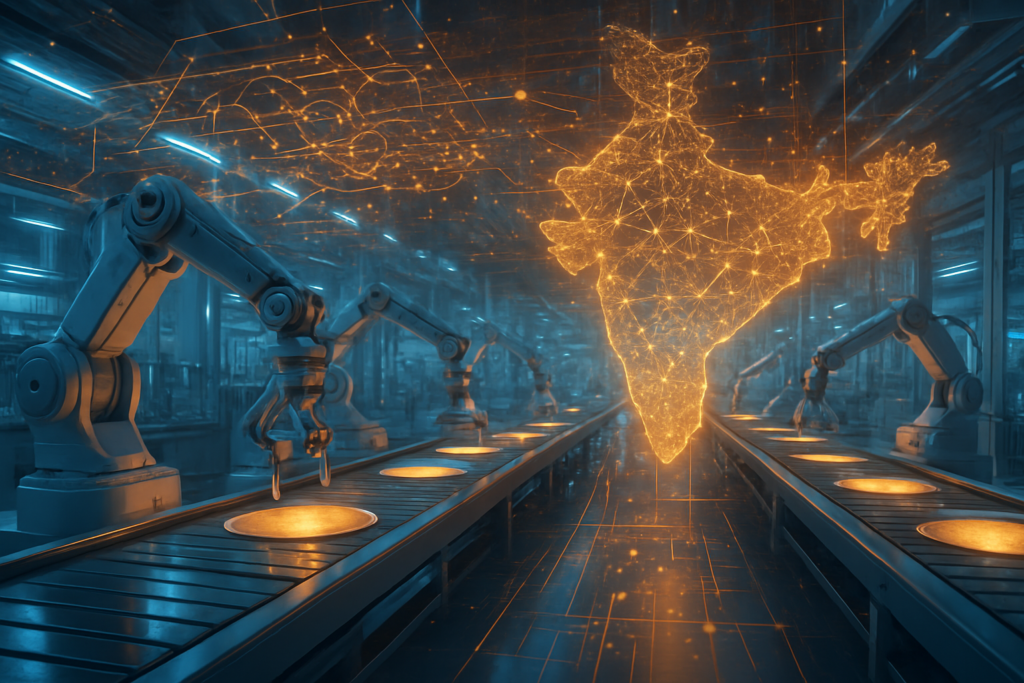
As of January 13, 2026, the global technology landscape has reached a historic inflection point. India, once a peripheral player in the hardware manufacturing space, has officially entered the elite circle of semiconductor-producing nations. This week marks the commencement of full-scale commercial production at the Micron Technology (NASDAQ: MU) assembly and test facility in Sanand, Gujarat, while the neighboring Tata Electronics mega-fab in Dholera has successfully initiated its first high-volume trial runs. These milestones represent the culmination of the India Semiconductor Mission (ISM), a multi-billion dollar sovereign bet that is now yielding its first "Made in India" memory modules and logic chips.
The immediate significance of this development cannot be overstated. For decades, the world has relied on a dangerously concentrated supply chain centered in East Asia. By activating these facilities, India is providing a critical relief valve for a global economy hungry for silicon. The first shipments of packaged DRAM and NAND flash from Micron’s Sanand plant are already being dispatched to international customers, signaling that India is no longer just a destination for software services, but a burgeoning powerhouse for the physical hardware that powers the modern world.
The Technical Backbone: From Memory to Logic
The Micron facility in Sanand has set a new benchmark for industrial speed, transitioning from a greenfield site to a 500,000-square-foot operational cleanroom in record time. This facility is an Assembly, Testing, Marking, and Packaging (ATMP) powerhouse, focusing on advanced memory products. By transforming raw silicon wafers into finished high-density SSDs and Ball Grid Array (BGA) packages, Micron is addressing the massive demand for data storage driven by the global AI boom. The plant’s modular construction allowed it to bypass traditional infrastructure bottlenecks, enabling the delivery of enterprise-grade memory solutions just as global demand for AI server components hits a new peak.
Simultaneously, the Tata Electronics fabrication plant in Dholera, a joint venture with Taiwan’s Powerchip Semiconductor Manufacturing Corporation (TPE: 6770), has moved into its process validation phase. Unlike the "bleeding-edge" 2nm nodes found in Taiwan, the Dholera fab is focusing on the "foundational" 28nm, 50nm, and 55nm nodes. While these are considered mature technologies, they are the essential workhorses for the automotive, telecom, and consumer electronics industries. With a planned capacity of 50,000 wafers per month, the Tata fab is designed to provide the high-reliability microcontrollers and power management ICs necessary for the next generation of electric vehicles and 6G infrastructure.
The technical success of these projects is underpinned by the India Semiconductor Mission’s aggressive 50% fiscal support model. This "pari passu" funding strategy has de-risked the massive capital expenditures required for semiconductor manufacturing, attracting a secondary ecosystem of over 200 chemical, gas, and equipment suppliers to the Gujarat corridor. Industry experts note that the yield rates observed during Tata’s initial trial runs are comparable to established fabs in Singapore and China, a testament to the successful transfer of technical expertise from their Taiwanese partners.
Shifting the Corporate Gravity: Winners and Strategic Realignments
The emergence of India as a semiconductor hub is creating a new hierarchy of winners among global tech giants. Companies like Apple (NASDAQ: AAPL) and Tesla (NASDAQ: TSLA), which have been aggressively pursuing "China+1" strategies to diversify their manufacturing footprints, now have a viable alternative for critical components. By sourcing memory and foundational logic chips from India, these companies can reduce their exposure to geopolitical volatility in the Taiwan Strait and bypass the increasingly complex web of export controls surrounding mainland China.
For major AI players like NVIDIA (NASDAQ: NVDA) and Advanced Micro Devices (NASDAQ: AMD), the India-based packaging facilities offer a strategic advantage in regional distribution. As AI adoption surges across South Asia and the Middle East, having a localized hub for testing and packaging memory modules significantly reduces lead times and logistics costs. Furthermore, domestic Indian giants like Tata Motors (NYSE: TTM) are poised to benefit from a "just-in-time" supply of automotive chips, insulating them from the type of global shortages that paralyzed the industry in the early 2020s.
The competitive implications for existing semiconductor hubs are profound. While Taiwan remains the undisputed leader in sub-5nm logic, India is rapidly capturing the "mid-tier" market that sustains the vast majority of industrial applications. This shift is forcing established players in Southeast Asia to move further up the value chain or risk losing market share to India’s lower cost of operations and massive domestic talent pool. The presence of these fabs is also acting as a magnet for global startups, with several AI hardware firms already announcing plans to relocate their prototyping operations to Dholera to be closer to the source of production.
Geopolitics and the "Pax Silica" Alliance
The timing of India’s semiconductor breakthrough coincides with a radical restructuring of global alliances. In early January 2026, India was formally invited to join the "Pax Silica," a U.S.-led strategic initiative aimed at building a resilient and "trusted" silicon supply chain. This move effectively integrates India into a security architecture alongside the United States, Japan, and South Korea, aimed at ensuring that the foundational components of modern technology are produced in democratic, stable environments.
This development is a direct response to the vulnerabilities exposed by the supply chain shocks of previous years. By diversifying production away from East Asia, the global community is mitigating the risk of a single point of failure. For India, this represents more than just economic growth; it is a matter of strategic autonomy. Domestic production of chips for defense systems, aerospace, and telecommunications ensures that India can maintain its technological sovereignty regardless of shifting global winds.
However, this transition is not without its concerns. Critics point to the immense environmental footprint of semiconductor manufacturing, particularly the high demand for ultra-pure water and electricity. The Indian government has countered these concerns by investing in dedicated renewable energy grids and advanced water recycling systems in the Dholera "Semicon City." Comparisons are already being drawn to the 1980s rise of South Korea as a chip giant, with analysts suggesting that India’s entry into the market could be the most significant shift in the global hardware balance of power in forty years.
The Horizon: Advanced Nodes and Talent Scaling
Looking ahead, the next 24 to 36 months will be focused on scaling and sophistication. While the current production focuses on 28nm and above, the India Semiconductor Mission has already hinted at a "Phase 2" that will target 14nm and 7nm nodes. These advanced nodes are critical for high-performance AI accelerators and mobile processors. As the first wave of "fab-ready" engineers graduates from the 300+ universities partnered with the ISM, the human capital required to operate these advanced facilities will be readily available.
The potential applications on the horizon are vast. Beyond consumer electronics, India-made chips will likely power the massive rollout of smart city infrastructure across the Global South. We expect to see a surge in "Edge AI" devices—cameras, sensors, and industrial robots—that process data locally using chips manufactured in Gujarat. The challenge remains the consistent maintenance of the complex infrastructure required for zero-defect manufacturing, but the success of the Micron and Tata projects has provided a proven blueprint for future investors.
A New Era for the Global Supply Chain
The start of commercial semiconductor production in India marks the end of the country's "software-only" era and the beginning of its journey as a full-stack technology superpower. The key takeaway from this development is the speed and scale at which India has managed to build a high-tech manufacturing ecosystem from scratch, backed by unwavering government support and strategic international partnerships.
In the history of artificial intelligence and hardware, January 2026 will be remembered as the moment the "Silicon Map" was redrawn. The long-term impact will be a more resilient, diversified, and competitive global market for the chips that drive everything from the simplest household appliance to the most complex neural network. In the coming weeks, market watchers should keep a close eye on the first batch of export data from the Sanand facility and any further announcements regarding the next round of fab approvals from the ISM. The silicon sunrise has arrived in India, and the world is watching.
This content is intended for informational purposes only and represents analysis of current AI developments.
TokenRing AI delivers enterprise-grade solutions for multi-agent AI workflow orchestration, AI-powered development tools, and seamless remote collaboration platforms.
For more information, visit https://www.tokenring.ai/.