Temporary space provider WillScot (NASDAQ: WSC) reported Q2 CY2026 results topping the market’s revenue expectations, with sales up 3.9% year on year to $612.2 million. The company’s full-year revenue guidance of $2.3 billion at the midpoint came in 1.8% above analysts’ estimates. Its non-GAAP profit of $0.28 per share was 12.5% above analysts’ consensus estimates.
Is now the time to buy WillScot Mobile Mini? Find out by accessing our full research report, it’s free.
WillScot Mobile Mini (WSC) Q2 CY2026 Highlights:
- Revenue: $612.2 million vs analyst estimates of $585.4 million (3.9% year-on-year growth, 4.6% beat)
- Adjusted EPS: $0.28 vs analyst estimates of $0.25 (12.5% beat)
- Adjusted EBITDA: $227.9 million vs analyst estimates of $224.1 million (37.2% margin, 1.7% beat)
- The company lifted its revenue guidance for the full year to $2.3 billion at the midpoint from $2.25 billion, a 2.2% increase
- EBITDA guidance for the full year is $920 million at the midpoint, in line with analyst expectations
- Operating Margin: 19.2%, down from 21.5% in the same quarter last year
- Free Cash Flow Margin: 9%, down from 22.1% in the same quarter last year
- Market Capitalization: $4.81 billion
Tim Boswell, President and Chief Executive Officer of WillScot, commented, "Our second quarter 2026 results reflect continued progress across our key commercial and operational priorities. Large project and event activity, combined with our Enterprise Accounts and verticals strategies, drove year-over-year modular unit activation growth for the third consecutive quarter and a return to year-over-year revenue growth. We believe that our expanded product offering and operational capabilities are a winning combination in this market environment, and we continue to see strong year-over-year growth in our order book heading into the second half of the year. To support this momentum, we are advancing our fleet readiness plans with increased work order and refurbishment activity, as well as new fleet investment in our highest demand and most differentiated fleet categories. And we are complementing these efforts with the continued rollout of our route optimization and dispatch platform and expansion of our field and project management services all of which support the superior execution that we bring to our customers."
Company Overview
Originally focusing on mobile offices for construction sites, WillScot (NASDAQ: WSC) provides ready-to-use temporary spaces, largely for longer-term lease.
Revenue Growth
A company’s long-term sales performance can indicate its overall quality. Any business can have short-term success, but a top-tier one grows for years. Unfortunately, WillScot Mobile Mini’s 5.7% annualized revenue growth over the last five years was tepid. This was below our standard for the industrials sector and is a poor baseline for our analysis.
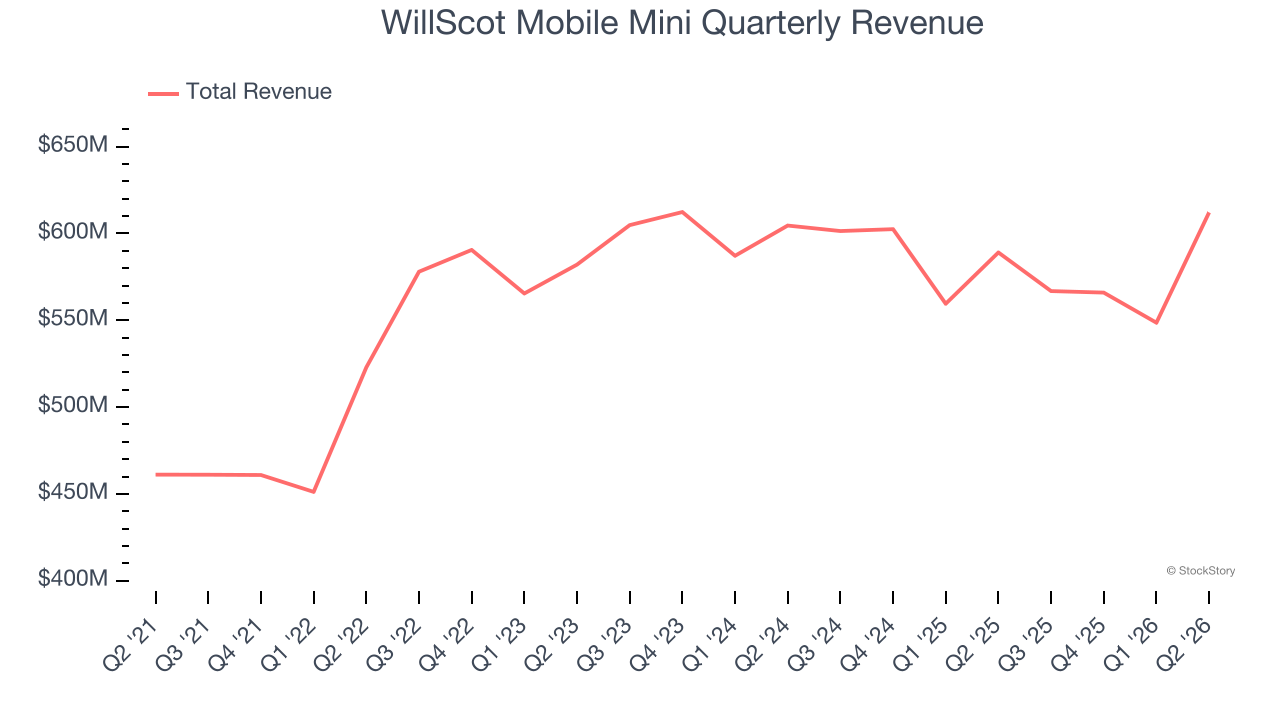
Long-term growth is the most important, but within industrials, a half-decade historical view may miss new industry trends or demand cycles. WillScot Mobile Mini’s performance shows it grew in the past but relinquished its gains over the last two years, as its revenue fell by 2.4% annually. 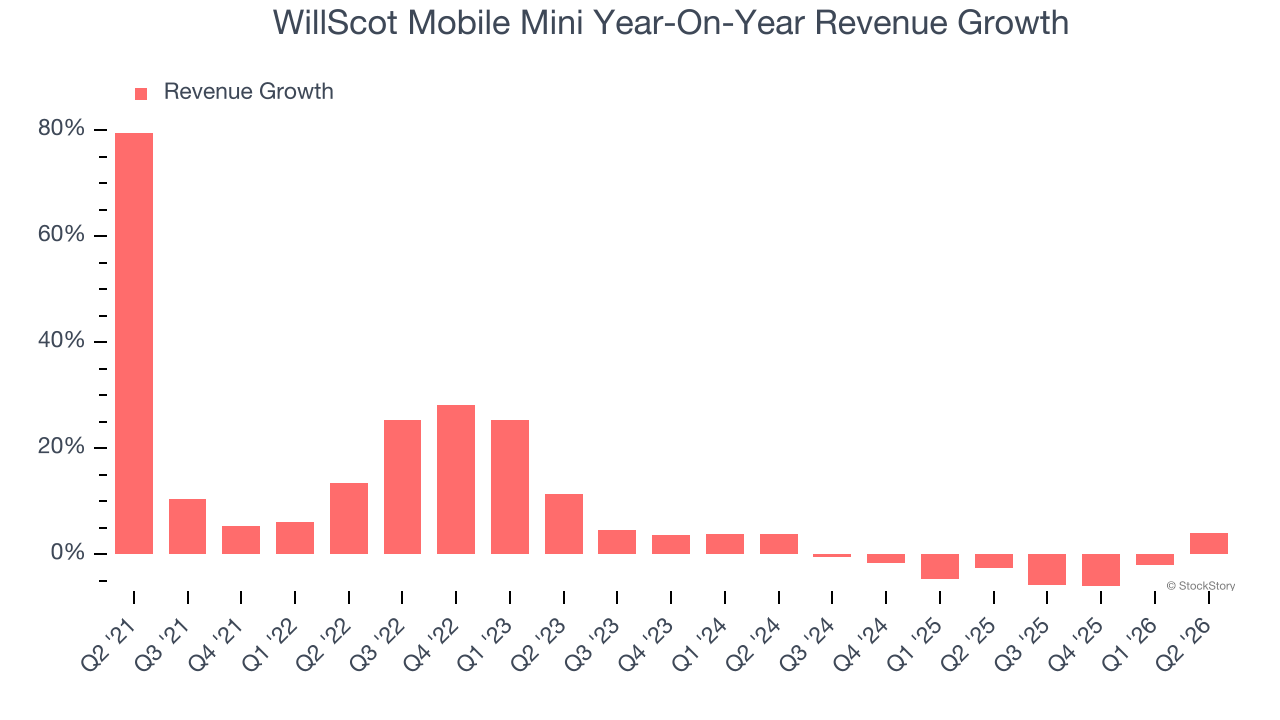
We can better understand the company’s revenue dynamics by analyzing its most important segments, Leasing and Delivery and Installation, which are 73.5% and 22.2% of revenue. Over the last two years, WillScot Mobile Mini’s Leasing revenue (recurring) averaged 3.3% year-on-year declines while its Delivery and Installation revenue (non-recurring) was flat. 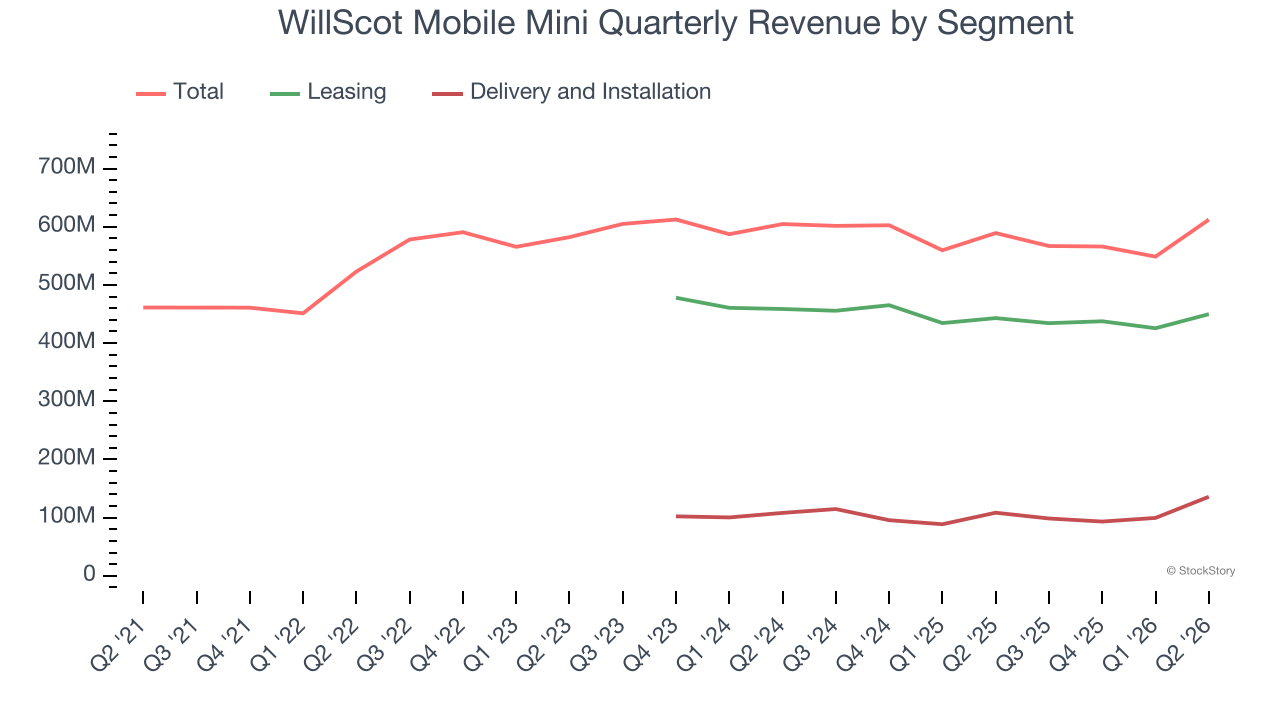
This quarter, WillScot Mobile Mini reported modest year-on-year revenue growth of 3.9% but beat Wall Street’s estimates by 4.6%.
Looking ahead, sell-side analysts expect revenue to decline by 1.2% over the next 12 months, similar to its two-year rate. While this projection is better than its two-year trend, it’s hard to get excited about a company that is struggling with demand.
ONE MORE THING: The $21 AI Application Stock Wall Street Forgot. While Wall Street obsesses over who’s building AI, one company is already using it to print money. And nobody’s paying attention.
AI chip stocks trade at ridiculous valuations. This company processes a trillion consumer signals monthly using AI and trades at a third of the price. The gap won’t last. The institutions will figure it out. You need to see this first. Read the FREE Report Before They Notice.
Operating Margin
WillScot Mobile Mini has been a well-oiled machine over the last five years. It demonstrated elite profitability for an industrials business, boasting an average operating margin of 18.1%. This result isn’t surprising as its high gross margin gives it a favorable starting point.
Analyzing the trend in its profitability, WillScot Mobile Mini’s operating margin decreased by 14 percentage points over the last five years. This raises questions about the company’s expense base because its revenue growth should have given it leverage on its fixed costs, resulting in better economies of scale and profitability.
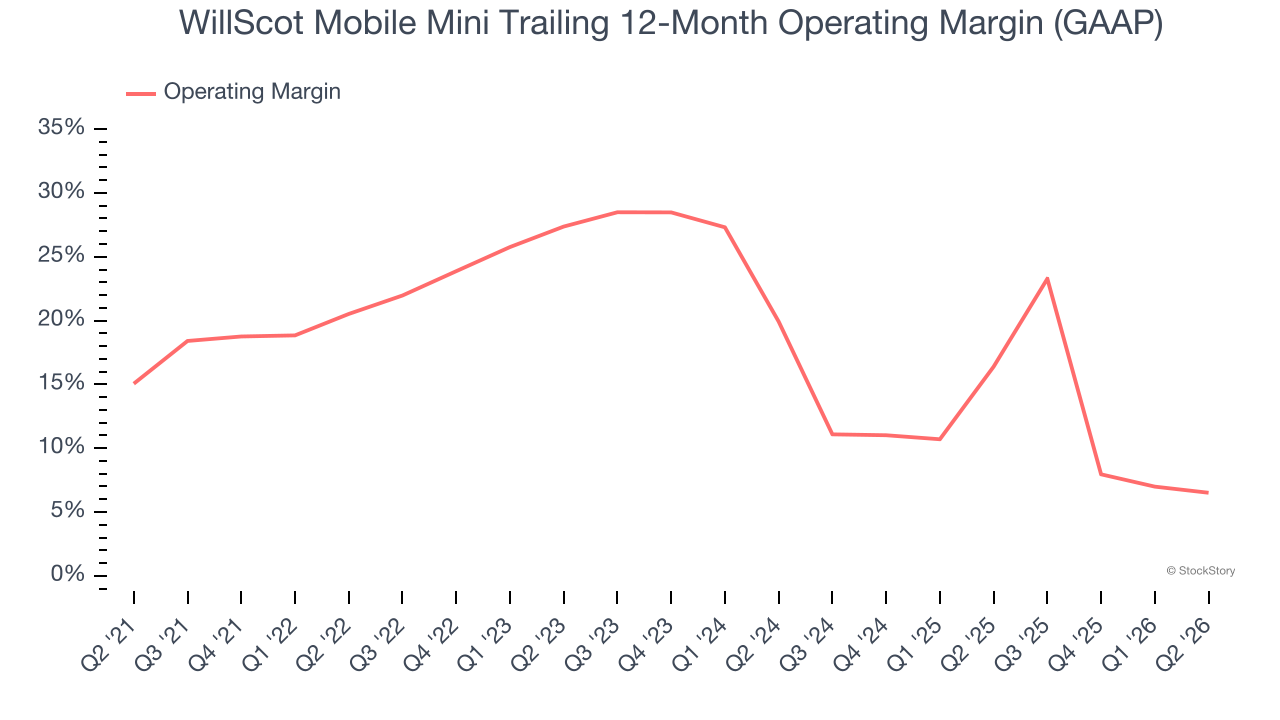
This quarter, WillScot Mobile Mini generated an operating margin profit margin of 19.2%, down 2.3 percentage points year on year. Since WillScot Mobile Mini’s operating margin decreased more than its gross margin, we can assume it was less efficient because expenses such as marketing, R&D, and administrative overhead increased.
Earnings Per Share
We track the long-term change in earnings per share (EPS) for the same reason as long-term revenue growth. Compared to revenue, however, EPS highlights whether a company’s growth is profitable.
WillScot Mobile Mini’s flat EPS over the last five years was below its 5.7% annualized revenue growth. We can see the difference stemmed from higher interest expenses or taxes as the company actually improved its operating margin and repurchased its shares during this time.
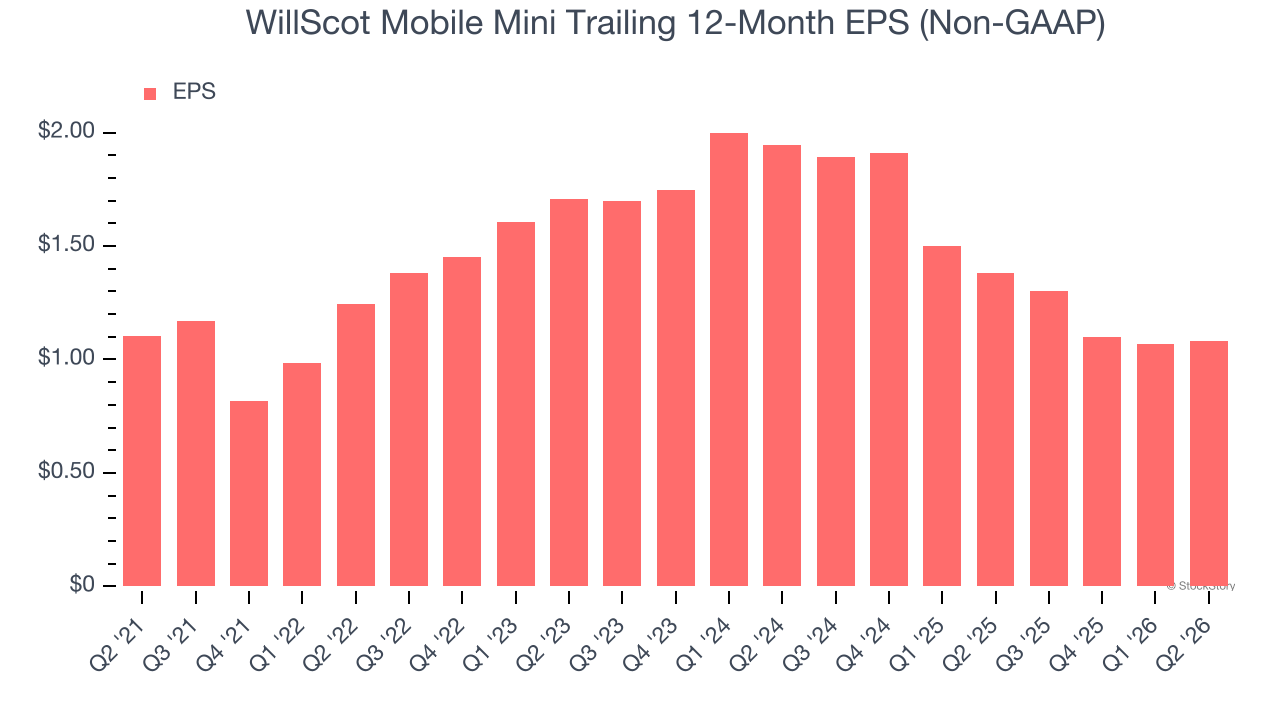
We can take a deeper look into WillScot Mobile Mini’s earnings to better understand the drivers of its performance. As we mentioned earlier, WillScot Mobile Mini’s operating margin declined by 14 percentage points over the last five years. This was the most relevant factor (aside from the revenue impact) behind its lower earnings; interest expenses and taxes can also affect EPS but don’t tell us as much about a company’s fundamentals.
Like with revenue, we analyze EPS over a more recent period because it can provide insight into an emerging theme or development for the business.
For WillScot Mobile Mini, its two-year annual EPS declines of 25.5% show its recent history was to blame for its underperformance over the last five years. These results were bad no matter how you slice the data.
In Q2, WillScot Mobile Mini reported adjusted EPS of $0.28, up from $0.27 in the same quarter last year. This print easily cleared analysts’ estimates, and shareholders should be content with the results. Over the next 12 months, Wall Street expects WillScot Mobile Mini’s full-year EPS to grow 9.7% from $1.08 to $1.18.
Key Takeaways from WillScot Mobile Mini’s Q2 Results
We were impressed by how significantly WillScot Mobile Mini blew past analysts’ revenue expectations this quarter. We were also glad its full-year revenue guidance exceeded Wall Street’s estimates. Overall, we think this was a decent quarter with some key metrics above expectations. The stock traded up 1.5% to $26.21 immediately after reporting.
WillScot Mobile Mini had an encouraging quarter, but one earnings result doesn’t necessarily make the stock a buy. Let’s see if this is a good investment. The latest quarter does matter, but not nearly as much as longer-term fundamentals and valuation, when deciding if the stock is a buy. We cover that in our actionable full research report which you can read here (it’s free).