
Entertainment venue operator Lucky Strike (NYSE: LUCK) fell short of the market’s revenue expectations in Q1 CY2026, with sales flat year on year at $342.2 million. The company’s full-year revenue guidance of $1.26 billion at the midpoint came in 1.5% below analysts’ estimates. Its GAAP profit of $0.10 per share was 45% below analysts’ consensus estimates.
Is now the time to buy Lucky Strike? Find out by accessing our full research report, it’s free.
Lucky Strike (LUCK) Q1 CY2026 Highlights:
- Revenue: $342.2 million vs analyst estimates of $353.9 million (flat year on year, 3.3% miss)
- EPS (GAAP): $0.10 vs analyst expectations of $0.18 (45% miss)
- Adjusted EBITDA: $109 million vs analyst estimates of $121.1 million (31.9% margin, 10% miss)
- The company dropped its revenue guidance for the full year to $1.26 billion at the midpoint from $1.29 billion, a 2.3% decrease
- EBITDA guidance for the full year is $347.5 million at the midpoint, below analyst estimates of $374.1 million
- Operating Margin: 19.2%, in line with the same quarter last year
- Same-Store Sales were flat year on year (-5.6% in the same quarter last year)
- Market Capitalization: $1.07 billion
Company Overview
Born from the transformation of traditional bowling alleys into modern entertainment destinations, Lucky Strike (NYSE: LUCK) operates bowling alleys and other entertainment venues with upscale amenities, arcade games, and food and beverage services across North America.
Revenue Growth
A company’s long-term sales performance can indicate its overall quality. Any business can put up a good quarter or two, but many enduring ones grow for years. Over the last five years, Lucky Strike grew its sales at a 38.1% compounded annual growth rate. Though this growth is acceptable on an absolute basis, we need to see more than just topline growth for the consumer discretionary sector, which can display significant earnings volatility. This means our bar for the sector is particularly high, reflecting the non-essential and hit-driven nature of the products and services offered. Additionally, five-year CAGR starts around Covid, when revenue was depressed then rebounded.
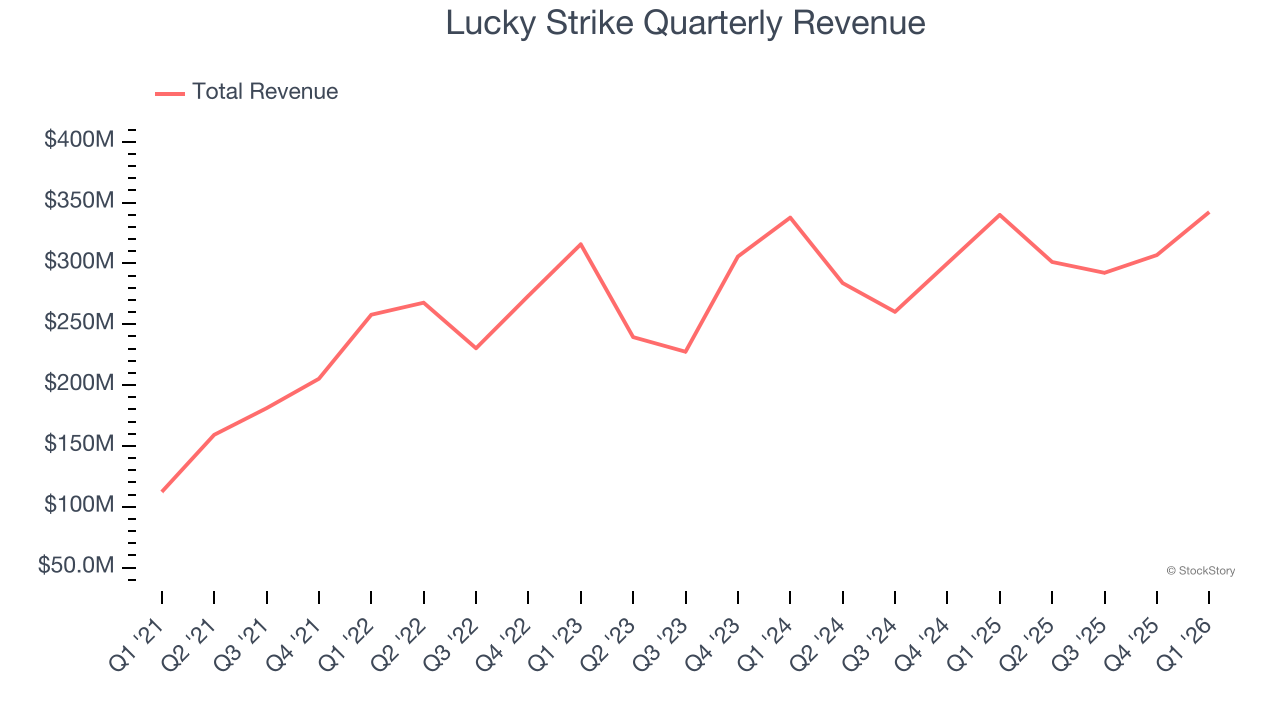
We at StockStory place the most emphasis on long-term growth, but within consumer discretionary, a stretched historical view may miss a company riding a successful new product or trend. Lucky Strike’s recent performance shows its demand has slowed as its annualized revenue growth of 5.8% over the last two years was below its five-year trend. We’re wary when companies in the sector see decelerations in revenue growth, as it could signal changing consumer tastes aided by low switching costs. Note that COVID hurt Lucky Strike’s business in 2020 and part of 2021, and it bounced back in a big way thereafter. 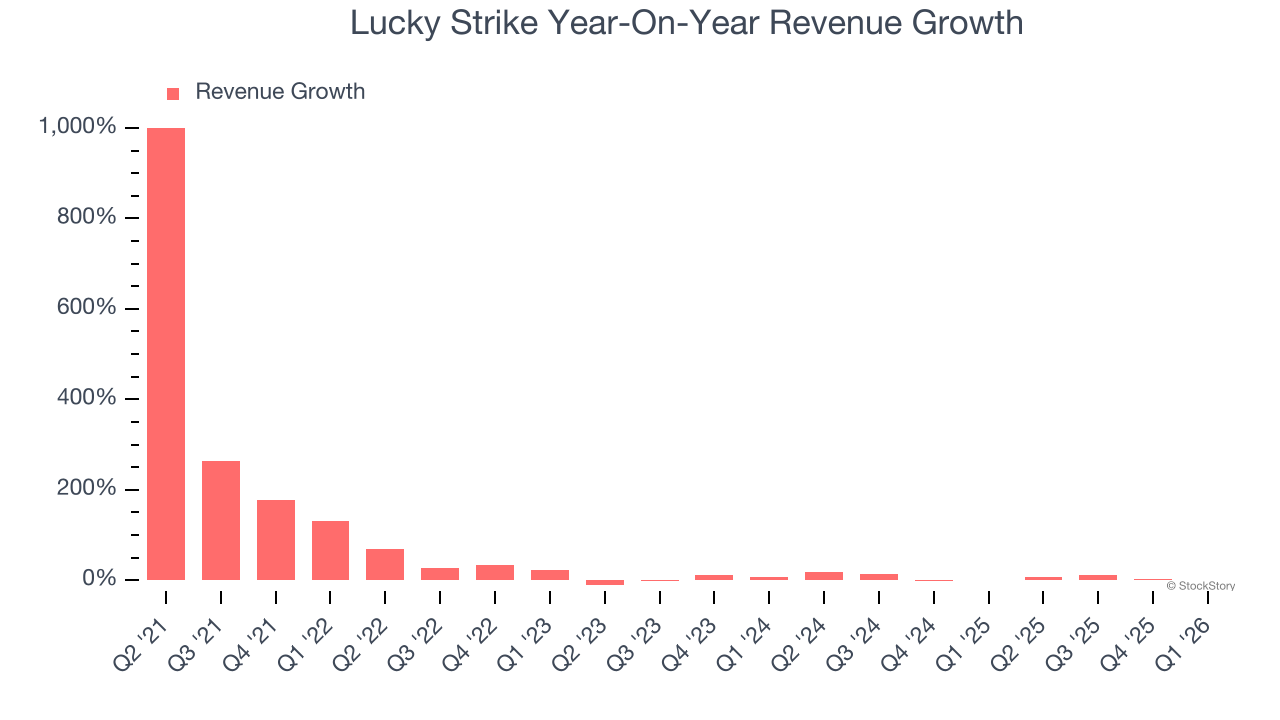
We can dig further into the company’s revenue dynamics by analyzing its same-store sales, which show how much revenue its established locations generate. Over the last two years, Lucky Strike’s same-store sales averaged 1.2% year-on-year declines. Because this number is lower than its revenue growth, we can see the opening of new locations is boosting the company’s top-line performance. 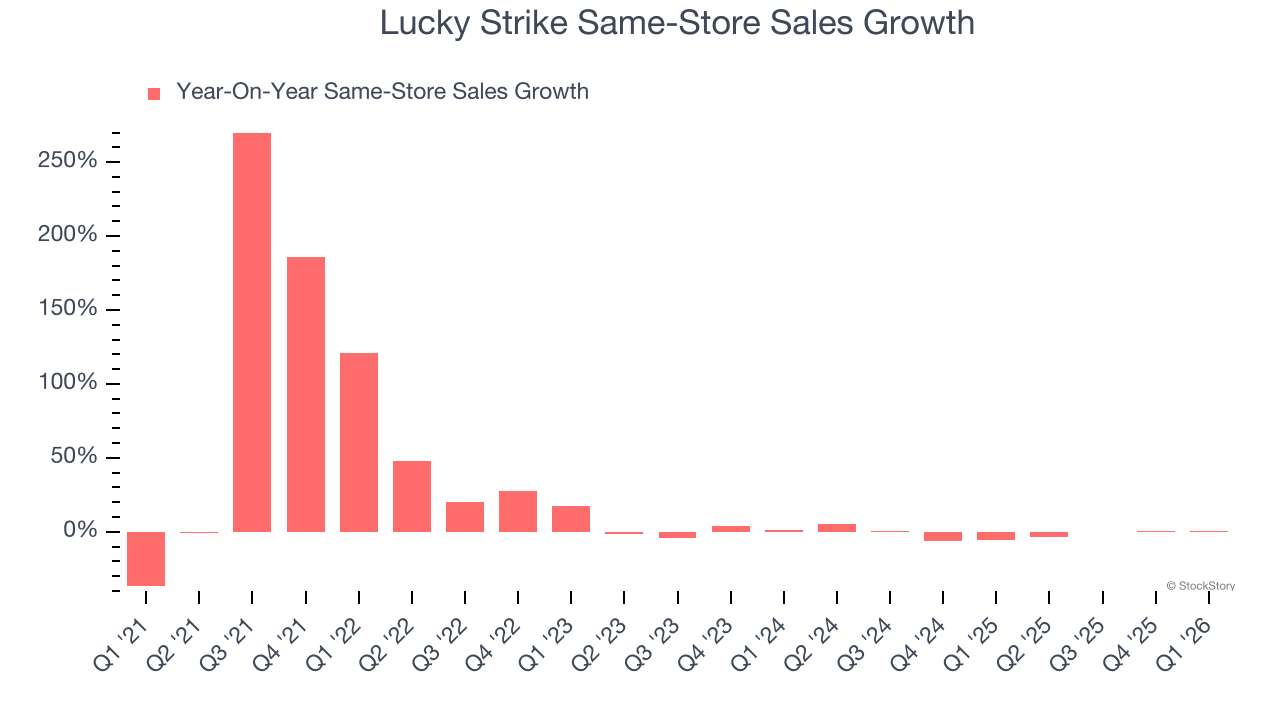
This quarter, Lucky Strike’s $342.2 million of revenue was flat year on year, falling short of Wall Street’s estimates.
Looking ahead, sell-side analysts expect revenue to grow 6.9% over the next 12 months, similar to its two-year rate. While this projection implies its newer products and services will spur better top-line performance, it is still below average for the sector.
ALSO WORTH WATCHING: Nvidia’s Quiet Partner. Nvidia’s chips cost a hundred grand. The connectors that make them work cost even more. One company makes them all.
Every AI server needs specialized infrastructure the chip companies don’t make. High-speed cables. Power connectors. Thermal sensors. This 90-year-old company built a monopoly on it. The AI boom just started. This stock is still flying under the radar. Claim The Stock Ticker Here for FREE.
Operating Margin
Lucky Strike’s operating margin has risen over the last 12 months and averaged 9.5% over the last two years. The company’s higher efficiency is a breath of fresh air, but its suboptimal cost structure means it still sports inadequate profitability for a consumer discretionary business.
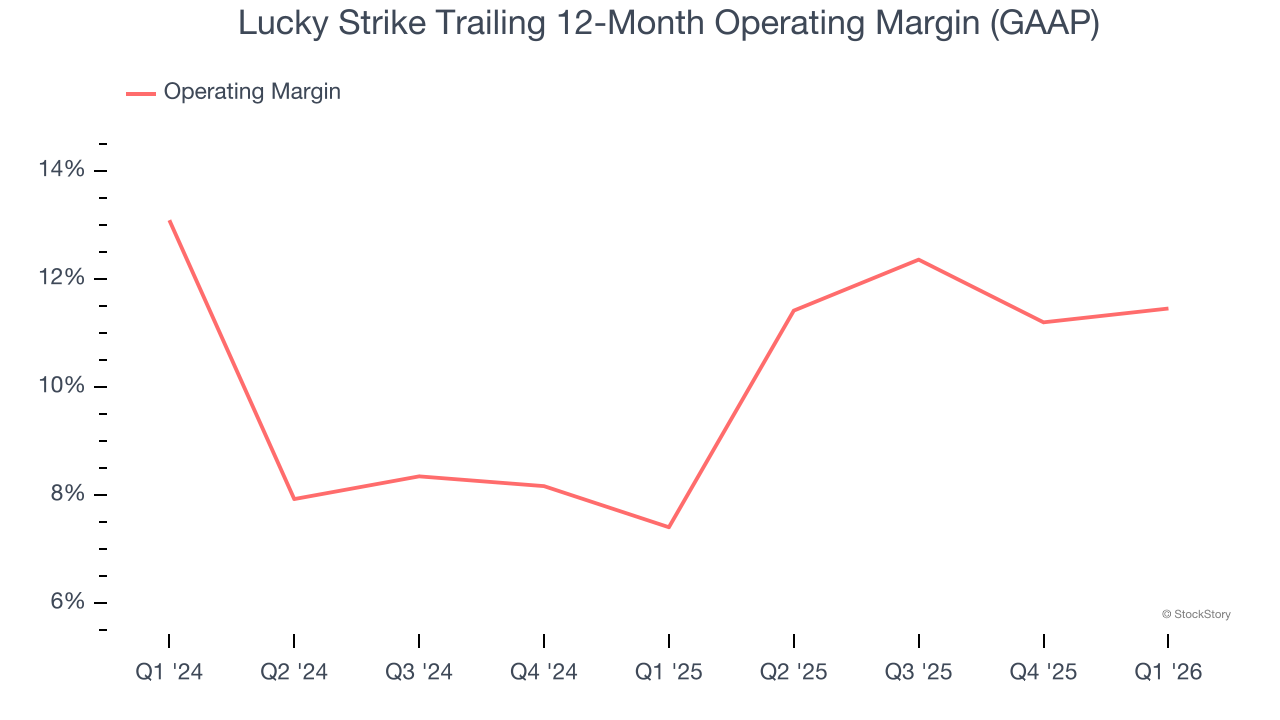
In Q1, Lucky Strike generated an operating margin profit margin of 19.2%, in line with the same quarter last year. This indicates the company’s overall cost structure has been relatively stable.
Earnings Per Share
We track the long-term change in earnings per share (EPS) for the same reason as long-term revenue growth. Compared to revenue, however, EPS highlights whether a company’s growth is profitable.
Although Lucky Strike’s full-year earnings are still negative, it reduced its losses and improved its EPS by 45.1% annually over the last five years. The next few quarters will be critical for assessing its long-term profitability.
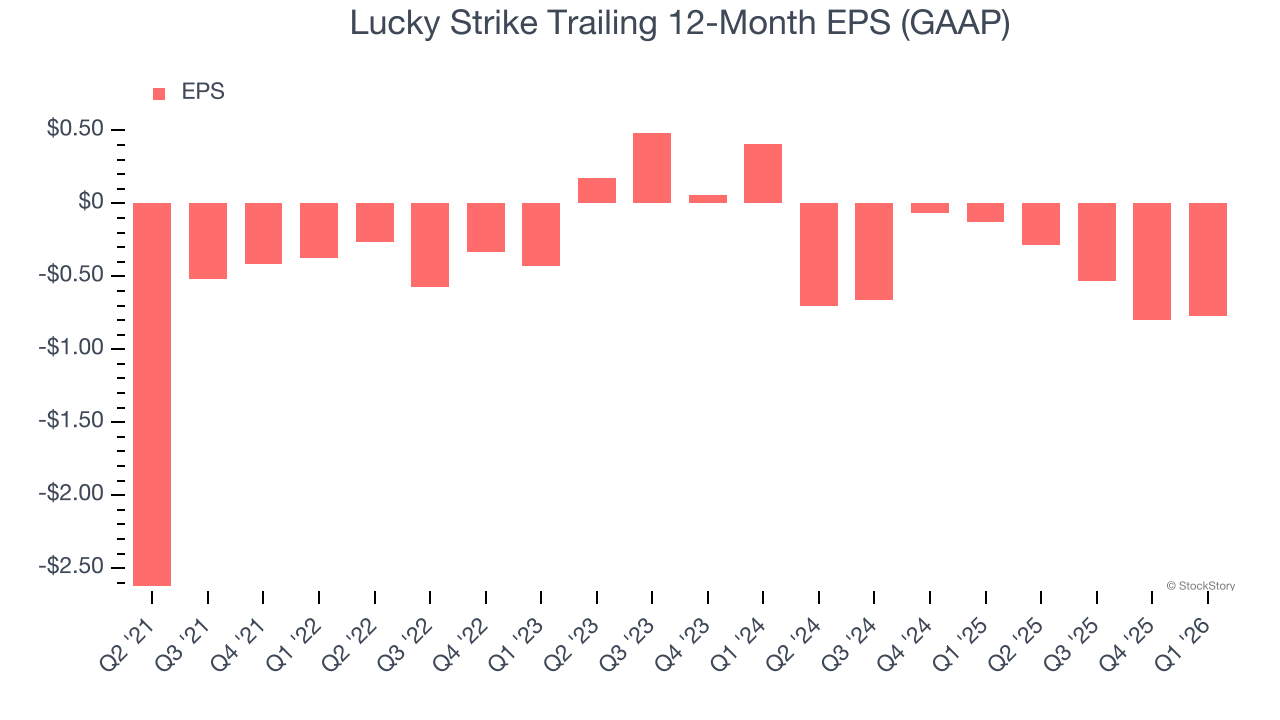
In Q1, Lucky Strike reported EPS of $0.10, up from $0.07 in the same quarter last year. Despite growing year on year, this print missed analysts’ estimates. Over the next 12 months, Wall Street is optimistic. Analysts forecast Lucky Strike’s full-year EPS of negative $0.77 will flip to positive $0.22.
Key Takeaways from Lucky Strike’s Q1 Results
We struggled to find many positives in these results. Its EPS missed and its revenue fell short of Wall Street’s estimates. Overall, this quarter could have been better. The stock traded down 11.4% to $6.86 immediately after reporting.
Lucky Strike didn’t show it’s best hand this quarter, but does that create an opportunity to buy the stock right now? We think that the latest quarter is only one piece of the longer-term business quality puzzle. Quality, when combined with valuation, can help determine if the stock is a buy. We cover that in our actionable full research report which you can read here (it’s free).