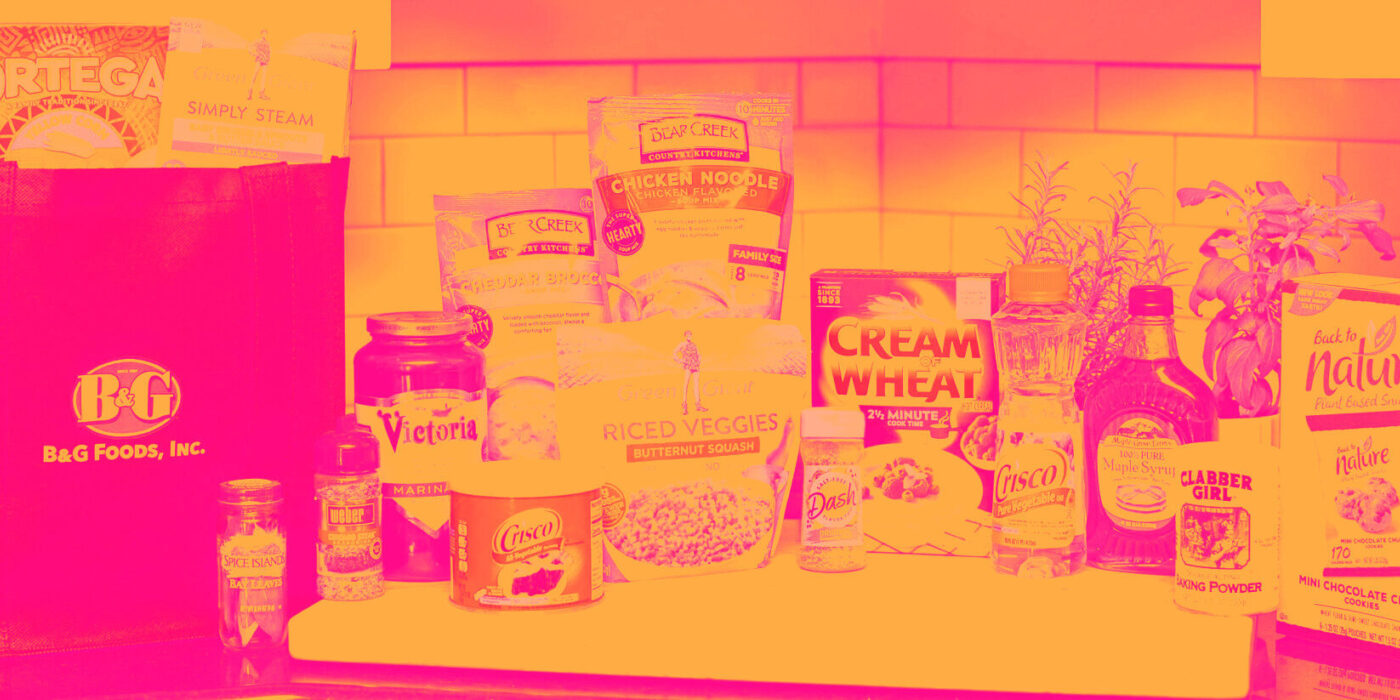
B&G Foods’ first quarter results were shaped by significant portfolio changes and persistent margin pressures, prompting a negative market response. Management attributed the sales decline to the divestiture of Green Giant U.S. Frozen, Don Pepino, and Le Sueur brands, partially offset by gains from Spices & Flavor Solutions and growth in foodservice and private label channels. CEO Kenneth Keller highlighted improved sales volumes and operational efficiency, but also acknowledged that the company’s operating margin contracted sharply as it absorbed costs from both restructuring and commodity inflation. Keller described the quarter as “a strong start for the year against a lower base” and emphasized ongoing efforts to refocus the portfolio and control expenses.
Is now the time to buy BGS? Find out in our full research report (it’s free for active Edge members).
B&G Foods (BGS) Q1 CY2026 Highlights:
- Revenue: $408.9 million vs analyst estimates of $399.4 million (3.9% year-on-year decline, 2.4% beat)
- Adjusted EPS: $0.08 vs analyst estimates of $0.06 (43.7% beat)
- Adjusted EBITDA: $57.65 million vs analyst estimates of $57.67 million (14.1% margin, in line)
- The company lifted its revenue guidance for the full year to $1.76 billion at the midpoint from $1.68 billion, a 4.8% increase
- Management raised its full-year Adjusted EPS guidance to $0.63 at the midpoint, a 4.2% increase
- EBITDA guidance for the full year is $282.5 million at the midpoint, above analyst estimates of $278.7 million
- Operating Margin: -2.7%, down from 8.4% in the same quarter last year
- Sales Volumes were up 1.9% year on year
- Market Capitalization: $332 million
While we enjoy listening to the management's commentary, our favorite part of earnings calls are the analyst questions. Those are unscripted and can often highlight topics that management teams would rather avoid or topics where the answer is complicated. Here is what has caught our attention.
Our Top 5 Analyst Questions From B&G Foods’s Q1 Earnings Call
-
Andrew Lazar (Barclays) asked about the impact of portfolio changes on the outlook and pricing flexibility. CEO Kenneth Keller clarified that only the addition of College Inn and Kitchen Basics affected guidance and stressed that pricing power remains for core brands.
-
Scott Marks (Jefferies) questioned the drivers of flat sales guidance across price, volume, and segment mix. Keller noted stable volumes and channel diversity, but expects less top-line forgiveness versus last year.
-
Robert Moskow (TD Cowen) pressed for details on cost pass-through strategies, especially for soybean oil and logistics. CFO Bruce Wacha said pricing discussions are ongoing for soybean oil, while logistics cost recovery will depend on sustained trends.
-
William Reuter (Bank of America) asked about communication with customers regarding potential price increases. Keller confirmed that soybean oil pricing is routinely discussed, but fuel and packaging cost talks will begin only if trends persist.
-
Carla Casella (JPMorgan) inquired about consumer sensitivity to price thresholds and refinancing plans. Keller explained that the company aims to keep prices below key consumer thresholds and expects to refinance debt well ahead of maturity.
Catalysts in Upcoming Quarters
In the coming quarters, the StockStory team will be watching (1) the integration progress and early performance of College Inn and Kitchen Basics within the B&G Foods portfolio, (2) further reductions in overhead and successful transition of divested Green Giant assets—including the pending Canadian divestiture, and (3) the company’s ability to manage input cost volatility, particularly for soybean oil and transportation. Execution on dividend-funded debt reduction and margin stabilization will also be key indicators of effective strategy.
B&G Foods currently trades at $4.13, down from $5.07 just before the earnings. At this price, is it a buy or sell? The answer lies in our full research report (it’s free).
High-Quality Stocks for All Market Conditions
ONE MORE THING: Top 6 Stocks for This Week. This market is separating quality stocks from expensive ones fast. AI taking down whole sectors with no warning. In a rotation this fast, you need more than a list of good companies.
Our AI system flagged Palantir before it ran 1,662%. AppLovin before it ran 753%. Nvidia before it ran 1,178%. Each week it produces 6 new names that pass the same tests. Get Our Top 6 Stocks for Free HERE.
Stocks that have made our list include now familiar names such as Nvidia (+1,326% between June 2020 and June 2025) as well as under-the-radar businesses like the once-micro-cap company Tecnoglass (+1,754% five-year return). Find your next big winner with StockStory today.