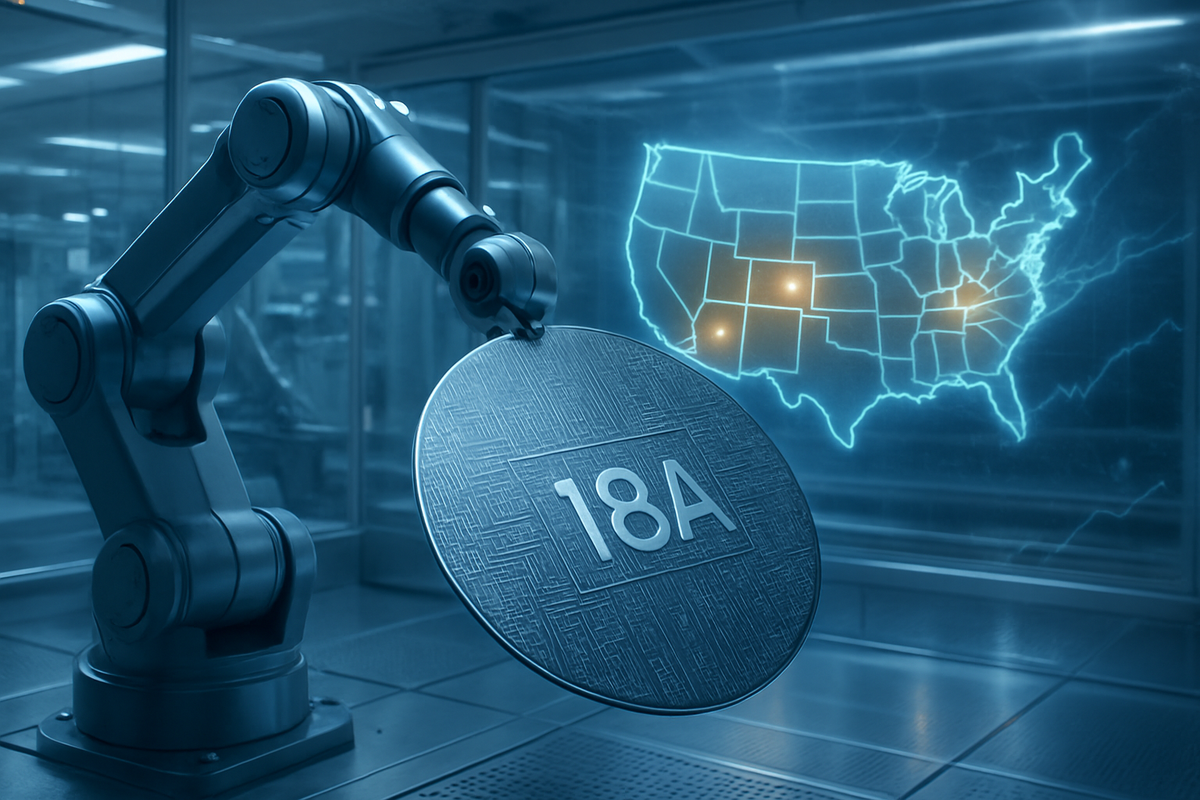
As global equity markets grapple with a surge in geopolitical instability and energy-driven inflation in early 2026, a surprising name has emerged as the semiconductor sector’s most resilient performer: Intel Corporation (NASDAQ: INTC). While high-flying AI favorites of years past have seen their valuations compressed by rising discount rates and regional supply chain shocks, Intel has maintained a steady upward trajectory. On April 7, 2026, Intel opened at $50.78, marking a staggering 159.5% return over the trailing 52 weeks—a far cry from its mid-2024 lows.
The immediate implication of Intel’s relative strength is a fundamental shift in investor sentiment from "growth at any cost" to "resilience at a reasonable price." With new military conflicts in the Middle East threatening energy flows to Asian fabrication hubs and ongoing tensions in the Taiwan Strait, Intel’s massive domestic manufacturing footprint in Arizona and Ohio has transformed the stock into a "safe haven" for institutional capital. For the first time in over a decade, Intel is being traded not as a legacy laggard, but as a critical piece of Western national security infrastructure.
The 18A Breakthrough and the Path to Parity
The primary catalyst for Intel’s recent gains is the successful deployment of its 18A (1.8nm-class) process node, which officially entered high-volume manufacturing (HVM) in January 2026. This milestone represents the culmination of CEO Pat Gelsinger’s "five nodes in four years" strategy, effectively ending the company’s decade-long struggle to keep pace with foreign rivals. The 18A node introduces RibbonFET architecture and PowerVia backside power delivery—technologies that have allowed Intel to reclaim the lead in transistor density and energy efficiency.
The timeline leading to this moment was fraught with skepticism. In late 2024 and throughout 2025, Intel faced razor-thin margins as it poured tens of billions into capital expenditures. However, the tide turned in August 2025 when the U.S. government, under the provisions of the CHIPS Act, converted several billion dollars in grants into a 9.9% equity stake in the company. This "nationalization-lite" move provided a valuation floor and signaled to the market that the success of Intel was now a matter of federal policy. With the opening of Fab 52 in Arizona earlier this year, Intel began churning out its "Panther Lake" consumer chips and "Clearwater Forest" server processors, both of which have received rave reviews for matching or exceeding the performance-per-watt of comparable products from competitors.
Winners and Losers in the New Silicon Order
The biggest winner in this shift is undeniably Intel itself, but the ripples extend across the industry. NVIDIA Corporation (NASDAQ: NVDA), despite being a traditional rival, has emerged as a strategic partner; the company made a headline-grabbing $5 billion investment in Intel Foundry services in early 2026 to secure future 18A capacity. This "coopetition" ensures that NVIDIA remains insulated from potential disruptions in Taiwan, while Intel gains a massive, high-margin customer for its fabrication plants. Microsoft Corporation (NASDAQ: MSFT) and Amazon.com, Inc. (NASDAQ: AMZN) have also deepened their ties with Intel, utilizing the "Systems Foundry" model to design custom AI silicon that is manufactured entirely within the United States.
Conversely, the landscape has become significantly more challenging for Taiwan Semiconductor Manufacturing Company (NYSE: TSM). While TSM remains the world’s most advanced pure-play foundry, its heavy concentration of assets in a geopolitically sensitive region has led to a "risk premium" being baked into its stock price. Similarly, Advanced Micro Devices, Inc. (NASDAQ: AMD) has found itself in a defensive posture. After years of gaining market share during Intel’s manufacturing slump, AMD is now facing a revitalized Intel that can match its architectural gains with superior supply chain control. While AMD’s EPYC server chips remain highly competitive, the sheer volume of Intel’s domestic capacity is beginning to tilt the procurement scales of large-scale cloud providers back toward the incumbent.
Sovereignty over Scarcity: The Wider Significance
Intel’s resurgence fits into a broader global trend of "Sovereign Silicon," where nation-states view semiconductor manufacturing as a strategic resource on par with oil or food. The recent energy crisis in the Middle East, which has disrupted shipping lanes and inflated the cost of running fabrication plants in East Asia, has underscored the importance of Intel’s geographical diversification. Unlike its competitors, who are largely reliant on the stability of a single region, Intel’s distributed network of fabs across the U.S. and Europe provides a buffer against the localized shocks that have characterized the 2026 market.
This event also signals a transition in the AI narrative. While 2023 and 2024 were dominated by "AI Training" and the dominance of massive GPU clusters, 2026 has become the year of the "AI PC" and "AI Inference." Intel’s dominance in the x86 ecosystem has allowed it to capture over 50% of the emerging AI PC market, as developers prioritize hardware that can run AI models locally and securely. Historically, whenever a major platform shift occurs—from mainframe to PC, or PC to mobile—the winner is often the company that controls the most reliable supply chain. Intel’s current performance suggests it is successfully applying this historical precedent to the AI era.
The Road Ahead: Yields and Beyond
In the short term, investors will be closely monitoring Intel’s 18A yields. While currently estimated to be in the 65% to 75% range, the company needs to hit an 80% target to achieve full foundry profitability and justify its current valuation. Management has guided for a significant ramp in the second half of 2026, which will be the ultimate test of the company’s manufacturing prowess. Any delays in yield improvements could temporarily stall the stock’s momentum, particularly if energy costs continue to pressure the operational margins of its domestic fabs.
Looking further ahead, the long-term success of Intel will depend on its ability to transition from a "product-first" company to a "foundry-first" organization. This pivot requires a cultural shift and a level of customer service that Intel has historically lacked. However, the emergence of the "Systems Foundry" model—where Intel provides not just chips, but the advanced packaging and software layers—offers a high-barrier-to-entry moat. If Intel can successfully onboard more "Big Tech" firms for their custom 1.8nm and 1.4nm designs over the next 24 months, it may well solidify its position as the undisputed backbone of the Western technology sector.
A Summary of the Silicon Rebirth
Intel’s relative strength in a volatile 2026 market is the result of a perfectly timed confluence of manufacturing execution and geopolitical necessity. The 18A node has restored its technical credibility, while the support of the U.S. government has provided a level of financial stability that its pure-play rivals cannot match. The core takeaway for the market is that Intel is no longer just a chipmaker; it is a critical infrastructure provider for the digital age.
Moving forward, the semiconductor market is likely to remain bifurcated between companies with geographic risk and those with domestic resilience. Investors should watch for further partnership announcements between Intel and other "Fabless" giants, as well as any updates on the progress of its next-generation 14A node. While risks remain—including the immense capital intensity of the foundry business—Intel’s performance in early 2026 suggests that the "Silicon Giant" has finally found its footing in the new global order.
This content is intended for informational purposes only and is not financial advice