
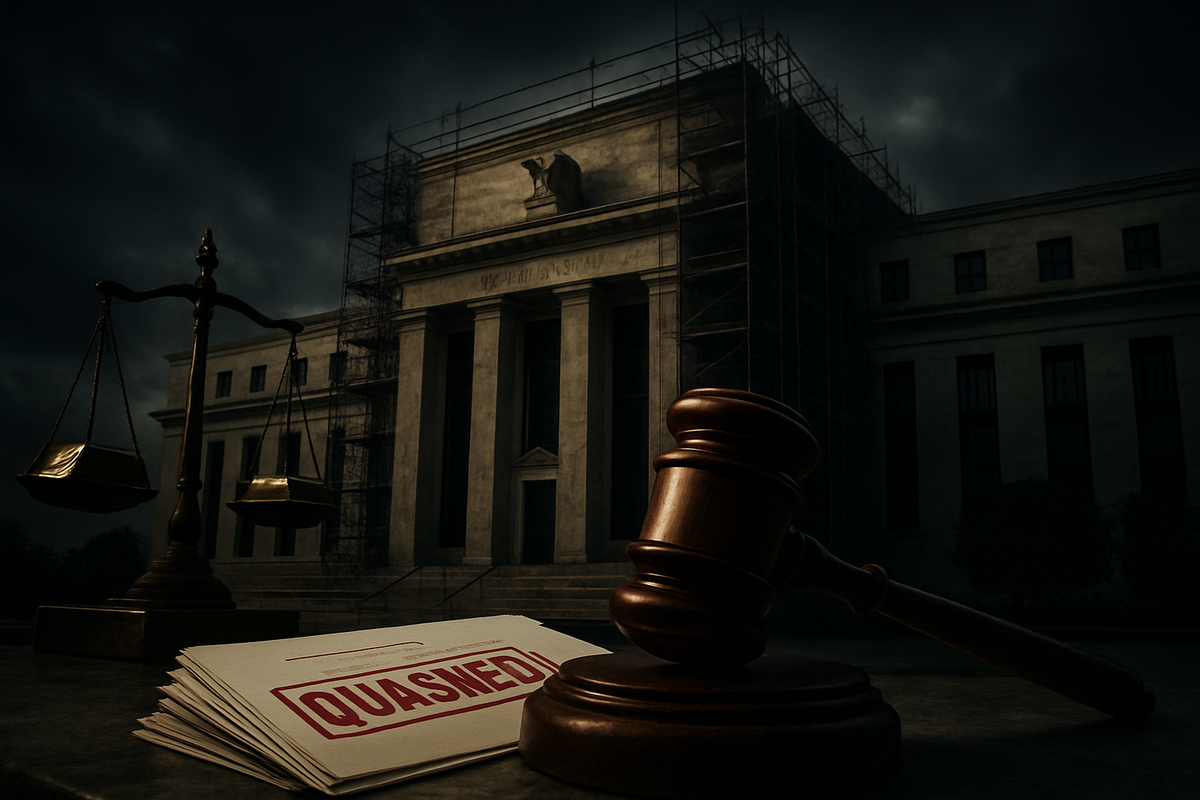
In a stinging defeat for the Department of Justice, Chief U.S. District Judge James Boasberg has quashed a series of grand jury subpoenas aimed at Federal Reserve Chair Jerome Powell, describing the ongoing criminal investigation as a "pretextual" attempt to undermine the independence of the central bank. The ruling, delivered late last week and reaffirmed in a final order on April 3, 2026, marks a pivotal moment in a months-long campaign led by U.S. Attorney Jeanine Pirro to hold the Fed Chair accountable for alleged financial mismanagement and misleading testimony regarding a multi-billion dollar renovation project.
The immediate implications of Judge Boasberg’s decision have sent ripples through both Pennsylvania Avenue and Wall Street. By explicitly labeling the DOJ’s probe as an effort to pressure the Federal Reserve into lowering interest rates, the court has effectively drawn a line in the sand for executive overreach. However, the standoff is far from over; as of today, April 15, 2026, federal investigators are reportedly continuing to seek alternative routes to scrutinize the Fed's operations, leading to a period of unprecedented institutional instability that has investors bracing for further volatility.
A Timeline of Confrontation: From Construction Costs to Criminal Contempt
The seeds of this legal firestorm were sown in June 2025, when Chair Jerome Powell testified before Congress regarding the $2.5 billion renovation of the Federal Reserve’s Washington, D.C. headquarters, specifically the Marriner S. Eccles Building and the FRB-East expansion. Following reports of an 80% cost overrun and allegations of bypassed federal approvals, the Department of Justice, under the aggressive direction of U.S. Attorney Jeanine Pirro, launched a criminal probe. Pirro alleged that Powell provided "questionable statements" to lawmakers to hide the true scale of the fiscal mismanagement, eventually escalating the inquiry into a grand jury investigation.
The conflict reached a fever pitch in March 2026, when Judge Boasberg first intervened to block subpoenas for Powell’s personal and professional records. In his blistering 24-page opinion, Boasberg noted that the government had produced "essentially zero evidence" of a crime, concluding that the investigation's "dominant purpose" was to harass the Fed Chair into a policy pivot or resignation. The tension was further exacerbated on April 14, 2026—just yesterday—when investigators from Pirro’s office attempted a "surprise visit" to the Fed’s construction site but were forcibly turned away by security, a move the Fed's legal counsel, Robert Hur, described as a "theatrical circumvention" of the court’s authority.
Initially, the markets reacted with visible distress to the prospect of a sitting Fed Chair facing criminal indictment. When the subpoenas were first announced in early 2026, the Dow Jones Industrial Average plummeted, and the Financial Select Sector SPDR Fund (NYSE: XLF) saw one of its worst weekly performances in years. Market participants have largely interpreted the DOJ's moves not as a quest for justice, but as a direct assault on the monetary policy independence that has anchored the U.S. economy for decades.
Market Fallout: Winners and Losers in the "Midas Shock"
The primary casualties of this institutional warfare have been the nation’s largest financial institutions. Major commercial banks, already navigating a complex interest rate environment, have seen their "stability premium" evaporate. Shares of JPMorgan Chase & Co. (NYSE: JPM) and Bank of America Corp. (NYSE: BAC) have traded under heavy pressure, with analysts citing the "politicization of the Fed" as a primary risk factor. Similarly, Citigroup Inc. (NYSE: C) and The Goldman Sachs Group, Inc. (NYSE: GS) have faced increased volatility, as the prospect of a leadership vacuum at the Fed threatens to de-anchor inflation expectations and disrupt the primary dealer system.
On the other side of the ledger, the chaos has been a boon for "hard assets" and safe havens. As the U.S. Dollar Index (DXY) weakened under the weight of the constitutional crisis, gold prices surged to record highs. This "Midas Shock" has significantly benefited precious metal producers like Newmont Corp (NYSE: NEM) and Barrick Gold Corp (NYSE: GOLD), both of which have seen their valuations climb as investors flee dollar-denominated assets. The SPDR Gold Shares (NYSE: GLD) has recorded historic inflows, serving as a primary refuge for those betting against a swift resolution to the DOJ-Fed impasse.
Even the construction sector has felt the heat. The primary firms involved in the controversial $2.5 billion renovation, including architectural giant Arcadis NV (OTC: ARCADY) and construction leader Balfour Beatty plc (OTC: BAFYY), have found themselves under the magnifying glass of federal auditors. While these companies are not the targets of the criminal probe, the intense scrutiny on their contracts and the potential for project halts has introduced a layer of regulatory risk that has tempered investor enthusiasm for large-scale federal infrastructure projects.
Analyzing the Precedent: A Threat to the "Volcker Independence"
The current crisis represents a departure from nearly half a century of precedent regarding the autonomy of the central bank. Historically, while presidents from Lyndon Johnson to Donald Trump have publicly critiqued Fed policy, the use of the Department of Justice to launch a criminal probe into a sitting Chair is a "nuclear option" previously unseen in American history. Scholars are already comparing the current era to the 1980s under Paul Volcker, though they note that Volcker faced political pressure, not the threat of a jail cell.
The wider significance of Judge Boasberg’s ruling cannot be overstated. By calling the probe a "pretext," the judiciary has positioned itself as the final arbiter of Fed independence. This sets a significant legal precedent: future administrations may find it significantly harder to use criminal investigators to influence monetary policy. However, the ripple effects are damaging. Global partners and central banks, such as the ECB and the Bank of Japan, are watching the erosion of the Fed's "neutral" status with alarm, which could eventually threaten the U.S. dollar’s role as the global reserve currency if the DOJ continues to pursue Powell.
Furthermore, the involvement of U.S. Attorney Jeanine Pirro has introduced a new level of volatility. Her public characterization of Judge Boasberg as an "activist judge" suggests a breakdown in the traditional professional decorum between the DOJ and the federal bench. This breakdown signals a broader trend toward the weaponization of administrative and legal tools for political ends, a shift that may outlast the current investigation regardless of its ultimate legal outcome.
The Road Ahead: Deadlock and Defiance
What comes next for Jerome Powell and the Fed depends largely on the Senate's stomach for a fight. The investigation has already created a legislative logjam; Senator Thom Tillis has vowed to block the confirmation of Kevin Warsh, the White House's nominee to succeed Powell when his term expires in May 2026, until the DOJ probe is officially shuttered. Powell himself has remained defiant, stating he will not resign under the cloud of a "sham" investigation, effectively daring the administration to attempt to remove him for cause—a move that would trigger an even larger Supreme Court battle.
In the short term, investors should prepare for a "war of attrition" between the DOJ and the Federal Reserve Board. While Judge Boasberg has quashed the subpoenas, Jeanine Pirro’s office is expected to appeal the ruling to the D.C. Circuit Court of Appeals. Should the appellate court overturn Boasberg's decision, the resulting document dump could provide more fuel for the fire, even if no crime was committed. Conversely, if the ruling stands, the DOJ may be forced to pivot to a narrower, less impactful administrative inquiry, potentially allowing markets to stabilize.
Market opportunities may emerge in the form of "independence plays." If Powell successfully fends off the DOJ and remains in his seat through May, a relief rally in the financial sector (XLF) is highly likely. However, the long-term challenge remains: the Fed's aura of invincibility has been pierced. Even a total victory for Powell in court cannot fully erase the memory of federal agents attempting to raid the Fed's campus, a fact that will likely keep a "risk premium" baked into U.S. Treasuries for the foreseeable future.
Conclusion: Watching the Watchers
The DOJ’s criminal investigation into Jerome Powell has evolved into a quintessential battle for the soul of the American regulatory state. Judge Boasberg’s decision to quash the subpoenas offers a temporary reprieve for the Fed, but the underlying tensions remain unresolved. The core takeaway for the market is that the boundaries of central bank independence are being redrawn in real-time, and the old rules of engagement no longer apply.
As we move forward through the spring of 2026, the assessment of the market is one of "cautious pessimism" regarding institutional stability. The lasting impact of this event is the normalization of using the legal system to challenge monetary policy, a precedent that will likely haunt future Fed Chairs regardless of their political affiliation. Investors should watch for the D.C. Circuit’s response to the DOJ’s appeal and any shifts in the Senate confirmation battle for Kevin Warsh as the next major catalysts.
In a world where the Federal Reserve is no longer viewed as a neutral arbiter, but as a political target, the traditional "Fed Put" may be replaced by a "Political Discount." For now, all eyes remain on the Eccles Building, where Jerome Powell continues to manage the nation’s economy while simultaneously fighting for his professional survival and the very concept of an independent central bank.
This content is intended for informational purposes only and is not financial advice.