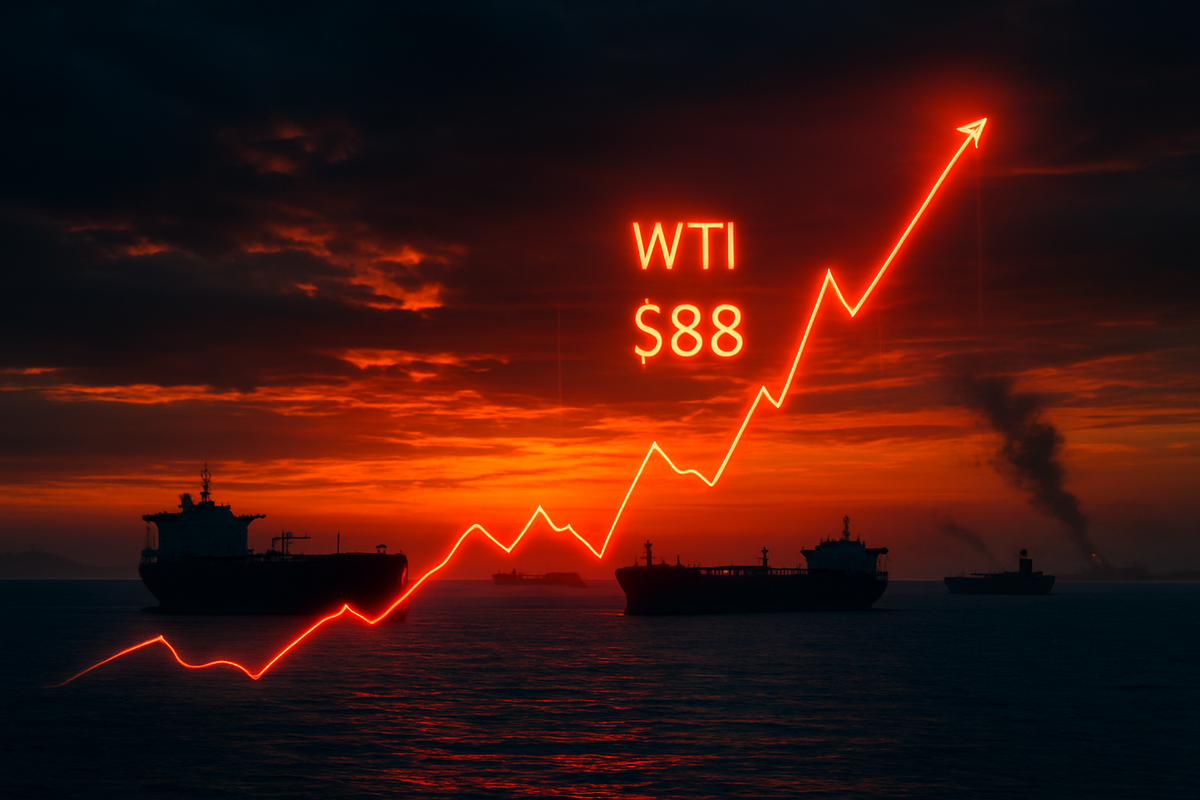
Global energy markets are reeling as the military confrontation between a U.S.-led coalition and Iran enters its second week, sending shockwaves through every major financial exchange. West Texas Intermediate (WTI) crude oil futures surged 6.7% this week, settling near $88 per barrel, as traders price in the highest geopolitical risk premium seen in years. The spike follows a series of retaliatory strikes that have effectively paralyzed the Strait of Hormuz, a vital artery for nearly 20% of the world’s oil supply, raising fears of a prolonged global energy shortage.
The immediate implications are stark: gasoline prices at the pump are already climbing toward multi-year highs, and the specter of "sticky" inflation has returned to haunt central banks just as they were preparing for a cycle of interest rate cuts. With President Donald Trump issuing a fiery demand for Iran’s "unconditional surrender," the diplomatic path to de-escalation appears increasingly narrow, leaving the market to brace for the possibility of oil prices reaching triple digits for the first time since 2022.
A Week of Fire and Force Majeure
The current crisis began on February 28, 2026, with Operation Epic Fury—a coordinated series of U.S. and Israeli airstrikes targeting Iranian nuclear facilities and missile infrastructure. As the conflict entered its seventh day on March 6, the scope of the battle expanded from military targets to the very foundation of the global energy grid. Iran responded to the initial strikes with "swarm" drone attacks and ballistic missile barrages aimed at American bases and oil infrastructure across the Gulf, including critical facilities in Saudi Arabia and the UAE.
The most crippling blow to the market has been the functional closure of the Strait of Hormuz. Tanker traffic has collapsed by more than 90% as insurance premiums for the region reached "war-risk" levels, effectively making commercial transit impossible. This maritime blockade has created an unprecedented storage crisis in the Gulf. Nations like Kuwait and Iraq have already begun shutting down oil fields because they have no way to export their crude and have reached the limits of their onshore storage capacity.
On March 6, President Donald Trump fundamentally altered the geopolitical stakes via a post on Truth Social, declaring that the United States would accept nothing less than the "unconditional surrender" of the Iranian leadership. This hardline stance, which explicitly rejects a negotiated settlement, signals a goal of regime change. Market participants reacted with immediate volatility; WTI futures saw an intraday peak of $89.62 shortly after the President's statement, as investors realized that a quick diplomatic off-ramp was no longer on the table.
Market Winners and Losers: The Energy and Defense Surge
The surge in oil prices has created a stark divide in the equity markets, with the energy and defense sectors seeing historic gains. Occidental Petroleum (NYSE: OXY) has emerged as one of the primary beneficiaries, with its stock jumping over 6% this week. Because Occidental has a high concentration of upstream production assets in the United States, it is uniquely positioned to benefit from higher prices without the immediate geographic risks associated with Middle Eastern operations.
Integrated oil giants have also seen significant tailwinds. ExxonMobil (NYSE: XOM) rose 4.5% to hit $149.82, as its diversified refining and production portfolio captured massive "crack spreads." Similarly, Chevron (NYSE: CVX) reached an all-time record high of nearly $190 on March 2. Analysts from major investment banks are treating these companies as "safe-haven" energy plays, as their production in the Permian Basin and Guyana provides a buffer against the chaos in the Persian Gulf.
Conversely, the aviation and logistics sectors are facing a "perfect storm" of rising costs and restricted routes. United Airlines (NASDAQ: UAL) fell 5.8% this week, hit hard by its exposure to Middle Eastern routes and the sudden spike in jet fuel costs. Delta Air Lines (NYSE: DAL) also saw its shares decline by 5.1% as investors feared that sustained energy costs would destroy consumer demand for international travel. Global shipping titan A.P. Møller – Mærsk A/S (CPH: MAERSK-B) has been forced to reroute vessels around the Cape of Good Hope, adding weeks to transit times and significantly increasing operational overhead.
Wider Significance and Historical Echoes
The current conflict is reshaping the global economic outlook for 2026. Analysts at Goldman Sachs and JPMorgan have warned that if oil prices sustain these levels, it could ignite a new "inflation shock" that would force the Federal Reserve to pivot away from its planned rate-cutting cycle. This risk-off sentiment is already visible in other asset classes; gold prices have surged past a staggering $5,100 an ounce, reflecting deep-seated fears of a wider regional war.
This event bears a chilling resemblance to the oil shocks of the 1970s, but with a modern twist. In the 20th century, the U.S. was far more dependent on foreign oil; today, while the U.S. is a major producer, the global nature of oil pricing means that a shutdown in the Gulf still impacts American consumers directly. Furthermore, the aggressive rhetoric from the White House regarding "unconditional surrender" marks a departure from the "containment" strategies of previous administrations, suggesting a new era of high-stakes, zero-sum geopolitics.
The regulatory implications are also mounting. Governments in Europe and Asia are already discussing the release of emergency strategic petroleum reserves. However, the International Energy Agency (IEA) has cautioned that the scale of the Gulf disruption—approximately 20 million barrels per day—far exceeds the capacity of strategic stockpiles to mitigate for more than a few weeks. This is likely to accelerate legislative efforts to fast-track alternative energy sources and domestic drilling permits in non-conflict zones.
What Comes Next: Scenarios and Strategic Pivots
In the short term, the market will remain hyper-sensitive to any news regarding the Strait of Hormuz. If Iran successfully deploys sea mines or advanced anti-ship missiles that further prolong the blockade, some analysts predict oil could reach $150 per barrel by the end of the month. This would likely trigger a global recession, as energy costs would siphon off disposable income from consumers in every major economy.
Longer-term, a "strategic pivot" is expected from both public and private sectors. Energy companies may accelerate their investments in "friend-shoring"—developing assets in politically stable regions like Brazil, Canada, and the U.S. shale patch. For the defense sector, companies like Lockheed Martin (NYSE: LMT) and RTX Corporation (NYSE: RTX)—both of which saw 6–7% gains this week—are likely to see a multi-year surge in orders as the U.S. and its allies replenish munitions used in the early stages of this conflict.
The most critical scenario to watch is the domestic political fallout in the United States. With the 2026 midterm elections approaching in November, the Trump administration’s ability to manage gasoline prices while maintaining a hardline stance on Iran will be the ultimate test of its policy. If the "surrender" demand does not lead to a swift collapse of the Iranian regime, the administration may face intense pressure to negotiate or risk a voter backlash over the soaring cost of living.
Conclusion: A Turning Point for Global Energy
The surge in oil to $88 and the intensifying conflict with Iran represent a watershed moment for the global economy in 2026. The initial market reaction—a flight to energy and defense stocks coupled with a sell-off in transportation—is only the beginning of a larger realignment. The closure of the Strait of Hormuz has exposed the lingering fragility of global energy security, proving that even in an era of diversified production, the Persian Gulf remains the world’s most volatile chokepoint.
Moving forward, the market will likely experience heightened volatility until there is clarity on the duration of the conflict. Investors should closely monitor satellite data for signs of renewed tanker traffic and pay attention to the rhetoric from other OPEC members. If the blockade remains in place, the "war risk premium" currently baked into oil prices will only grow, potentially reshaping the economic landscape for the remainder of the decade.
The key takeaway for the months ahead is that the era of "cheap energy" has once again been interrupted by the harsh realities of geopolitics. Whether this leads to a permanent shift in energy policy or a temporary spike remains to be seen, but the events of early March 2026 have ensured that the energy sector will remain the focal point of the global financial narrative for the foreseeable future.
This content is intended for informational purposes only and is not financial advice.