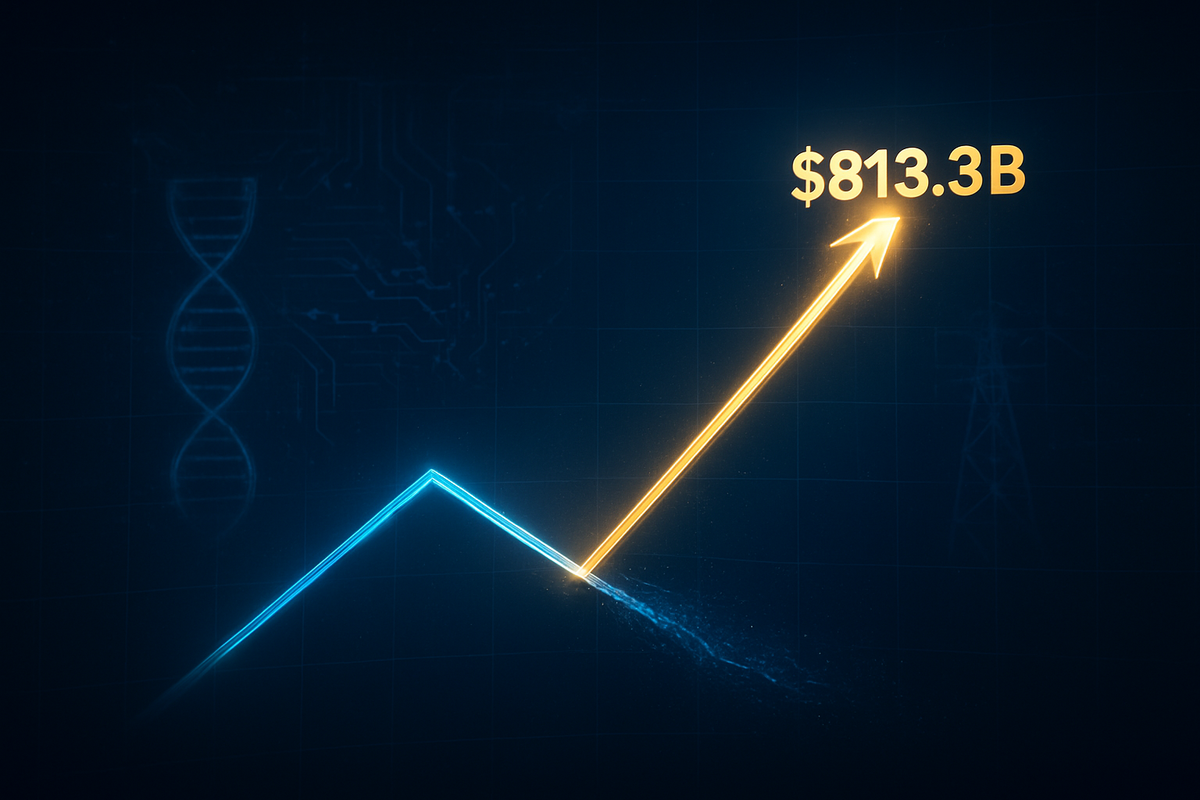
As the first quarter of 2026 draws to a close, the global mergers and acquisitions (M&A) market has delivered a paradox that is reshaping the financial landscape. Preliminary data reveals that total deal values surged to a record-breaking $813.3 billion in Q1, a staggering leap that signals a return to the era of the "Megadeal." However, beneath this headline-grabbing figure lies a sobering reality for many: deal volume—the actual number of transactions—has continued its two-year decline.
This "K-shaped" recovery is creating a market of two halves. On the upper arm of the K, a handful of corporate titans are executing massive, industry-altering consolidations in the Technology, Healthcare, and Energy sectors, fueled by stabilized interest rates and a newfound regulatory pragmatism. On the lower arm, mid-market activity remains sluggish, as smaller firms struggle with a higher cost of capital and a "valuation gap" that has yet to fully close. The result is a concentration of capital and corporate power unseen since the pre-inflationary peaks of 2021.
The Return of the Blockbuster: How We Got Here
The journey to this $813.3 billion record began with the stagnation of 2024. Following the "deal drought" of 2023, where high interest rates and aggressive antitrust litigation by the FTC and DOJ chilled boardrooms, a series of catalysts converged in late 2025 to break the ice. The most significant of these was the "One Big Beautiful Bill Act" (OBBBA), signed in July 2025, which restored 100% bonus depreciation and allowed interest deductions to be calculated based on EBITDA rather than the more restrictive EBIT. This tax shift fundamentally improved the math for large-scale leveraged transactions.
In the first three months of 2026 alone, several "once-in-a-generation" deals have dominated the tape. The centerpiece was the massive $111 billion acquisition of Warner Bros. Discovery (NASDAQ: WBD) by a combined Paramount Global (NASDAQ: PARA) and Skydance Media entity. This deal, aimed at creating a domestic content powerhouse to rival "Trillion-Dollar Tech," would have been unthinkable under previous regulatory regimes. Similarly, in the industrial space, Union Pacific (NYSE: UNP) made shockwaves with an $85 billion bid for Norfolk Southern (NYSE: NSC), a move toward creating the first truly transcontinental American railroad.
The energy sector has been equally aggressive, driven by the "AI-Energy Nexus." As data centers for Artificial General Intelligence (AGI) demand unprecedented amounts of power, firms like Devon Energy (NYSE: DVN) and Coterra Energy (NYSE: CTRA) announced a $58 billion merger in January to secure long-term shale assets. These megadeals are not just about growth; they are defensive maneuvers designed to secure infrastructure and scale in an increasingly volatile global economy.
Winners and Losers in the New Consolidation Era
The primary winners in this K-shaped environment are the "Bulge Bracket" investment banks and the dominant large-cap strategics. Companies like Goldman Sachs (NYSE: GS) and Morgan Stanley (NYSE: MS), which thrive on the high fees of multi-billion dollar advisory roles, are seeing their best quarter in years. For the strategics, the current environment allows them to gobble up market share and essential technology while mid-sized competitors are sidelined by financing hurdles.
In the healthcare sector, Abbott Laboratories (NYSE: ABT) and Eli Lilly (NYSE: LLY) have emerged as aggressive victors. Abbott’s $21 billion acquisition of Exact Sciences (NASDAQ: EXAS) in February highlights the trend of "Scale over Spark," as major pharmaceutical and med-tech firms move to offset the "2026 Patent Cliff." By acquiring late-stage clinical assets and established diagnostics platforms, these giants are ensuring cash flow stability even as older blockbuster drugs lose exclusivity.
Conversely, the "losers" of this cycle are the mid-market firms and small-cap innovators. With capital concentrated at the top, many startups that would traditionally have been acquired for $100 million to $500 million are finding the "M&A exit" closed. Private equity firms, while sitting on over $2 trillion in "dry powder," are increasingly ignoring the small-fry deals in favor of massive takeprivates. Furthermore, the "energy shock" caused by the recent Iran War has driven oil prices to $120 per barrel, squeezing the margins of non-energy-independent firms and making them less attractive targets for anyone without a massive balance sheet.
Regulatory Thaw and the AI-Energy Supercycle
The wider significance of the Q1 2026 surge cannot be overstated. It marks a definitive pivot in the regulatory philosophy of the United States. Following the appointment of Andrew Ferguson as FTC Chairman in 2025, the commission has shifted away from the "litigate everything" strategy of the early 2020s. The new "Remedy-First" approach allows companies like Microsoft (NASDAQ: MSFT) and Alphabet (NASDAQ: GOOGL) to pursue major infrastructure acquisitions provided they agree to specific divestitures. This pragmatism has cleared the way for the "AI Infrastructure Supercycle," an estimated $5 trillion investment wave that is merging the tech and utility sectors.
This trend is also visible in the consumer space. The $48.7 billion acquisition of Kenvue (NYSE: KVUE) by Kimberly-Clark (NYSE: KMB) demonstrates a shift toward defensive, "essential" brand consolidation. As geopolitical tensions in the Middle East drive up transport and energy costs, companies are seeking the pricing power that only comes with massive scale.
Historically, this concentration of power often precedes a period of intense scrutiny or a market correction. Comparisons are already being drawn to the 1990s "Great Merger Wave," which eventually led to a significant regulatory backlash. However, for now, the market is viewing these deals as a necessary response to the fragmented global supply chains and the massive capital requirements of the AI age.
The Road Ahead: Geopolitics and Interest Rate Volatility
Looking forward, the remainder of 2026 remains clouded by the ongoing Iran War. While Q1 was defined by high-value deals, the "energy shock" has forced the Federal Reserve to pause its long-awaited rate-cutting cycle. With interest rates stabilized at a relatively high 3.5% to 3.75%, the "cost of ambition" remains expensive. If inflation reignites due to $120-per-barrel oil, the financing for the next wave of megadeals could evaporate, potentially stalling the K-shaped recovery.
In the short term, we expect a flurry of activity in the railroad and logistics sectors as the Union Pacific (NYSE: UNP) and Norfolk Southern (NYSE: NSC) deal moves through its second round of regulatory review in April. Should this "Transcontinental Merger" receive a green light, it will likely trigger a final wave of consolidation across the North American transport grid. For the tech sector, all eyes remain on the private markets, where the rumored merger of SpaceX and xAI could create a private entity with a valuation exceeding $1 trillion, further bifurcating the market between the "Mega-Caps" and everyone else.
The Bottom Line for Investors
The M&A market of March 2026 is a study in extremes. We are witnessing record-high capital flows into a record-low number of hands. For investors, the takeaway is clear: scale is the primary currency of the mid-2020s. The companies successfully navigating this K-shaped recovery—such as Nvidia (NASDAQ: NVDA), which continues to provide the silicon backbone for these consolidating giants, and ExxonMobil (NYSE: XOM), which benefits from the energy-heavy M&A trend—are those that sit at the intersection of infrastructure and innovation.
Moving forward, the primary risk to this trend is "over-leverage" in an era of geopolitical instability. While the OBBBA tax benefits have made large deals more attractive, the high absolute debt levels required to fund $100 billion mergers leave little room for error if the global economy slows. Investors should keep a close watch on the "deal-to-volume" ratio; until we see a recovery in the "lower arm" of the K—the small and mid-cap deals—the market's health will remain dependent on the appetite of a very small group of corporate titans.
This content is intended for informational purposes only and is not financial advice.