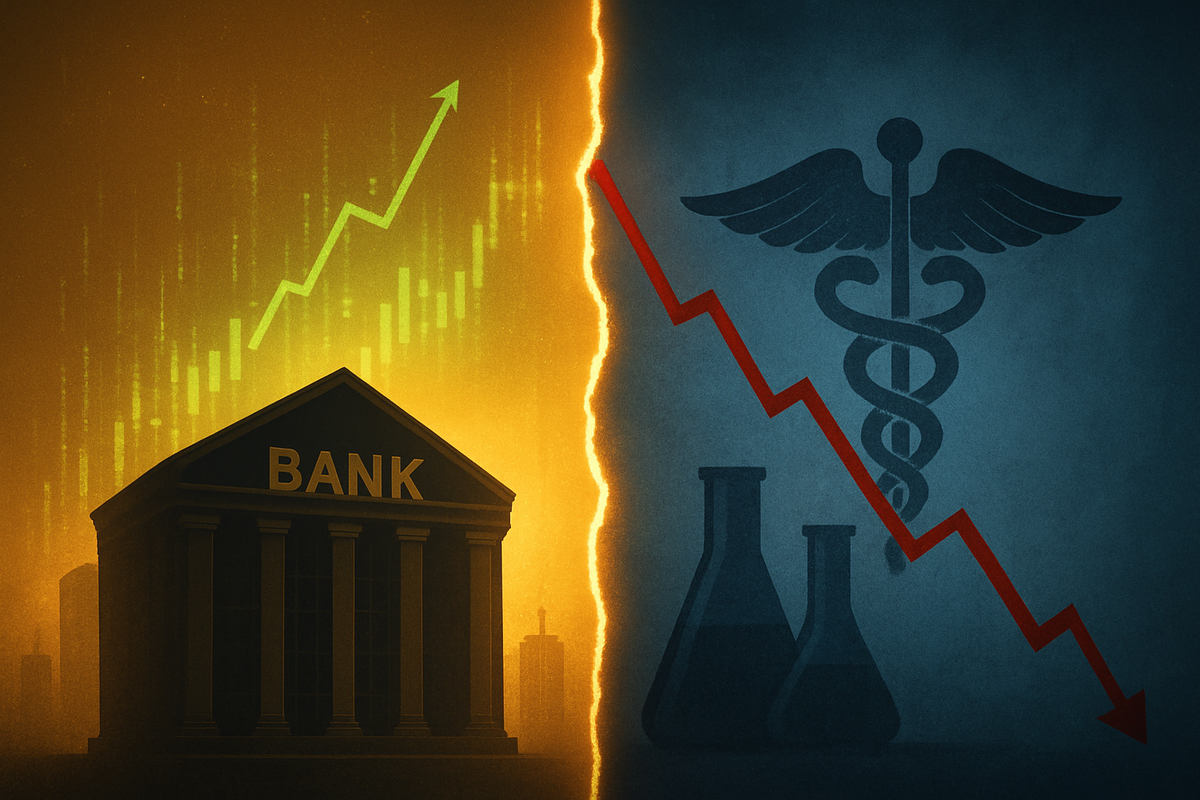
As the first quarter of 2026 draws to a close, the S&P 500 is witnessing one of the most dramatic sector performance splits in recent financial history. According to consensus estimates as of March 17, 2026, the Finance sector is projected to report a staggering 19% year-over-year earnings growth, fueled by a sweeping deregulatory wave and a revitalized capital market. In sharp contrast, the Health Care sector is reeling from a projected 8.8% decline, marking its worst performance since the post-pandemic "hangover" of 2024.
This widening chasm between the "cyclical engines" and the "defensive anchors" of the market reflects a fundamental shift in the macro-economic and legislative environment. While Wall Street prepares for a windfall of buybacks and deal-making fees, the pharmaceutical and managed care industries are grappling with the first major wave of federal drug price negotiations and a "super-cliff" of patent expirations. This divergence isn't just a statistical anomaly; it represents a massive reallocation of capital and a reimagining of sector leadership for the second half of the decade.
A Perfect Storm of Regulatory Relief and Clinical Headwinds
The extraordinary 19% projected growth in Finance is the culmination of several favorable tailwinds that converged in late 2025. Following a series of Federal Reserve rate cuts that stabilized terminal rates between 3.0% and 3.25%, large-cap banks have seen significant net interest margin expansion. While deposit costs have fallen rapidly, long-term yields have remained stubbornly elevated above 4%, allowing banks to profit from a "bull steepening" yield curve. This "borrow short, lend long" environment has turned the traditional banking model into a high-octane growth engine for the first time in years.
Beyond the monetary environment, a systemic "regulatory reset" has fundamentally altered the sector's profitability profile. The reversal of the controversial Basel III "Endgame" capital requirements has allowed the nation’s largest financial institutions to signal the return of over $200 billion in excess capital to shareholders. Furthermore, the 2025 Guiding and Establishing National Innovation for U.S. Stablecoins (GENIUS) Act has opened new digital asset revenue streams, allowing banks to modernize payment rails and compete directly with fintech disruptors.
Conversely, the Health Care sector’s 8.8% projected decline is largely self-inflicted—or rather, legislatively mandated. On January 1, 2026, the first ten negotiated drug prices under the Inflation Reduction Act (IRA) officially went into effect, slashing revenue for some of the world’s most widely used medications by as much as 66%. This was compounded by the passage of the "One Big Beautiful Bill Act" (OBBBA) in late 2025, which introduced national Medicaid work requirements and ended enhanced ACA subsidies. These moves have spiked "uncompensated care" costs for hospitals and triggered a massive enrollment contraction for managed care providers.
Initial market reactions have been swift and decisive. Throughout February and early March, institutional investors have rotated heavily out of traditional defensive "safe havens" like pharma and into diversified financials. While the broader S&P 500 has remained relatively resilient, the internal "sector churn" suggests that the market is pricing in a multi-year period of financial sector outperformance, driven by a return to pre-2008 levels of leverage and deal-making intensity.
Winners in the Vault, Losers in the Lab
The primary beneficiaries of this divergence are the "bulge bracket" investment banks and diversified giants. JPMorgan Chase (NYSE: JPM) is at the forefront, with analysts expecting the firm to leverage its massive scale to dominate the newly deregulated stablecoin and digital custody markets. Similarly, Goldman Sachs (NYSE: GS) is poised for a banner quarter as the global M&A pipeline, which exceeded $5 trillion in 2025, finally begins to convert into lucrative advisory fees. For these firms, the combination of lower capital requirements and a revived IPO market creates a "Goldilocks" scenario for earnings beats.
Bank of America (NYSE: BAC) and Citigroup (NYSE: C) are also seeing a resurgence as credit quality remains surprisingly high despite the late-cycle environment. These institutions are benefiting from the effective halting of Consumer Financial Protection Bureau (CFPB) oversight, which has preserved billions in fee-based revenue that was previously on the chopping block. For the large-cap banks, Q1 2026 isn't just about growth; it’s about a fundamental expansion of their "earnings power" through reduced compliance costs and increased operational flexibility.
The outlook is far bleaker for the titans of the pharmaceutical world. Pfizer (NYSE: PFE) and Merck & Co. (NYSE: MRK) are navigating a "super-cliff" of patent expirations that will see over $200 billion in annual sales threatened by generics through the end of the decade. Merck, in particular, is facing the first full quarter of generic competition for its blockbuster Januvia, while Pfizer is battling the loss of exclusivity for Xeljanz. These "patent holes" are proving difficult to fill even with aggressive M&A, as the cost of capital remains higher than the zero-interest-rate era of the early 2020s.
Managed care organizations are facing their own unique set of crises. UnitedHealth Group (NYSE: UNH), long considered the "gold standard" of the sector, is staring down its first projected revenue dip in decades as Medicare Advantage utilization rates continue to climb among an aging population. Simultaneously, Humana (NYSE: HUM) is struggling to maintain margins as the OBBBA legislation forces a "right-sizing" of their insured pools. Even Bristol Myers Squibb (NYSE: BMY), which has a robust pipeline, is seeing its current cash-cow, Eliquis, face the brunt of the new federal price-setting regime, leading to a significant contraction in its Q1 guidance.
Broad Implications and Historical Echoes
The 28% gap between Finance and Health Care earnings is more than just a quarterly quirk; it signals a broader shift toward "pro-cyclical" deregulation. For much of the past decade, Health Care was the reliable growth engine, providing steady dividends and clinical innovation. However, the current landscape suggests a reversal of roles. The deregulation seen in the Finance sector mirrors the "pre-crisis" era of the mid-2000s, where reduced oversight fueled rapid capital expansion. Critics warn that this could lead to systemic risks, but for now, the market is rewarding the immediate boost to the bottom line.
This event also highlights a growing divide in the "social contract" of the U.S. economy. The legislative cuts to Medicaid and the ACA, coupled with drug price controls, suggest a policy pivot away from government-subsidized health expansion. This has profound ripple effects on hospital systems and medical device manufacturers, who are seeing their "payer mix" deteriorate as millions of Americans lose coverage or face higher out-of-pocket costs. Historically, such shifts have led to a period of consolidation within the health industry, as smaller players are swallowed by larger ones better equipped to handle low-margin environments.
Comparing this to the 2024 "Post-Pandemic Divergence" reveals a crucial difference. In 2024, Health Care's decline was largely due to "difficult comparisons" against COVID-era profits. In 2026, the decline is structural and legislative. This makes the current divergence more permanent and potentially more dangerous for long-term investors in the health space. Conversely, the Finance sector's growth is no longer just about "recovery" from high interest rates; it is about a structural expansion of their business model into digital assets and unregulated fee structures.
What Lies Ahead: Strategic Pivots and Market Opportunities
In the short term, investors should expect a "repricing event" following the official Q1 earnings releases in April. If the 19% growth for Finance is realized, it could trigger a new wave of bank mergers as mid-tier institutions seek the scale necessary to compete in the digital stablecoin market. For Health Care, the "strategic pivot" will likely involve a desperate surge in biotech acquisitions. With their stock prices depressed, big pharma companies may use their remaining cash reserves to buy up early-stage "innovation" to fill the revenue gaps left by the IRA and patent cliffs.
Longer-term, the divergence may force a rebranding of the Health Care sector from a "growth" play to a "value/distressed" play. Companies that can successfully transition their legacy portfolios to biosimilars or "next-gen" biologics will eventually emerge stronger, but the path through 2026 and 2027 looks treacherous. In Finance, the challenge will be managing the "over-exuberance" that often accompanies rapid deregulation. The emergence of the GENIUS Act provides a new frontier, but it also introduces unknown systemic risks into the banking core.
Conclusion: A Market in Transition
The Q1 2026 earnings projections offer a clear verdict: the "era of the bank" has returned, while the "era of the blockbuster drug" is under siege. The Finance sector’s 19% growth projection is a testament to the power of deregulation and favorable monetary policy, while Health Care's 8.8% decline is a sobering reminder of the impact of legislative intervention and the relentless march of the patent clock.
As we move toward the April reporting season, investors should watch for two key indicators: the actual volume of capital returned by banks via buybacks and the specific "bad debt" figures reported by health systems. These numbers will confirm whether this "Grand Divergence" is a temporary shift or the beginning of a long-term reordering of the S&P 500's power structure. For now, the market’s compass is pointing firmly toward the vault, and away from the clinic.
This content is intended for informational purposes only and is not financial advice.