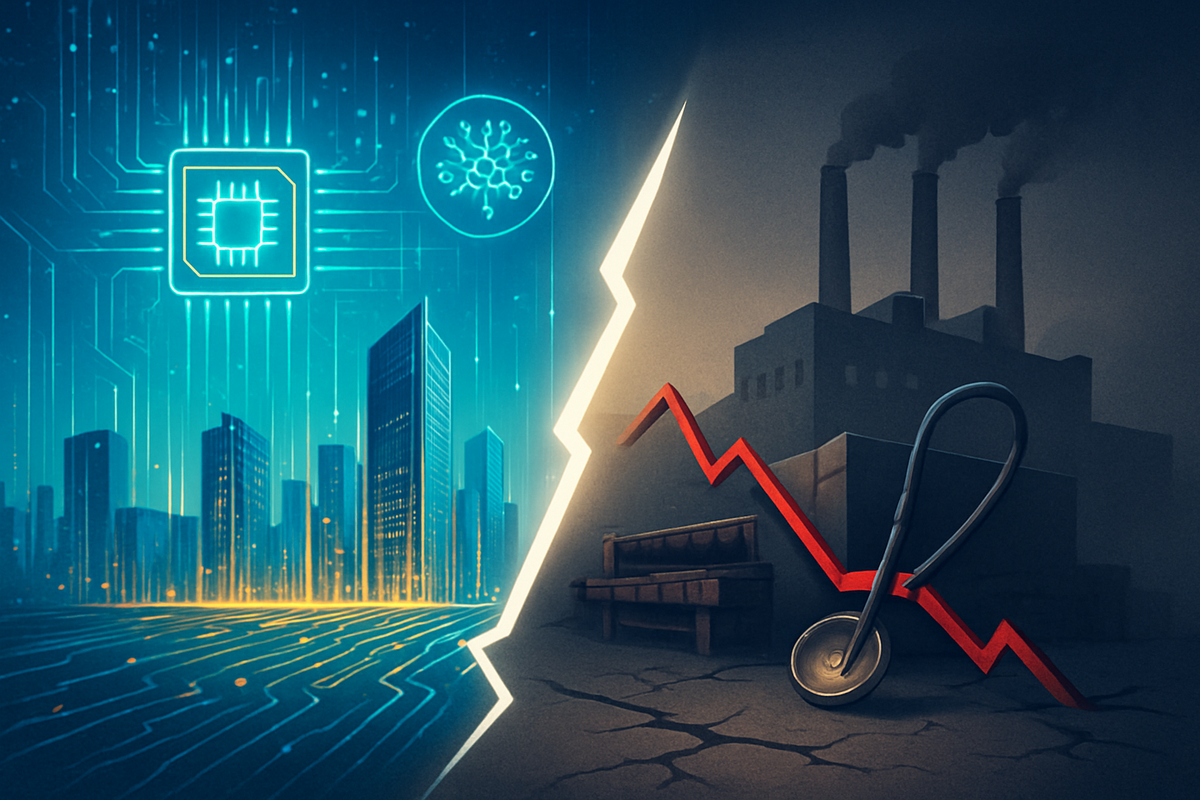
The final trading week of February 2026 has laid bare a striking fracture in the U.S. equity markets. While the technology sector continues to feast on a relentless AI-driven "execution" cycle, the broader market indices are increasingly weighed down by deep-seated structural issues in the healthcare and industrial sectors. This "Great Divergence" has created a deceptive headline environment: while the S&P 500 remains within striking distance of its January milestone of 7,000, its internal breadth tells the story of a market held aloft by a few high-flying giants while the bedrock of the "old economy" begins to crumble under regulatory and operational pressure.
For investors, this internal market dynamic suggests that the current rally may be thinner and more fragile than the index levels imply. The divergence is no longer just about growth versus value; it is about a fundamental shift in capital allocation as the market digests the "Warsh Shock"—the nomination of Kevin Warsh to lead the Federal Reserve—and a wave of Medicare rate shocks that have sent shockwaves through the managed care space. As technology gains are increasingly offset by double-digit losses in defensive and cyclical names, the health of the broader bull market is coming under intense scrutiny.
The Month of Two Markets: A February Timeline
The divergence began in earnest during the first week of February 2026, following a series of disruptive events that bifurcated the trading floor. On February 5, Anthropic released its Claude 4.6 (Opus) model, followed shortly by the launch of "Claude Cowork," a sophisticated "agentic" AI platform. This sparked a renewed frenzy for semiconductor and infrastructure plays, as it signaled that the AI boom was moving from the "experimental" phase into "autonomous execution." However, the euphoria was localized. Just as the Nasdaq began its climb to record highs, the healthcare sector was hit by a "Medicare Rate Shock." The Centers for Medicare & Medicaid Services (CMS) issued a surprise advance notice on February 2, proposing a "flat" rate increase of only 0.09% for 2027 Medicare Advantage payments—a move that fundamentally threatened the margins of the nation's largest insurers.
By mid-February, the split became a chasm. On February 13, the Dow Jones Industrial Average (DJI) hit the psychological milestone of 50,000, but it struggled to hold the level as industrial stalwarts faced a "delivery drought." Boeing (NYSE: BA), a critical Dow component, reported that its January aircraft deliveries had plummeted to just 46 units, down from 63 in December, as the company prioritized "stabilization" over volume. This news, combined with an uneven ISM Manufacturing PMI report on February 2, which showed a contraction in durable goods orders despite a slight expansion in headline manufacturing, effectively capped any upside for the industrial sector.
The timeline culminated on February 25, when NVIDIA (NASDAQ: NVDA) reported a staggering $68.1 billion in quarterly revenue, representing 73% year-over-year growth. While the tech-heavy indices surged on the news, the gains were almost entirely offset by a massive sell-off in healthcare names like Novo Nordisk (NYSE: NVO), which warned of steep sales declines for its GLP-1 portfolio due to new global pricing mandates. The result was a "flat" market day that masked a violent rotation happening beneath the surface.
Winners and Losers of the Divergence
The primary beneficiaries of this divergence have been the "AI Infrastructure" and "AI-Enabled Biotech" sectors. NVIDIA (NASDAQ: NVDA) remains the undisputed champion of this era, with its hardware serving as the backbone for the new agentic AI economy. Similarly, Microsoft (NASDAQ: MSFT) has seen its shares remain resilient as it integrates "Claude-level" agentic capabilities into its enterprise suite. A surprise winner in this landscape has been Eli Lilly (NYSE: LLY), which recently finalized a landmark $1 billion partnership with NVIDIA to build an AI-driven drug discovery lab. This has allowed Eli Lilly to trade more like a high-multiple tech firm than a traditional pharma company, insulating it from the broader healthcare rout.
Conversely, the "losers" list is dominated by managed care and traditional manufacturing. UnitedHealth Group (NYSE: UNH) and Humana (NYSE: HUM) have been the biggest anchors on the market this month. UnitedHealth suffered a historic 13% year-to-date decline as investors priced in the combination of the Medicare rate freeze and the ongoing margin pressure from its recent cyberattack recovery. The industrial sector has also seen significant weakness beyond Boeing; companies like Caterpillar (NYSE: CAT), while showing record backlogs, have struggled with the volatility of the "Warsh Shock" as investors worry about his hawkish stance on shrinking the Fed's balance sheet, which could tighten the credit markets essential for heavy equipment financing.
The divergence has also claimed victims in the "SaaSpocalypse"—the traditional software-as-a-service firms that are now seen as vulnerable to AI agents. Companies like RELX (LSE:REL) and Thomson Reuters (NYSE: TRI) have faced selling pressure as investors fear that autonomous AI agents will cannibalize their seat-based subscription models. This internal tech rotation—from "Software" to "Agents"—has further complicated the market's breadth, making it a "stock-picker’s minefield."
Wider Significance and Historical Precedents
The current market dynamic fits into a broader trend that economists are calling "Productive Dovishness." The nomination of Kevin Warsh to succeed Jerome Powell has introduced the theory that AI-driven productivity gains will act as a permanent check on inflation, allowing the Fed to remain accommodative toward growth even while bond yields fluctuate. This "Warsh Shock" has provided a tailwind for high-multiple technology stocks, which thrive in an environment where growth is prized above all. However, it has left traditional sectors like healthcare and industrials—which are more sensitive to regulatory shifts and balance sheet mechanics—exposed.
This period echoes the late 1990s, but with a crucial difference in "execution." In 1999, the divergence was driven by speculation; in 2026, it is driven by record-breaking earnings from the tech leaders. However, the ripple effects on competitors are becoming more severe. The "SaaSpocalypse" suggests that AI is no longer a rising tide lifting all boats; it is now a disruptive force that is actively sinking those who cannot adapt to agentic workflows. Furthermore, the regulatory crackdown on healthcare pricing (GLP-1s and Medicare Advantage) reflects a growing government focus on fiscal discipline, providing a stark contrast to the "Wild West" regulatory environment currently enjoyed by the AI sector.
Looking Ahead: The "Warsh Rotation" and Strategic Pivots
In the short term, market participants are bracing for what is being called the "Warsh Rotation." Today, February 27, 2026, we are seeing early signs of a "valuation reset" where investors are finally taking profits on "good news" in the tech sector and cautiously rotating capital back into beaten-down defensive staples and healthcare names. The potential for a "snap-back" rally in healthcare is high if the CMS final rule in April proves to be less draconian than the February proposal. However, for industrials, the path forward is more complex, requiring a clear stabilization of the manufacturing supply chain and a resolution to Boeing's production bottlenecks.
The long-term outlook will depend on how quickly "Old Economy" companies can integrate the very AI technologies that are currently outperforming them. We are already seeing "Brawn-to-Brain" pivots, such as Caterpillar (NYSE: CAT) leveraging AI to manage its $51 billion backlog and optimize data center power generation units. The primary challenge for the market will be maintaining the 7,000 level on the S&P 500 without broader participation; if the "Magnificent Seven" begin to fatigue before the other 493 stocks recover, the market could face a significant "air pocket."
Summary of the Market Pulse
The "Great Divergence" of February 2026 serves as a stark reminder that the headline indices can often be a "hall of mirrors." The record-breaking performance of AI-centric technology firms has effectively masked a severe contraction in the healthcare and industrial sectors, driven by regulatory shocks and manufacturing inconsistencies. While the Nasdaq remains the darling of the "Warsh Shock" era, the weakness in the Dow and the XLV (Healthcare ETF) suggests that the foundation of this bull market is narrower than many would like to admit.
Moving forward, investors should watch for a "convergence" of these trends. The health of the market in the coming months will be determined not by how high NVIDIA (NASDAQ: NVDA) can go, but by whether UnitedHealth (NYSE: UNH) and Boeing (NYSE: BA) can find a floor. A healthy rally requires "universal participation," and until the divergence closes, the market remains vulnerable to a sharp recalibration. As we enter March, the focus will shift from AI potential to regulatory reality—a transition that will separate the true market leaders from those merely riding the momentum.
This content is intended for informational purposes only and is not financial advice.