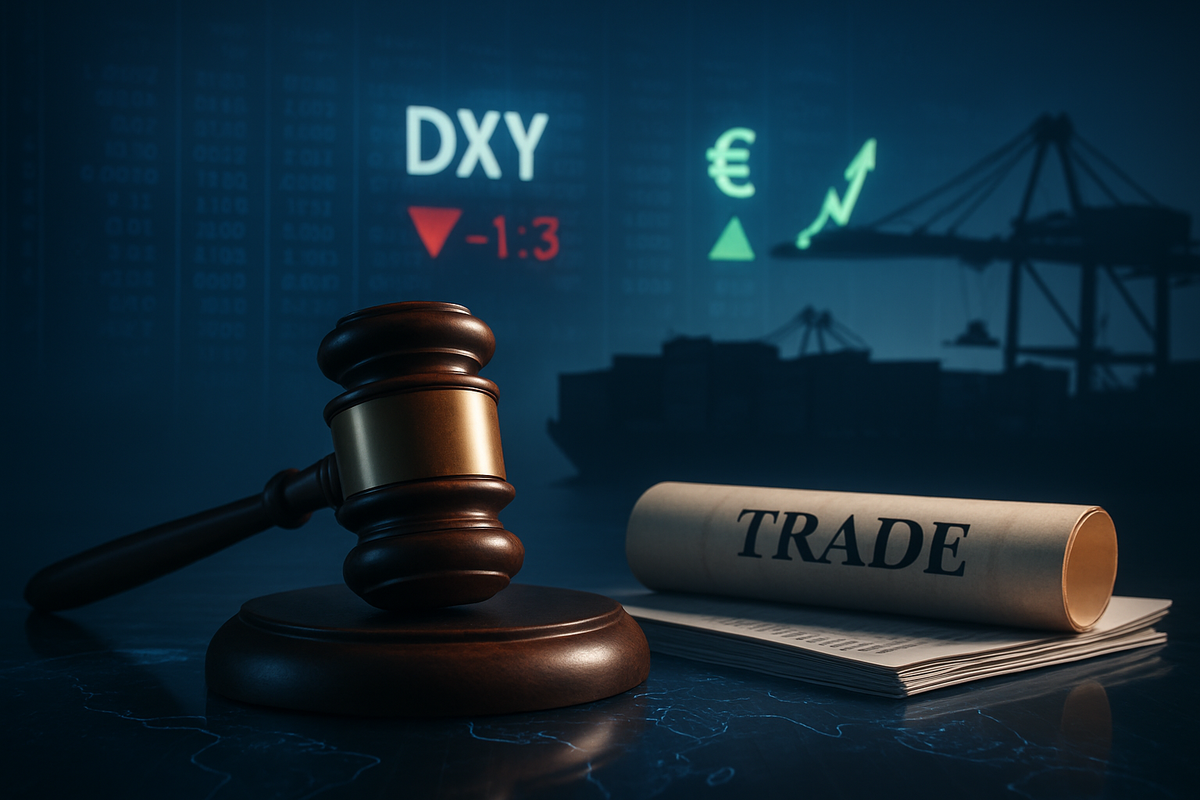
The global currency markets are reeling this week as the U.S. dollar edges lower against major peers, a direct consequence of a landmark Supreme Court ruling that has upended the executive branch's trade authority. Following the decision in Learning Resources, Inc. v. Trump on February 20, 2026, which invalidated broad tariffs imposed under the International Emergency Economic Powers Act (IEEPA), the U.S. Dollar Index (DXY) has retreated to 97.65. Investors are now grappling with a "policy risk premium" as the legal foundation of U.S. protectionism shifts beneath their feet.
The immediate implications are a mix of relief and renewed anxiety. While the ruling potentially clears the way for billions of dollars in corporate refunds, the administration’s rapid pivot to "stop-gap" tariffs under Section 122 of the Trade Act of 1974 has created a 150-day window of extreme volatility. For currency traders, the dollar's traditional role as a safe haven is being tested by domestic legal instability, allowing the Euro and the Japanese Yen to claw back significant ground as world leaders reassess their own trade commitments in this new legal landscape.
The Ruling That Shook the Markets
On Friday, February 20, 2026, the Supreme Court delivered a 6-3 decision that effectively dismantled the administration’s primary mechanism for imposing global tariffs. Chief Justice John Roberts, writing for the majority, invoked the "major questions doctrine," asserting that the 1977 IEEPA does not grant the President the unilateral power to impose what are essentially taxes on the American public without explicit Congressional approval. This ruling was the culmination of a year-long legal battle led by domestic importers who argued that the "national emergency" justifications used for 2025's sweeping trade barriers were an unconstitutional overreach of executive power.
The timeline of this crisis accelerated almost immediately. Within hours of the SCOTUS announcement, the White House criticized the court’s "interference with national security" and invoked Section 122 of the Trade Act of 1974. This move established a new 10% global baseline tariff, which was hiked to 15% just 24 hours later. However, unlike the previous indefinite IEEPA duties, Section 122 authorities are strictly limited to a 150-day duration unless Congress intervenes—a prospect that remains unlikely in a divided Washington. This "temporary" nature of the new tariffs has left the markets in a state of "regulatory whiplash," unsure if the trade war is winding down or entering a more chaotic phase.
The reaction across the Atlantic and Pacific has been one of cautious optimism. In Europe, the Euro climbed to $1.1832 as German business confidence hit a six-month high, spurred by the hope that the SCOTUS ruling will lead to a more predictable, rules-based trade relationship. Meanwhile, the offshore Yuan reached a 34-month high of 6.89, as the invalidation of the most punitive IEEPA-based reciprocal tariffs provided a much-needed reprieve for Chinese exporters, despite the new 15% flat-rate hurdle.
Winners and Losers in the "Refund Era"
The corporate landscape is sharply divided between those positioned to reclaim billions in past duties and those facing the administrative nightmare of the new 150-day tariff window. Apple Inc. (NASDAQ: AAPL) stands as a primary potential beneficiary; analysts estimate the tech giant could be eligible for up to $3.3 billion in refunds for duties deemed illegal by the Court. While Apple’s stock rose 0.87% to $266.89 following the news, the gains were tempered by concerns that the new 15% flat tariff will eliminate the specific geographic exemptions the company had successfully negotiated in India and Vietnam.
Conversely, retail behemoths like Walmart Inc. (NYSE: WMT) are navigating a more treacherous path. Walmart recently saw its market capitalization slip below the $1 trillion mark as management warned of a "tariff inflation nightmare." The company is currently tasked with the monumental challenge of tracking and reclaiming past duties while simultaneously adjusting supply chains for a 15% levy that may only exist for five months. The uncertainty has led to a cautious 2026 outlook, as the "Liberation Day" tariffs of April 2025 continue to weigh on consumer spending and inventory costs.
In the industrial sector, Caterpillar Inc. (NYSE: CAT) exemplifies the volatility of the current moment. Initially a supporter of protectionist measures that shielded domestic manufacturing, Caterpillar now faces an estimated $2.6 billion tariff hit for 2026 under the new stop-gap measures. Investors are weighing the loss of long-term protective barriers against the rising input costs for steel and machinery, leading to sharp swings in CAT’s share price as the market attempts to value the company in a post-IEEPA world.
Wider Significance and Policy Implications
The SCOTUS ruling represents a fundamental shift in the balance of power between the executive and legislative branches regarding trade policy. By applying the "major questions doctrine" to trade, the Court has signaled that the era of "trade by tweet" or executive fiat may be coming to a close. This fits into a broader industry trend of judicial skepticism toward the administrative state, a movement that has gained momentum since the mid-2020s. For global partners, this means that future U.S. trade commitments—or threats—will require more substantial domestic consensus, potentially leading to more stable, if slower-to-evolve, international agreements.
The ripple effects extend far beyond the United States. Leaders like French President Emmanuel Macron have hailed the ruling as a victory for the "rule of law," yet the immediate imposition of Section 122 tariffs suggests that trade tensions will not evaporate overnight. Historically, this situation draws parallels to the trade disputes of the 1970s, where temporary measures often became semi-permanent fixtures of the economic landscape. However, the 150-day "ticking clock" established by the current legal framework is a new variable that forces both domestic companies and foreign governments to operate on an extremely compressed strategic timeline.
Furthermore, the ruling has put the Federal Reserve in a difficult position. The weakening dollar and the potential for a massive influx of "refund capital" into the corporate sector could be inflationary, complicating the Fed's efforts to maintain a stable interest rate environment. The market is now closely watching for any signals that the central bank might adjust its 2026 roadmap to account for this sudden injection of liquidity and the shifting dynamics of imported inflation.
What Comes Next: The 150-Day Countdown
The market is now entering what many are calling the "Confusion Zone." In the short term, the primary focus will be on the legal battle over the Section 122 "stop-gap" tariffs. Pro-trade groups are already preparing challenges, arguing that the 15% levy exceeds the intended scope of the 1974 Act. If these challenges succeed, or if Congress refuses to extend the authority in July 2026, the U.S. could face a "tariff cliff," where trade barriers drop precipitously overnight. This scenario would likely lead to further dollar weakness as the U.S. "protectionist premium" fully evaporates.
Long-term, multinational corporations will likely continue their "China Plus N" diversification strategies, but with a renewed focus on legal resilience. Companies may prioritize investments in countries with formal Free Trade Agreements (FTAs) with the U.S., as these are less susceptible to executive whim following the SCOTUS ruling. Strategic pivots will be required for companies that relied on executive exemptions, which have now been revealed as legally fragile.
Potential scenarios range from a full-scale return to Congressional trade dominance to a period of prolonged legislative deadlock that leaves the U.S. with no coherent trade policy at all. Investors should watch for the emergence of new bipartisan trade legislation that might attempt to provide the "clear congressional authorization" the Supreme Court has demanded. The success or failure of such a bill will be the ultimate signal for the long-term trajectory of the dollar and global trade stability.
Market Wrap-Up and Investor Outlook
The events of late February 2026 have marked a watershed moment for the global financial system. The U.S. dollar's decline reflects a market that is reassessing the "exceptionalism" of U.S. trade policy and the powers of its executive. The key takeaway for investors is that the legal framework of global commerce is no longer a static background element but a primary driver of currency and equity volatility. The 97.65 level for the DXY is a signpost of this new reality, where domestic legal checks have global financial consequences.
Moving forward, the market will likely remain in a state of high sensitivity to any headlines regarding the $175 billion in potential corporate refunds and the status of the Section 122 tariffs. While the SCOTUS ruling provides a path for massive capital returns to shareholders, the administrative and political hurdles remaining are significant. Investors should maintain a diversified stance, favoring companies with strong balance sheets that can weather "regulatory whiplash" and those that are less dependent on specific executive trade favors.
In the coming months, the most critical factors to watch will be the July expiration of the current tariff authority and the Federal Reserve’s reaction to the changing trade landscape. As the "protectionist premium" fades, the dollar's performance will increasingly rely on fundamental economic data rather than geopolitical posturing. This transition back to a "rules-based" market may be painful in the short term, but it could ultimately lead to a more transparent and predictable global economy.
This content is intended for informational purposes only and is not financial advice.