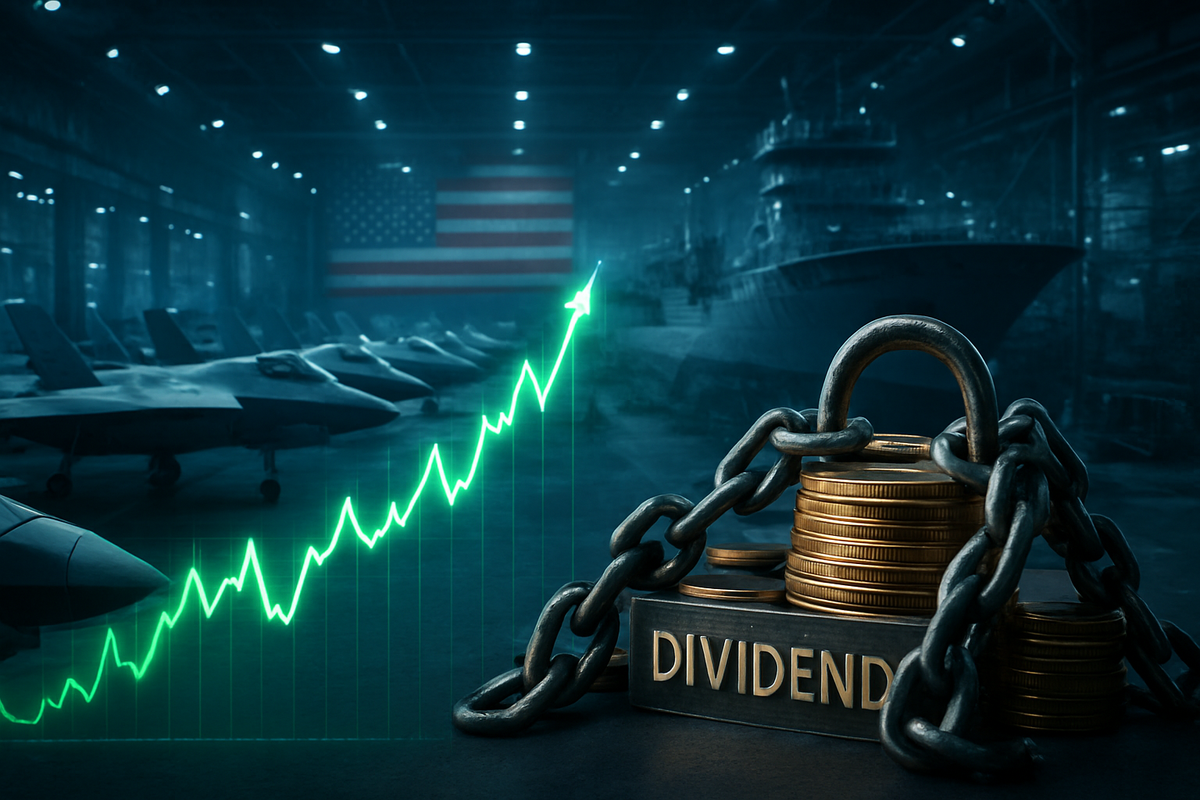
The global defense sector was sent into a whirlwind of volatility this week following a series of high-stakes announcements from the Trump administration. On January 7, 2026, President Donald Trump proposed a staggering $1.5 trillion defense budget for Fiscal Year 2027—a massive leap from the previous $901 billion baseline. The proposal aims to build what the President describes as a "Dream Military," funded largely through aggressive tariff revenues. However, the promise of a historic spending spree came with a significant caveat: a new Executive Order (EO) that threatens to freeze dividends and share buybacks for contractors that fail to meet production and efficiency standards.
The immediate reaction in the markets was a study in contradictions. Initially, shares of major defense primes plummeted as investors grappled with the prospect of losing the reliable income streams provided by dividends. However, as the sheer scale of the $1.5 trillion figure—representing a nearly 50% increase in potential contract volume—was digested, a late-day rally emerged. Market participants are now weighing the long-term benefits of a massive military expansion against a new era of "production-first" corporate governance that could fundamentally alter the financial profile of the defense industrial base.
The Road to $1.5 Trillion: A New Doctrine of Production
The proposal for a $1.5 trillion budget did not emerge in a vacuum but followed months of escalating rhetoric regarding national security and industrial capacity. On the morning of January 7, President Trump took to social media to unveil the figure, stating that the previous target of $1 trillion was insufficient to secure the United States "regardless of foe." This "Dream Military" initiative focuses on rapid modernization, expanded naval fleets, and a massive replenishment of munitions stockpiles that have been depleted over the last several years.
Central to this plan is the role of Secretary of Defense Pete Hegseth, who has been tasked with enforcing the administration’s new "performance-based" financial mandates. Under the newly signed Executive Order, the Department of Defense (DoD) has 30 days to identify contractors that are underperforming or failing to invest in manufacturing capacity. These companies will be barred from making share repurchases or paying dividends until they can prove they are delivering "superior products, on time and on budget."
The timeline of events moved rapidly. Following the President’s announcement, the DoD held a briefing outlining that future contracts would include "buyback-ban" clauses as a standard legal requirement. This shift represents a radical departure from the last decade of defense finance, where companies often utilized high margins and steady government cash flows to reward shareholders. By the afternoon of January 7, the administration also proposed a $5 million annual cap on executive compensation for contractors failing to meet modernization goals, further signaling a populist shift in defense policy.
Winners and Losers: The "Big Six" Under the Microscope
The impact of this policy shift is unevenly distributed across the sector. Lockheed Martin (NYSE: LMT), the nation’s largest defense contractor, saw its stock dip nearly 5% before recovering. While the company stands to be a primary beneficiary of the $1.5 trillion budget—particularly for F-35 procurement and missile defense—it remains a primary target of the administration’s ire regarding cost overruns. Similarly, Northrop Grumman (NYSE: NOC) faces a complex outlook; while it is essential for the Sentinel ICBM program, the threat of dividend restrictions looms large over its capital allocation strategy.
RTX (NYSE: RTX), formerly Raytheon, was explicitly singled out by the President as being "the least responsive" in increasing production volumes. The threat to cut off future contracts unless the company ceases buybacks put immediate pressure on the stock. Conversely, smaller, more agile "defense tech" firms and those focused on high-volume manufacturing, such as L3Harris (NYSE: LHX) and Huntington Ingalls Industries (NYSE: HII), may find themselves in a better position if they can demonstrate the rapid production scaling the administration demands.
Traditional aerospace giant Boeing (NYSE: BA) and ground systems leader General Dynamics (NYSE: GD) also face a "carrot and stick" scenario. The "carrot" is a share of the additional $500 billion in proposed spending, while the "stick" is a potential multi-year ban on returning capital to shareholders. For income-focused investors who have traditionally viewed these stocks as "bond-proxies" with reliable yields, the new Executive Order introduces a level of equity-like risk that has not been seen in the sector for decades.
A Paradigm Shift in Defense Policy and Finance
This event marks a significant departure from broader industry trends of the past twenty years. Since the early 2000s, the defense industry has consolidated into a few major "primes" that prioritized lean manufacturing and shareholder returns. President Trump’s proposal effectively seeks to reverse this, forcing a return to the "Arsenal of Democracy" model of the 1940s, where excess capacity is prioritized over financial efficiency. This shift has massive ripple effects on competitors and partners, as European firms like Leonardo and BAE Systems may see increased interest from global investors looking for defense exposure without the "Trump-tax" on dividends.
The regulatory implications are equally profound. The funding for this $1.5 trillion budget is tied to the administration’s broad tariff regime, a legal strategy currently facing a challenge in the Supreme Court. A ruling expected as early as January 9, 2026, will determine if the President has the authority to use the International Emergency Economic Powers Act (IEEPA) to fund domestic spending through global trade levies. If the Court rules against the administration, the $1.5 trillion budget could be left without a clear funding source, potentially leading to a massive market correction.
Historically, the only precedent for such a direct intervention in corporate capital allocation was during the World Wars or the 1950s Defense Production Act era. However, those measures were typically accompanied by guaranteed "cost-plus" contracts that protected margins. The current proposal is unique because it demands higher production and lower costs simultaneously, while stripping away the financial tools (buybacks) that CEOs have used to bolster stock prices during periods of slow growth.
The Path Ahead: Short-Term Pain vs. Long-Term Growth
In the short term, investors should expect continued volatility as the "Big Six" and their lobbyists descend on Washington to negotiate the specifics of the "underperformance" triggers. The next 30 days will be critical as Secretary Hegseth releases the list of contractors subject to the immediate dividend ban. Companies may be forced to make strategic pivots, such as divesting underperforming units or aggressively shifting capital from dividends toward building new robotic assembly lines and "dark factories."
Long-term, the $1.5 trillion budget represents a massive market opportunity for companies that can adapt to the new "production-first" reality. If the administration successfully forces the industry to reinvest its profits into capacity, the United States could see a manufacturing renaissance in the defense sector. However, the risk of a "brain drain" exists; if executive compensation is capped and shareholder returns are restricted, top talent and private capital might migrate toward commercial tech or international competitors, potentially undermining the very modernization the President seeks.
Final Takeaways for the Market
The rally in defense stocks, despite the proposed restrictions, suggests that the market believes the sheer volume of new spending will eventually outweigh the pain of the dividend ban. However, the "Golden Age" of defense dividends appears to be over, replaced by a "Production Age" where stock performance will be driven by contract wins and delivery speeds rather than financial engineering.
Moving forward, investors should watch for the Supreme Court’s ruling on tariff funding and the DoD’s first "Underperformer List." These two factors will determine whether the $1.5 trillion budget is a sustainable reality or a political aspiration. For now, the defense sector has been put on notice: the government is no longer just a customer, but an active manager of the industrial base’s balance sheets.
This content is intended for informational purposes only and is not financial advice.