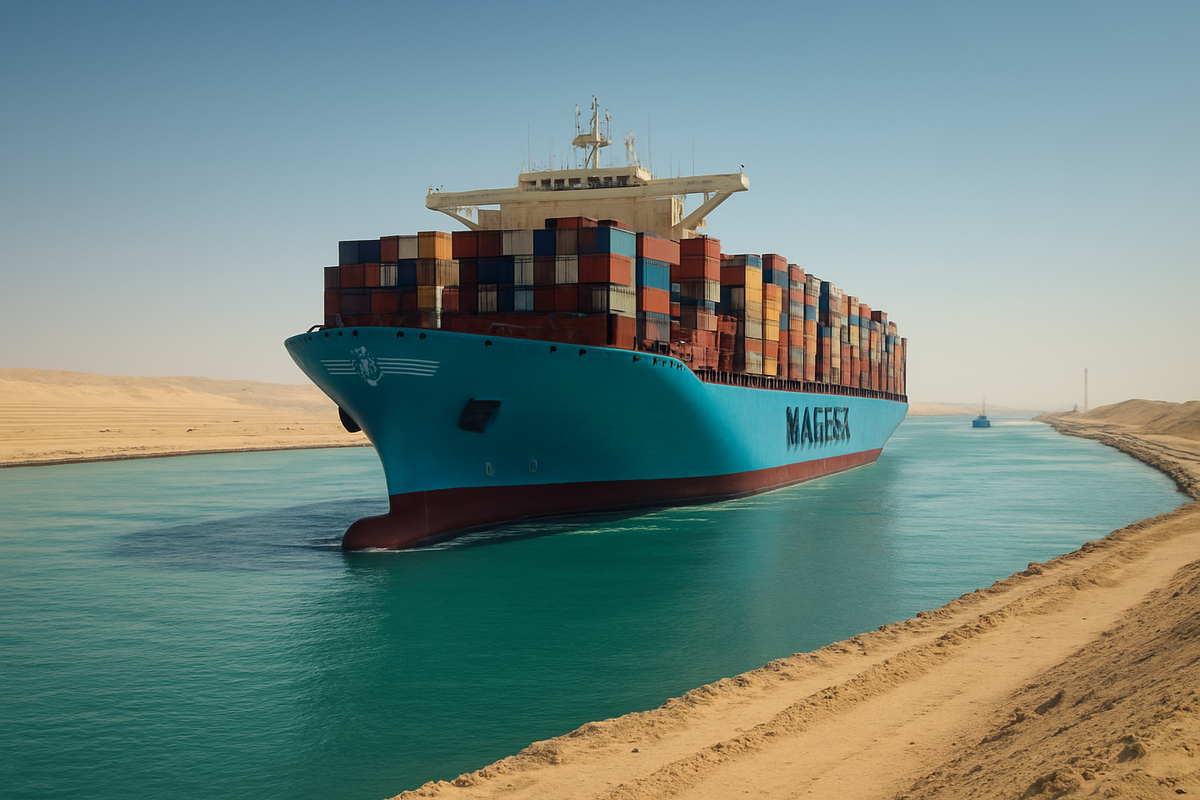
LONDON, January 15, 2026 — In a move that signals the beginning of the end for the longest period of global shipping disruption since the 1960s, A.P. Moller - Maersk (CPH: MAERSK-B) has officially commenced its structural return to the Suez Canal. Today, the vessel Cornelia Maersk is scheduled to depart Jebel Ali, marking the permanent reinstatement of the company’s Middle East/India to U.S. East Coast (MECL) service through the Red Sea. This strategic pivot marks a critical milestone for global logistics, ending more than two years of costly diversions around the Cape of Good Hope and setting the stage for a dramatic realignment of freight rates and supply chain timelines.
The decision by the world’s second-largest container line follows a series of successful "test" transits over the last month and a notable 100-day period of relative calm in the Bab el-Mandeb strait. However, while the return to the Suez route promises to slash transit times by up to 14 days and significantly reduce fuel consumption, it arrives at a time of "unstable normalization." Market analysts warn that the sudden influx of capacity—estimated at over 2 million TEUs (Twenty-foot Equivalent Units) being released back into the market—could trigger a price war and cause severe "inventory whiplash" at major European and American ports.
The Long Road Back: Timeline of a Two-Year Detour
The path to today’s departure of the Cornelia Maersk began in late 2023, when escalating regional tensions and drone attacks forced nearly all major carriers to abandon the Suez Canal. For over 700 days, the global fleet was rerouted around Africa, adding thousands of miles to voyages and billions of dollars in operational costs. A.P. Moller - Maersk (OTC: AMKBY), which initially attempted to resume transits in early 2024 before a series of narrow misses forced another retreat, has spent much of 2025 operating a fractured network that relied on "bridge" services and high-speed air freight for time-sensitive cargo.
The tide began to turn in late 2025. Following the successful trial passage of the Maersk Sebarok in December and the Maersk Denver on January 11, 2026, the company felt confident enough to commit to a full schedule. They are not alone in this move; the French shipping giant CMA CGM announced a "full return" for its mega-ships in late December, and the Suez Canal Authority has incentivized the return with a 15% toll discount for large vessels. Despite this momentum, the industry remains divided. Hapag-Lloyd (ETR: HLAG) remains the most prominent holdout, maintaining a cautious "Cape-only" policy for its major services until security is deemed "absolute."
Winners and Losers in the Realigned Market
The restoration of the Suez route creates a complex landscape for public companies. ZIM Integrated Shipping Services (NYSE: ZIM) stands at a particularly precarious crossroads. After suffering a staggering 90% plunge in net income during the late-2025 fiscal period—a result of high operational costs and the phasing out of expensive short-term charters—ZIM's CEO Eli Glickman recently stated that a return to Suez is "imminent." For ZIM, the shorter route is essential for survival, yet the company faces the challenge of a market where freight rates are expected to plummet as more ships squeeze through the canal.
On the logistics and parcel side, the impact is equally profound. FedEx Corporation (NYSE: FDX) and United Parcel Service, Inc. (NYSE: UPS) both implemented 5.9% General Rate Increases (GRIs) in early January 2026. However, these companies now face a "soft" parcel market. During the height of the Red Sea crisis, many shippers moved cargo to premium air freight to bypass the 40-day ocean transit times. With ocean routes now normalizing to 25–28 days, FedEx and UPS are likely to see a migration of cargo back to sea, putting pressure on their air divisions. Conversely, freight forwarders with strong ocean contracts may see a margin boost as their underlying costs drop faster than the prices they charge their clients.
Broader Industry Trends and the "Inventory Whiplash"
The resumption of Suez transits is not merely a return to the old way of doing business; it is occurring in an era of massive overcapacity. During the 2024–2025 crisis, carriers ordered record numbers of new, larger vessels to compensate for the longer routes around Africa. As these ships return to the shorter Suez route, the effective capacity of the global fleet will surge by roughly 6%. This "ghost capacity" is expected to depress spot rates across the Transpacific and Asia-Europe lanes for much of 2026.
Furthermore, economists are tracking a phenomenon known as "inventory whiplash." Because ships returning via the Suez will arrive significantly faster than the last vessels still rounding the Cape, many European hubs like Rotterdam and Hamburg are bracing for "vessel bunching." This could lead to a scenario where two months' worth of inventory arrives within a single three-week window, overwhelming warehouse capacity and potentially causing a short-term spike in local trucking and drayage costs. This mirrors the post-pandemic supply chain shocks, albeit in reverse, highlighting how sensitive global trade remains to route fluctuations.
Looking Ahead: The Future of "Unstable Normalization"
As we move deeper into 2026, the industry is entering a phase of "unstable normalization." Maersk and its competitors have developed sophisticated "Pivot Protocols," allowing them to revert to the Cape of Good Hope within 24 hours if hostilities resume. This level of strategic flexibility is now a permanent fixture of maritime operations. Short-term, investors should expect significant volatility in shipping stocks as the market prices in the end of the "crisis premium" in freight rates.
In the long term, the return to Suez may accelerate the decommissioning of older, less efficient vessels. With environmental regulations tightening, the "Big Three" carriers are likely to use the current capacity surplus as an opportunity to scrap 15-to-20-year-old ships that were kept in service only to cover the longer African route. This "green scrapping" could eventually help rebalance the market by late 2027, but the intervening 18 months will likely be a period of intense competition and margin compression.
Wrap-Up: What Investors Need to Watch
The departure of the Cornelia Maersk today marks a psychological and operational turning point for the markets. The key takeaways for the start of 2026 are clear: transit times are falling, capacity is rising, and the era of "emergency" freight rates is over. While this is a win for global retailers and manufacturers who will see their shipping costs decline, it presents a challenging environment for pure-play ocean carriers.
Moving forward, investors should keep a close eye on port congestion metrics in Northern Europe and the U.S. East Coast over the next 60 days to see if the "inventory whiplash" materializes. Additionally, monitoring the pace at which Hapag-Lloyd and other cautious players join Maersk in the Red Sea will serve as a barometer for regional stability. For now, the global trade engine is shifting back into a higher gear, but the road ahead remains fraught with the lessons of the last two years of disruption.
This content is intended for informational purposes only and is not financial advice.