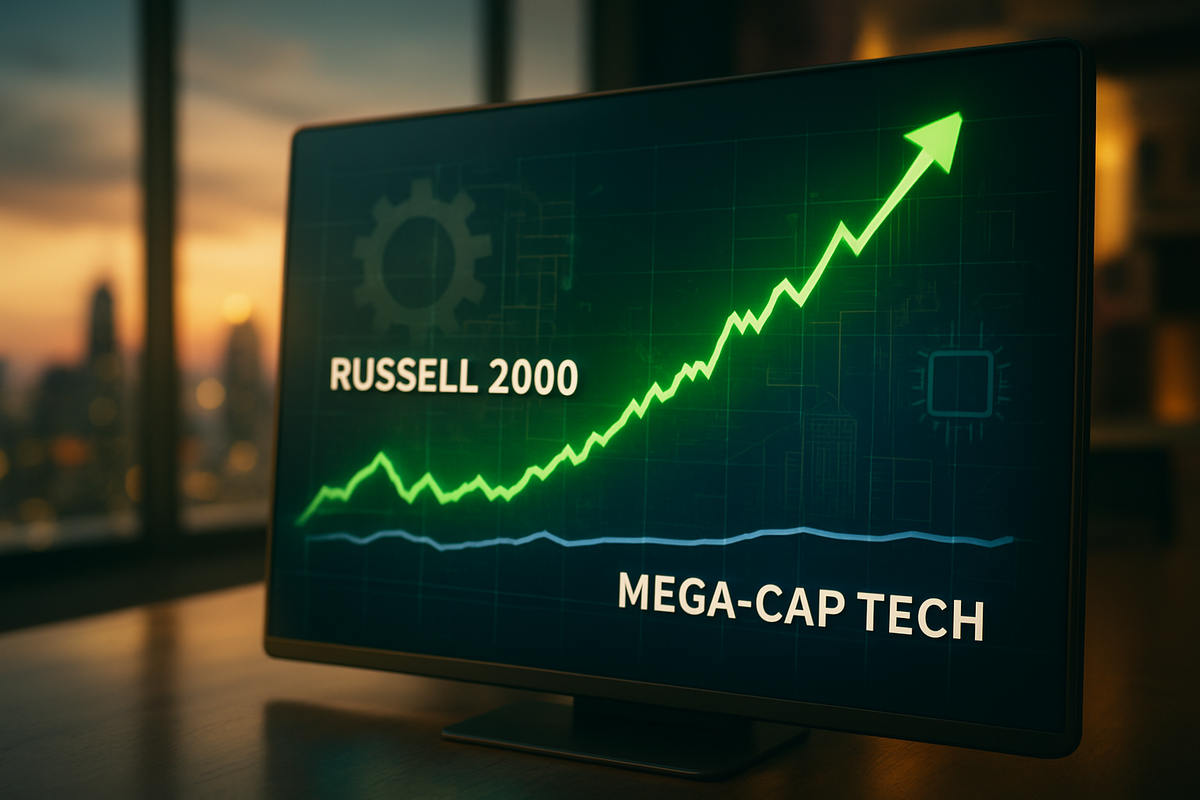
The dawn of 2026 has brought a seismic shift to Wall Street, as the long-awaited "Great Rotation" from mega-cap technology to domestic small-cap stocks finally materialized with historic intensity. As of mid-January, the Russell 2000 Index, tracked by the iShares Russell 2000 ETF (NYSE Arca: IWM), has rocketed 5.8% year-to-date, marking its strongest opening to a year in over a decade. This surge stands in stark contrast to the tech-heavy Nasdaq 100 (NASDAQ: QQQ), which has remained relatively flat, gaining a meager 2.0% as investors take profits from the artificial intelligence titans that dominated the previous two years.
This divergence signals a fundamental regime shift in the U.S. equity markets. For years, the "Magnificent Seven" and a handful of AI-centric leaders provided the bulk of market returns, but the narrative has flipped. A combination of a "soft landing" economic environment, a more accommodative Federal Reserve, and aggressive domestic fiscal policies has turned the Russell 2000 into a "coiled spring," releasing years of pent-up value as capital flows into the often-overlooked "other 493" and their smaller counterparts.
The Perfect Storm for Small-Cap Leadership
The outperformance of the Russell 2000 did not occur in a vacuum; it is the result of a deliberate cooling in the mega-cap space and a series of macroeconomic catalysts that hit their stride in the first two weeks of January. Throughout late 2025, the Federal Reserve successfully navigated the U.S. economy toward a soft landing, culminating in three consecutive 0.25% interest rate cuts. By January 14, 2026, the federal funds rate settled into a more manageable 3.50%–3.75% range. This easing cycle has provided a vital lifeline to small-cap firms, which typically carry higher levels of floating-rate debt and rely more heavily on external financing than cash-rich giants like Apple Inc. (NASDAQ: AAPL) or Microsoft Corp. (NASDAQ: MSFT).
Fueling this rally further is the tangible impact of the "One Big Beautiful Act" (OBBBA), a sweeping piece of fiscal legislation passed in July 2025. The act stabilized the corporate tax rate at 21% and, more importantly for capital-intensive small firms, reintroduced 100% bonus depreciation. Analysts at Goldman Sachs (NYSE: GS) note that the ability to immediately deduct capital expenditures has "unlocked" billions in domestic investment, favoring companies with heavy U.S. footprints. The market reaction has been swift, with small-cap value funds like the Vanguard Small-Cap Value ETF (NYSE Arca: VBR) seeing record inflows as institutional portfolios rebalance away from overextended tech valuations.
Winners and Losers in the New Market Regime
The clear winners in this rotation are the domestic-focused sectors that populate the Russell 2000. Regional banks have led the charge, benefiting from a steepening yield curve and a resurgence in middle-market merger and acquisition (M&A) activity. KeyCorp (NYSE: KEY) and other regional lenders have seen significant appreciation as credit concerns ease and loan demand from mid-sized businesses rises. Similarly, the industrial sector has found a second wind; companies like Caterpillar Inc. (NYSE: CAT) and Rockwell Automation Inc. (NYSE: ROK) are seeing renewed interest as the OBBBA incentives drive a "reshoring" boom, bringing manufacturing back to American soil.
On the other side of the ledger, the former market darlings are feeling the weight of their own success. NVIDIA Corp. (NASDAQ: NVDA), which spent 2024 and 2025 as the undisputed engine of the S&P 500, has struggled to find new buyers at current multiples, trading nearly flat since the start of the year. Apple Inc. (NASDAQ: AAPL) has even dipped into negative territory for the year, falling 4.3% in the first two weeks of January as investors harvest gains to fund their small-cap allocations. While these companies remain fundamentally strong, the "AI-at-any-price" trade has clearly hit a valuation ceiling, leaving them as the primary donors of liquidity for the small-cap surge.
A Structural Shift Toward Domestic Value
This rotation is more than just a "January Effect" or a temporary short-squeeze; it represents a historical reversion to the mean. By the end of 2025, the valuation gap between small and large caps had reached a 25-year extreme. The Russell 2000 was trading at a forward price-to-earnings (P/E) ratio of roughly 18x, while the S&P 500 hovered near 26x—and the tech-heavy Nasdaq even higher. This valuation disconnect made small-caps a "coiled spring" for value seekers. Furthermore, the political landscape in early 2026 has emphasized "America First" industrial policy, with proposed military budget increases benefiting smaller defense contractors like Kratos Defense & Security Solutions Inc. (NASDAQ: KTOS) and established players like Lockheed Martin Corp. (NYSE: LMT).
Historically, similar periods of market broadening have lasted for several quarters, if not years. The current environment mirrors the post-dot-com bubble era of the early 2000s, where small-caps and value stocks significantly outperformed the previously dominant tech sector for an extended period. With the Federal Reserve signaling a stable, if not lower, rate environment and the domestic economy proving resilient, the "average stock" is finally getting its moment in the sun, reducing the concentration risk that has plagued the major indices for years.
Navigating the Road Ahead for 2026
Looking forward, the momentum behind the Russell 2000 suggests that the index could reach new heights by year-end. Jefferies (NYSE: JEF) has already revised its year-end target for the Russell 2000 to 2,825, implying double-digit upside from current levels. However, the path will not be without challenges. Small-cap companies are notoriously sensitive to economic data; any sign of a resurging inflation or a sudden uptick in unemployment could stall the rally. Investors will need to focus on "quality" small-caps—those with strong balance sheets and positive cash flow—rather than the speculative "zombie" companies that survived on zero-interest-rate policy in years past.
Strategic pivots are already appearing in the asset management world. Several major hedge funds have reported shifting their net exposure toward "Cyclicals" and "Value" while maintaining "Market Neutral" positions on mega-cap tech. As the year progresses, the resurgence of middle-market M&A could provide another catalyst, as larger corporations use their still-formidable cash piles to acquire the very small-cap companies that are currently leading the market rally.
The Bottom Line for Investors
The first two weeks of 2026 have rewritten the playbook for the modern investor. The dominance of mega-cap tech, while not over, has certainly been challenged by a reinvigorated small-cap sector that is better positioned to benefit from the current fiscal and monetary landscape. The Russell 2000's 5.8% YTD gain is a clarion call that market breadth is returning, offering a more diversified and potentially more stable foundation for the broader equity market.
As we move deeper into 2026, the key for investors will be monitoring the persistence of the "Great Rotation." While the initial jump is impressive, the long-term sustainability of this move will depend on continued corporate earnings growth among small-cap firms and the steady execution of domestic industrial policies. For now, the "Other 493" and the small-cap universe are no longer just an afterthought—they are the new leaders of the pack.
This content is intended for informational purposes only and is not financial advice