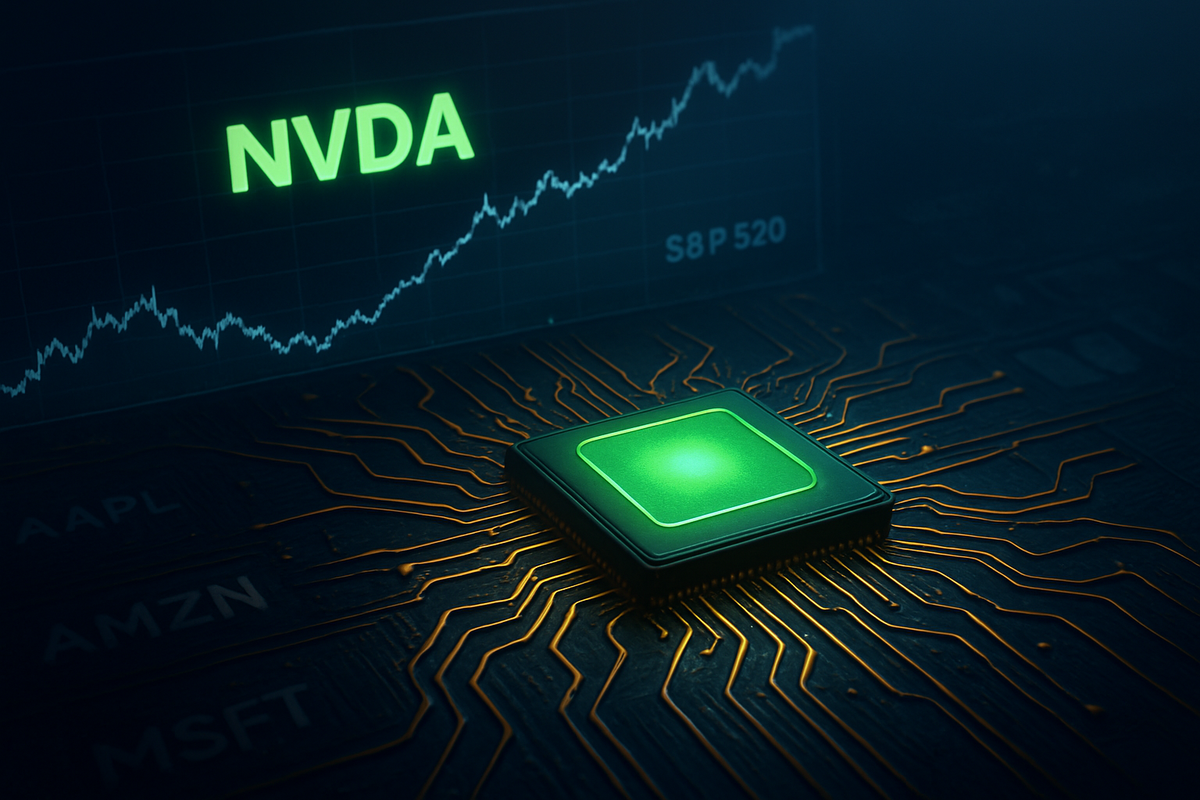
As we approach the final days of 2025, the financial world remains gripped by a phenomenon now known as the "Nvidia Effect." What began as a semiconductor success story has evolved into a structural shift in the global equity markets, with NVIDIA Corporation (NASDAQ: NVDA) exerting an unprecedented level of control over the S&P 500. For much of the past year, the index has functioned less like a broad basket of American commerce and more like a leveraged bet on a single company’s ability to reinvent the world through artificial intelligence.
The implications of this concentration are staggering. In 2024, Nvidia was responsible for nearly 22.4% of the S&P 500's total return, a trend that has persisted through 12/22/2025. While this dominance has propelled the index to record highs, it has also created a "double-edged sword" for passive investors. When Nvidia surges, the market follows; when it stumbles, the broader index provides little safety, as the standard market-cap-weighted S&P 500 has become increasingly decoupled from the performance of the average American stock.
The Year of Blackwell and the 8% Weighting
The story of 2025 has been defined by the high-stakes rollout of Nvidia’s Blackwell architecture. Following a brief period of volatility in late 2024—sparked by rumors of design "mask issues"—the company silenced skeptics by ramping up production to an estimated 800,000 units in the first quarter of 2025. CEO Jensen Huang’s description of demand as "insane" proved to be an understatement, as hyperscalers like Microsoft (NASDAQ: MSFT) and Alphabet (NASDAQ: GOOGL) engaged in a bidding war for the B200 and GB200 chips, which carry a 60-70% price premium over their predecessors.
This insatiable demand pushed Nvidia’s weighting in the S&P 500 to a historic peak of approximately 8% earlier this year. This is the highest concentration for any single stock in the index in over five decades, surpassing the multi-year dominance of Apple (NASDAQ: AAPL). The result is a market where Nvidia’s quarterly earnings reports are no longer just corporate updates; they have become "macro events" that move not only the tech sector but also uncorrelated assets like Bitcoin and international indices.
The divergence between the "haves" and "have-nots" is most visible when comparing the standard S&P 500 to the S&P 500 Equal Weight Index (NYSEARCA:RSP). In 2024, the standard index outperformed its equal-weighted counterpart by a massive 12.5%, the largest gap in recent history. However, the first quarter of 2025 provided a stark warning: during a brief tech-led sell-off in February, the cap-weighted S&P 500 fell nearly 5%, while the Equal Weight version held up significantly better, falling only 2.9%. This "Nvidia Effect" in reverse highlighted the fragility of a market where the top 10 companies now account for nearly 40% of the index's total value.
The AI Ecosystem: Winners and Losers
While Nvidia sits at the apex of the AI revolution, its dominance has created a secondary tier of "infrastructure winners." Vertiv Holdings Co (NYSE: VRT) has emerged as a standout performer in 2025, with its stock price tracking Nvidia’s rise. As AI rack densities reached 300kW, traditional air cooling became obsolete, making Vertiv’s direct liquid cooling (DLC) technology the industry standard. Similarly, Taiwan Semiconductor Manufacturing Company (NYSE: TSM) has solidified its role as the world's indispensable foundry, securing over 70% of the advanced packaging capacity required for Nvidia’s next-gen chips.
On the hardware side, Dell Technologies (NYSE: DELL) has successfully pivoted into the AI server market, reporting a record $14 billion backlog by the third quarter of 2025. Meanwhile, memory giant Micron Technology (NASDAQ: MU) has benefited from the transition to HBM4 memory, which is critical for Nvidia’s 2026 roadmap. Even Advanced Micro Devices (NASDAQ: AMD) has found a profitable niche as the "credible alternative," capturing roughly 40% of the cloud server market among providers looking to mitigate the "Nvidia Tax."
However, the "Nvidia Effect" has not lifted all boats. Super Micro Computer (NASDAQ: SMCI), once a high-flyer, faced a 70% drawdown this year due to internal governance issues and a margin-crushing price war with Dell. Broadcom (NASDAQ: AVGO) also faced headwinds as hyperscalers push for cheaper custom silicon to bypass Nvidia’s 75%+ profit margins. Perhaps most notably, Intel (NASDAQ: INTC) has spent much of 2025 in a state of transition, only staging a late-year comeback by pivoting toward AI inference and striking a strategic partnership to integrate Nvidia GPUs with Intel CPUs.
Historical Echoes and Regulatory Storms
The current market environment has invited frequent comparisons to the year 2000, when Cisco Systems (NASDAQ: CSCO) became the world's most valuable company during the Dot-com boom. Like Cisco, Nvidia provides the "picks and shovels" for a technological paradigm shift. However, analysts point out a key difference: valuation. While Cisco peaked at a staggering 200x price-to-earnings (P/E) ratio, Nvidia in late 2025 trades at a more grounded 30x–35x forward P/E, supported by actual triple-digit earnings growth rather than speculative projections.
Despite this fundamental strength, Nvidia is navigating the most intense regulatory environment in its history. As of December 2025, the U.S. Department of Justice is actively investigating the company for alleged antitrust violations, specifically regarding claims that it pressured customers to avoid competitors like AMD. In Europe, regulators are scrutinizing the acquisition of Run:ai, fearing that Nvidia’s bundling of hardware and software (the CUDA moat) creates an insurmountable barrier for startups.
Geopolitics also remains a wildcard. A significant trade policy shift by the Trump administration in mid-2025 allowed Nvidia to resume sales of the H200 chips to "approved" Chinese customers, provided the company pays a 25% "revenue-sharing fee" to the U.S. Treasury. This move reopened a $25 billion revenue stream but has added a layer of political complexity that keeps many institutional investors on edge.
Beyond Blackwell: The Rubin Era and Sovereign AI
Looking ahead to 2026, the market is already pricing in the next catalyst: the "Rubin" architecture. Named after astronomer Vera Rubin, this next-generation platform is expected to utilize TSMC’s 3nm and 2nm nodes, promising a 4x performance leap over Blackwell. The shift toward the "Vera" CPU also signals Nvidia’s intent to move toward a "CPU-first" data center strategy, potentially encroaching further on territory once held by Intel and AMD.
Furthermore, the "Sovereign AI" initiative has become a multi-billion dollar tailwind. National governments—including Saudi Arabia, the UAE, and Japan—are building domestic AI clusters to ensure data sovereignty. This segment is on track to deliver over $20 billion in revenue for Nvidia in 2025, providing a crucial diversification of the company’s customer base away from the "Magnificent Seven" American tech giants.
The Road Ahead for Investors
As we close out 2025, the "Nvidia Effect" remains the dominant force in global finance. The key takeaway for the coming months is that while Nvidia’s fundamentals remain robust, the S&P 500’s high concentration means that market-wide volatility is now inextricably linked to the fortunes of a single semiconductor firm. Investors should watch for the first signs of "AI fatigue" among hyperscalers, as well as the progression of the DOJ’s antitrust probe.
The market moving forward will likely be characterized by a "wait and see" approach regarding the Rubin rollout. While the AI revolution is far from over, the era of easy gains from index-wide momentum may be shifting toward a stock-picker’s market, where infrastructure providers and specialized software firms begin to capture a larger share of the value. For now, the S&P 500 remains a house built on a foundation of silicon, and as long as Nvidia continues to deliver, the house stands firm.
This content is intended for informational purposes only and is not financial advice