As of April 7, 2026, Tesla, Inc. (NASDAQ: TSLA) finds itself at the most significant crossroads in its twenty-three-year history. Once the undisputed king of the electric vehicle (EV) revolution, the Austin-based titan is currently undergoing a painful but purposeful metamorphosis. The company is transitioning from a high-growth automotive manufacturer into what CEO Elon Musk describes as a "Physical AI" powerhouse.
With a market capitalization hovering near $1.32 trillion, Tesla remains the world’s most valuable automaker by a staggering margin, despite losing its title as the top global seller of battery electric vehicles (BEVs) to China’s BYD in 2025. Today, the investment thesis for TSLA is no longer about how many cars it can deliver in a quarter, but rather the speed at which it can solve unsupervised autonomy and commercialize humanoid robotics. This article explores the intricate balance between Tesla's legacy hardware business and its burgeoning AI future.
Historical Background
Founded in 2003 by Martin Eberhard and Marc Tarpenning, with Elon Musk joining as lead investor shortly after, Tesla’s mission was to prove that electric cars could be better, quicker, and more desirable than gasoline-powered counterparts. The 2008 Roadster set the stage, but the 2012 launch of the Model S redefined the industry.
The company's history is marked by "bet-the-company" moments. The 2017–2019 "production hell" of the Model 3 nearly led to bankruptcy before the car became the best-selling EV globally. The subsequent years (2020–2021) saw a parabolic rise in valuation as Tesla scaled Giga Shanghai and Berlin, becoming the first automaker to achieve high-margin mass production of EVs. However, 2024 and 2025 were characterized by a "valuation reset" as higher interest rates and a cooling global EV market forced Tesla to slash prices, impacting its once-peerless margins and forcing the strategic pivot toward AI and the "Cybercab" platform we see today.
Business Model
Tesla operates through two primary segments: Automotive and Energy Generation & Storage.
- Automotive (85% of Revenue): This includes the sale of the Model 3, Y, S, X, and the Cybertruck. Revenue is also derived from regulatory credits and "Services & Other," which encompasses Supercharging, insurance, and performance software.
- Energy Generation & Storage (13% of Revenue): This segment is Tesla’s fastest-growing arm. It involves the sale of Powerwalls for homes and Megapacks for utility-scale projects. In 2025, the energy segment reached record deployment levels, providing a crucial buffer against fluctuating car sales.
- AI and Robotics (Emerging): While not yet a standalone reporting segment, this includes Full Self-Driving (FSD) subscriptions and the nascent commercialization of the Optimus humanoid robot.
Tesla’s customer base has shifted from early-adopting tech enthusiasts to mass-market consumers, though it is increasingly targeting industrial clients for its energy and robotics products.
Stock Performance Overview
Tesla’s stock performance has been a roller coaster for long-term holders.
- 10-Year View: An astronomical return of approximately 10,850% has made TSLA a legendary "wealth creator."
- 5-Year View: The stock is up ~57% from April 2021, a period marked by massive volatility, including a 2022 crash and a 2023 recovery.
- 1-Year View: TSLA is up ~51% over the last 12 months, recovering from a deep 2025 trough as the market began to price in the "AI story."
- Year-to-Date (2026): The stock is down ~21.5% as of April 7, 2026, following a Q1 delivery miss of 358,000 units against higher Wall Street expectations.
Financial Performance
The fiscal year 2025 was a year of consolidation. Tesla reported an annual revenue of $94.8 billion, representing a 3% decline—the first in its history—due to lower average selling prices and a saturated EV market.
However, efficiency gains have started to bear fruit. Q4 2025 gross margins rebounded to 20.1%, up from the mid-17% range seen earlier that year. Free Cash Flow (FCF) for 2025 stood at $6.2 billion, demonstrating the company’s ability to remain self-funding even during a capital-intensive product shift. Currently, Tesla holds one of the strongest balance sheets in the industry, with roughly $29 billion in cash and equivalents, providing the "war chest" needed for the Optimus and Cybercab ramps.
Leadership and Management
Elon Musk remains the central, and often polarizing, figure of Tesla. In December 2025, a landmark Delaware Supreme Court ruling reinstated Musk's 2018 $56 billion pay package, ending a multi-year legal saga. Following this, shareholders approved a new incentive plan geared toward a $10 trillion market cap, cementing Musk’s long-term commitment to the company.
The leadership team has seen significant stabilization after the departures of 2024. The addition of Jack Hartung (former CFO of Chipotle) to the board in 2025 brought much-needed governance rigor. Nevertheless, the company's strategy remains heavily top-down, with Musk’s vision for "unsupervised autonomy" driving almost every capital allocation decision.
Products, Services, and Innovations
Tesla’s product pipeline is currently focused on three pillars:
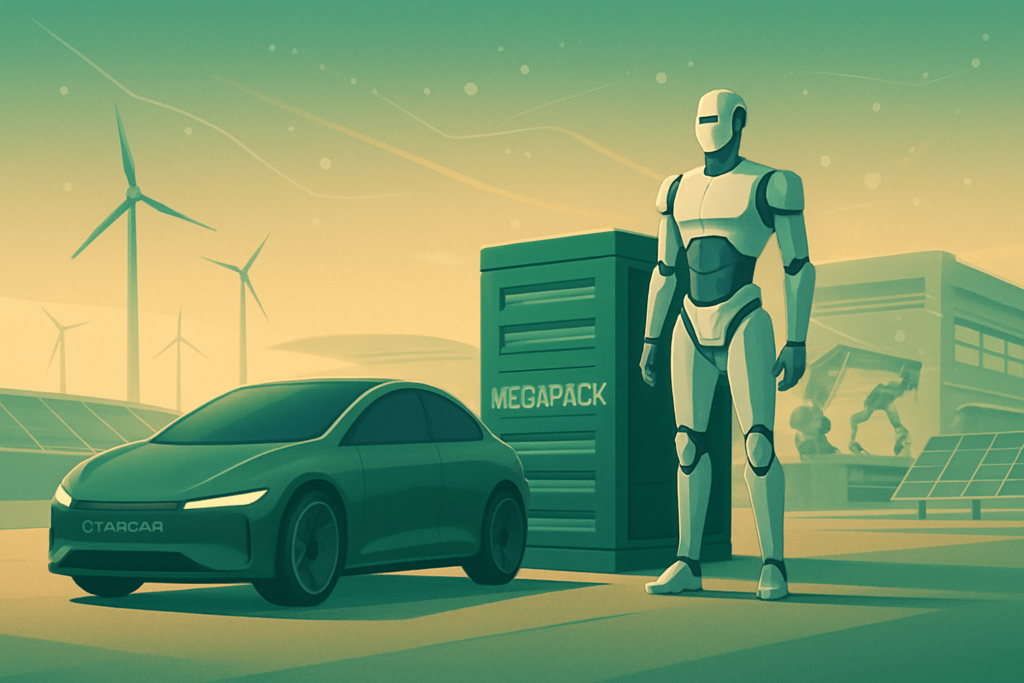
- The Cybercab: Scheduled for mass production starting this month (April 2026), the Cybercab is a dedicated robotaxi with no steering wheel or pedals. It utilizes Tesla’s "Unboxed" manufacturing process, designed to reduce costs by 50%.
- Optimus (Humanoid Robot): Now in "Gen 3" pilot production, Optimus is currently performing basic logistics tasks in Tesla factories. External deliveries for industrial partners are slated for late 2026.
- FSD v14.3 and AI5: Tesla’s latest FSD version has moved toward an "end-to-end neural net" architecture. The new AI5 computer, which began shipping in late 2025, offers 10x the compute power of the previous Hardware 4, enabling more complex decision-making in urban environments.
Competitive Landscape
The landscape has changed dramatically since 2023. Tesla is no longer just fighting legacy automakers like Ford (F) and Volkswagen (VOW3.DE); it is in a fierce battle with Chinese tech-heavy OEMs.
- BYD (1211.HK): Surpassed Tesla in BEV volume in 2025, leveraging a vertically integrated supply chain and low-cost batteries.
- Xiaomi (1810.HK): The smartphone giant’s entry into the EV space has successfully challenged Tesla’s Model 3 in the premium sedan segment.
- Legacy OEMs: Companies like General Motors (GM) have largely pulled back on aggressive EV targets, inadvertently giving Tesla more breathing room in the US market, even as demand slows.
Industry and Market Trends
The "EV gold rush" has cooled, replaced by a "hybrid hedge" from many consumers. However, Tesla’s dominance in the charging infrastructure (NACS standard) has turned its Supercharger network into a steady, high-margin utility. Furthermore, the global shift toward AI infrastructure has made Tesla’s Dojo supercomputer and distributed inference (using the car fleet) a unique asset that traditional car companies cannot replicate.
Risks and Challenges
- Execution Risk: The "Unboxed" manufacturing process is unproven at scale. Any delays in the Cybercab ramp could lead to another "production hell" scenario.
- Regulatory Scrutiny: Despite technical progress, "unsupervised" FSD requires a patchwork of state and federal approvals. A single high-profile accident could trigger massive regulatory rollbacks.
- Concentration Risk: Tesla is deeply tied to Musk’s personal brand and bandwidth. His involvement in X (formerly Twitter), SpaceX, and xAI continues to raise concerns about "key-man risk."
- China Exposure: With Giga Shanghai producing over half of Tesla's global volume, any escalation in US-China trade tensions remains a systemic threat.
Opportunities and Catalysts
- FSD Licensing: Musk has hinted at ongoing discussions with two major legacy OEMs to license FSD. A deal here would provide high-margin software revenue with zero hardware cost.
- Energy Storage: The new "Megablock" (a 20 MWh storage unit) is seeing massive demand from utilities looking to stabilize aging power grids.
- Robotaxi Launch: The planned pilot of a Tesla-branded ride-hailing app in Austin and Las Vegas later this year could be the "iPhone moment" for Tesla’s services division.
Investor Sentiment and Analyst Coverage
Wall Street is deeply divided.
- Bulls (e.g., Dan Ives, Wedbush): Maintain targets near $600, arguing that Tesla is an AI company unfairly valued as an auto company. They see the Robotaxi and Optimus as $10 trillion opportunities.
- Bears (e.g., Ryan Brinkman, JPMorgan): Set targets as low as $145, focusing on deteriorating vehicle demand, the expiration of the US $7,500 tax credit in late 2025, and record levels of unsold inventory.
- Retail Sentiment: Remains fiercely loyal, often viewing TSLA as a "technology index" rather than a car stock.
Regulatory, Policy, and Geopolitical Factors
The regulatory environment is a double-edged sword. While the expiration of US federal tax credits in September 2025 hindered domestic sales, Tesla has benefited from favorable EU tariff rulings. Because of Giga Shanghai’s efficiency, the EU imposed a relatively low 7.8% tariff on Tesla exports compared to the 35%+ imposed on other Chinese manufacturers. Geopolitically, Tesla remains the only Western automaker with a 100%-owned factory in China, a position that requires a delicate diplomatic balancing act.
Conclusion
Tesla in April 2026 is no longer a growth story based on car volumes; it is a high-stakes wager on the future of autonomous intelligence. Investors must weigh the near-term headwinds of a stagnating automotive market and missing Q1 deliveries against the transformative potential of the Cybercab and Optimus.
For the risk-averse, Tesla’s current valuation remains difficult to justify based on car sales alone. For the visionary investor, the company represents the most advanced and well-funded effort to merge AI with the physical world. The coming 12 months, specifically the success of the Cybercab production and the Austin robotaxi pilot, will likely determine whether Tesla returns to its $2 trillion glory or faces a "lost decade" as a niche hardware player.
This content is intended for informational purposes only and is not financial advice.