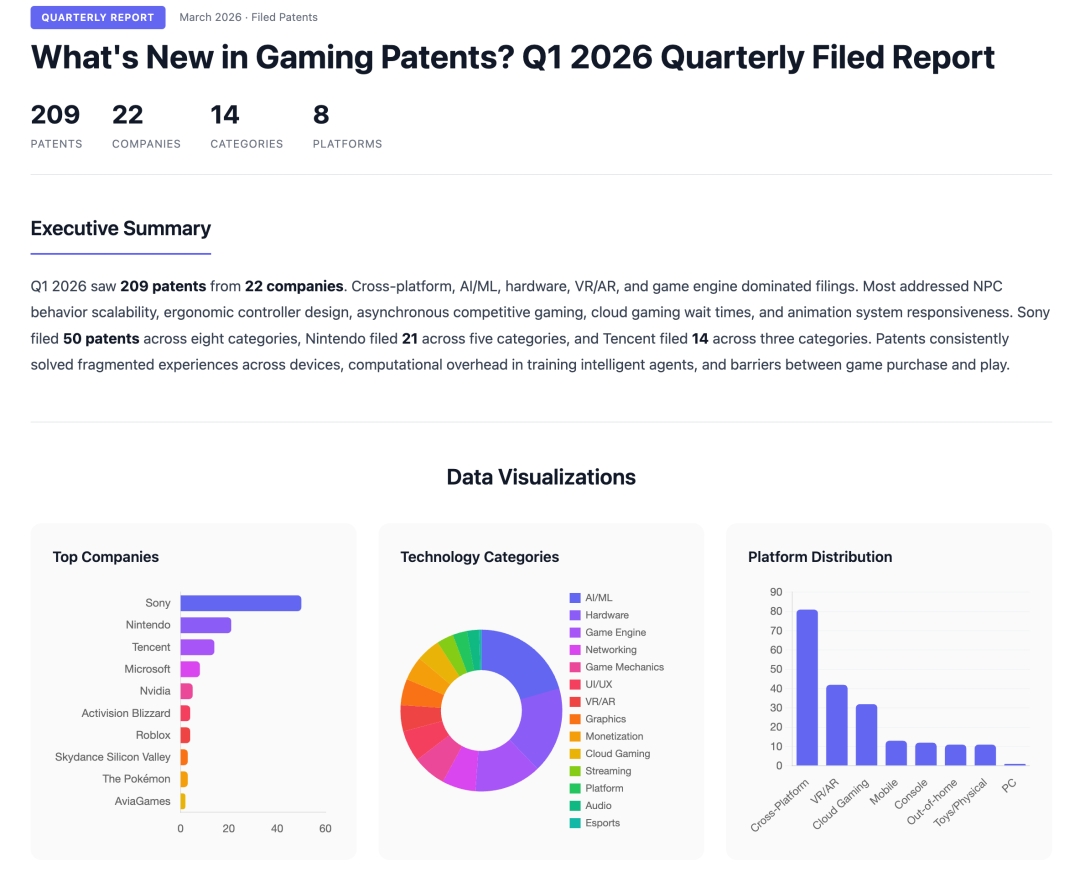
PRAGUE, CZECH REPUBLIC - Apr 8, 2026 - Future of Gaming, the strategic intelligence platform tracking gaming patents from the USPTO, has published its Q1 2026 Quarterly Filed Report analyzing 209 patent applications from 22 companies. The report reveals cross-platform technology as the quarter's dominant filing category, with 81 patents addressing the problem of fragmented gaming experiences across devices.
"Cross-platform filed more patents than AI, hardware, and game engines individually," said Alex Kirillov, founder of Future of Gaming. "That tells you where the real engineering effort is going. The industry has accepted that players move between phone, console, and PC constantly, and right now the infrastructure to support that seamlessly doesn't exist. That's what these 81 patents are trying to fix."
Key Findings
Cross-platform leads all categories with 81 patents. Save synchronization, unified account systems, and controller compatibility across devices dominated Q1 filings. Multiple companies filed patents solving the same core problem: players lose progress, settings, and context when switching hardware. The volume exceeded AI/ML (43), hardware (36), and game engines (28) individually.
Sony filed more patents than the next three companies combined. Sony's 50 patents span eight categories, from AI-driven podcast generation to MEMS microphone designs and procedural hair rendering. This breadth contrasts with more focused filings from Nintendo (21 patents across five categories) and Tencent (14 patents across three categories).
NPC intelligence is an industry-wide priority. Eight patents from four companies (Tencent, Sony, Microsoft, AMD) address the same problem: controlling hundreds of NPCs without computational overhead. Tencent developed dual-layer control systems where group logic modifies status parameters across multiple NPCs without individual instruction delivery. AMD created leader-follower hierarchies where advanced NPCs demonstrate behaviors that followers learn from.
Asynchronous competitive gaming is emerging. Six patents from three companies (AviaGames, Nintendo, Valve) enable players to compete against AI-driven replays of historical performances, eliminating the need to find opponents online simultaneously. AviaGames filed multiple patents using skill-based matchmaking and shared random seeds to ensure identical playing conditions between live and replayed sessions.
Cloud gaming is solving the download problem. Valve created systems monitoring file access patterns to enable instant play by pre-downloading critical files while streaming the rest in the background. Multiple patents from Valve, Huawei, and Adeia target the barrier between purchase and play created by 100GB+ game downloads.
Ergonomic controller design attracted five companies. Nintendo, Qanba USA, Chicony Electronics, Shenzhen Qanba, and Sony all filed patents addressing physical discomfort during extended play. Solutions range from unibody housings eliminating grip seams to adjustable button height mechanisms and arc-shaped keyboard layouts.
Company Strategies
The report breaks down strategic direction for each major filer:
Sony (50 patents, 8 categories) spread investment across AI personalization, procedural graphics, cloud infrastructure, VR, streaming, audio, and game engine tooling. A recurring theme across their filings is replacing storage retrieval with real-time generation, from procedural hair rendering to on-the-fly 3D asset creation.
Nintendo (21 patents, 5 categories) concentrated on hardware ergonomics and game engine innovation, including racing systems enabling character switching across open fields and seamless transitions between exploration and racing modes.
Tencent (14 patents, 3 categories) focused on mobile UI optimization and NPC intelligence, with four patents addressing multitasking friction through floating windows and shareable quest path systems.
Microsoft (8 patents, 3 categories) filed exclusively around gameplay assistance infrastructure, including AI testing bots that operate through virtual controller emulation and proximity-based authentication letting players temporarily access console profiles from their smartphones.
Report Access
The full Q1 2026 Quarterly Filed Report, including detailed technology trend analysis, platform distribution breakdowns, company strategy sections, and emerging theme identification, is available at Future of Gaming.
Future of Gaming publishes quarterly reports covering all gaming patent activity alongside twice-weekly patent analyses, monthly reports with company rankings and technology trends, and real-time trend tracking across 14 technology categories.
Media Contact
Company Name: Future Of Gaming
Contact Person: Alex Kirillov
Email: Send Email
Country: Czech Republic
Website: https://futureofgaming.com