As more entrepreneurs launch Shopify stores, the gap between “getting sales” and “keeping profit” is driving a shift toward margin-first setup, lean app stacks, and realistic income expectations.
Launching a Shopify store in 2026 can happen in a weekend. Turning that store into predictable income is a different story-and the difference is rarely effort alone.
New merchants are entering a market that moves faster than it did a few years ago. Competitors can copy products and creatives quickly. Customers expect clearer shipping timelines and smoother post-purchase experiences. And fees-payment processing, apps, refunds, shipping variability-quietly scale with revenue. The result is a common early-stage pattern: stores get “busy,” sometimes even hit decent sales numbers, but struggle to understand why profit feels thin.
That’s why many Shopify newcomers are shifting toward a profit-first approach from day one: start lean, build trust quickly, install only the apps that earn their keep, and set expectations using realistic earnings benchmarks rather than viral success stories.
The Shopify model you choose decides your early profit ceiling
Shopify is a platform, not a business model. Before a merchant chooses a theme or installs apps, the most important decision is what kind of store they’re building-because the model determines margins, cash needs, and operational complexity.
In 2026, most new stores start in one of these directions:
Dropshipping and print-on-demand remain popular because they reduce inventory risk and speed up validation. Stocked inventory and private label offer more control (and often stronger brand equity), but require more upfront capital and tighter operations. Digital products can be high margin, but depend heavily on positioning and trust.
There isn’t a universally “best” model. The better question is: which model can you execute consistently while keeping customer expectations clear and margins healthy?
How much can merchants make on Shopify in 2026?
Income expectations can either keep a merchant motivated-or push them into the wrong decisions.
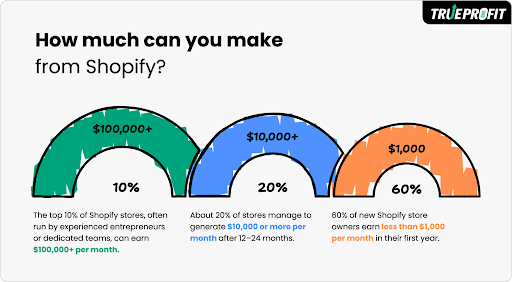
According to TrueProfit’s analysis, outcomes are not evenly distributed: 60% of new Shopify stores earn under $1,000/month, 20% reach $10,000+ per month after consistent effort, and the top 10% make $100,000+ per month.
The key phrase is “consistent effort.” Merchants who move up income tiers tend to build repeatable systems rather than rely on single-product luck: a product mix with margin buffer, one dependable traffic engine, and cost discipline that prevents profit leaks.
For a deeper breakdown of earnings ranges and what typically drives them, see average Shopify store earnings revenue 2026.
Shopify fees in 2026 aren’t just the plan price
Many new merchants treat Shopify costs as a monthly subscription line item. In practice, Shopify costs behave more like a stack: a fixed monthly base plus per-order fees that scale as soon as sales pick up.
Even without getting lost in rate tables, the categories are predictable:
Your fixed costs typically include your Shopify plan and any recurring tools or app subscriptions. Your per-sale costs include payment processing and, depending on payment setup and region, additional transaction-related fees and currency conversion costs. As order volume grows, these “small” percentages and per-transaction charges become meaningful-especially for low average order value stores where fixed components (like per-transaction fees) take a bigger bite.
In 2026, the merchants who protect profit early treat fees like a part of pricing-not an afterthought.
The fastest way new stores get unprofitable: app overload
A modern Shopify store can look polished because of apps: review widgets, bundles, upsells, email automation, popups, shipping add-ons, analytics dashboards, and more.
But apps have a hidden behavior: they turn your store into a subscription stack. One app at $19/month doesn’t feel dangerous. Ten apps at $19–$49/month quietly becomes a meaningful fixed cost, especially for stores earning under $1,000/month.
That’s why a growing number of merchants now treat apps like hires. Every app needs a job, and that job should either increase revenue (conversion, retention, trust) or protect profit (automation, operational accuracy, analytics). If an app doesn’t clearly earn its keep, it becomes cost creep.
Installing the right Shopify apps in 2026 (and avoiding expensive guessing)
Most beginners install apps based on recommendations, influencer screenshots, or Shopify App Store browsing. A more reliable approach is competitive observation: look at stores in your niche that already convert well, then figure out what they use-and why.
That’s where TrueProfit’s Shopify App Detector becomes useful. It helps merchants quickly identify apps running on a Shopify store, which can shorten the research cycle and reduce “trial-and-error” installs that create unnecessary monthly costs.
Merchants typically use app detection for three practical reasons:
First, to understand what’s common in a niche (for example, whether most competitors rely on a specific review app or bundling approach). Second, to spot patterns in higher-quality stores-especially around trust-building, post-purchase flows, and conversion optimization. Third, to avoid redundant tooling by seeing which apps appear to cover multiple functions.
The goal isn’t to copy blindly. It’s to install apps intentionally-based on what your store actually needs at its current stage.
A lean app stack that supports profit-first growth
In most cases, new stores don’t need ten apps on day one. They need a small stack that supports trust and basic operations.
Early-stage stores typically benefit most from a simple trust layer (reviews or social proof), a basic retention layer (email capture and follow-ups), and a customer support layer (FAQ or chat). Depending on the model, the next layer might be bundles/upsells, shipping clarity tools, or subscription functionality.
The “profit-first” principle is straightforward: install what improves outcomes, remove what doesn’t, and review monthly the same way you review ad spend.
Why many Shopify stores scale revenue and still feel “stuck”
The most common reason is fragmented visibility.
Revenue is visible in Shopify. Costs are scattered: payment fees in one place, apps in another, shipping variability in fulfillment tools, refunds over time, and marketing spend in ad platforms. When these costs aren’t viewed together, merchants make decisions based on partial truth.
That’s why a store can “look like it’s working” and still struggle to keep profit.
This is also why merchants increasingly measure success less by “sales volume” and more by whether the business can keep margin after real operating costs-especially once marketing becomes a serious lever.
Where TrueProfit fits as stores mature past the beginner stage
As merchants move beyond early experiments, profit clarity becomes more valuable than more tools. TrueProfit is positioned as a Net Profit Analytics platform built for Shopify and ecommerce merchants (including dropshippers and POD sellers) who want profit-first visibility as their store gains more moving parts.
TrueProfit focuses on keeping profitability legible-so decisions about products, marketing, and scaling are grounded in what the merchant actually keeps after costs.
TrueProfit’s core capabilities include:
- Real-time profit dashboard (product, ad channel, store level): Helps merchants see what’s truly profitable across the store and drill into the products and channels that keep margin.
- Accurate cost tracking: Helps capture the “ignored costs” that erode profitability-COGS, payment processing fees, international and currency conversion fees, Shopify app fees, premium theme costs, shipping and fulfillment, refunds, taxes, and custom costs.
- Ad spend sync: Helps evaluate marketing using profitability outcomes rather than surface metrics alone.
- P&L reporting: Helps merchants review weekly or monthly performance in a structured way and spot profit leaks earlier.
- Customer value insights: Helps guide acquisition and retention decisions with long-term profitability in mind.
- Mobile monitoring and all-store view: Helps owners monitor profit changes across stores quickly without relying on spreadsheet-heavy workflows.
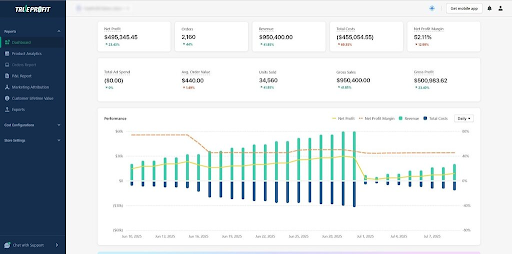 In practical terms, the benefit is decision quality. Merchants can identify which products are truly profitable after fees and refunds, which channels produce real profit, and where cost creep is quietly rising.
A practical checklist for starting Shopify in 2026 without overbuilding
In 2026, many stores don’t fail because the merchant didn’t work hard. They fail because the merchant built complexity before building clarity.
A profit-first start usually looks like this: pick a model you can execute, choose a niche you can market clearly, launch a minimum viable store that earns trust, keep the app stack lean, and anchor expectations using realistic earnings benchmarks. From there, track costs early so scaling decisions are based on what you actually keep-not just what Shopify reports as sales.
The bigger trend: “profit-first” is replacing “launch-fast” culture
The Shopify ecosystem will likely continue to lower the barrier to launch. The constraint is no longer “can I start?”-it’s “can I build something that stays profitable when competition and costs rise?”
In 2026, merchants who win tend to treat profit as a discipline, not a hope: margin-aware product selection, intentional app stacks, realistic earnings expectations, and systems that prevent hidden fees and operational friction from eating the business alive.