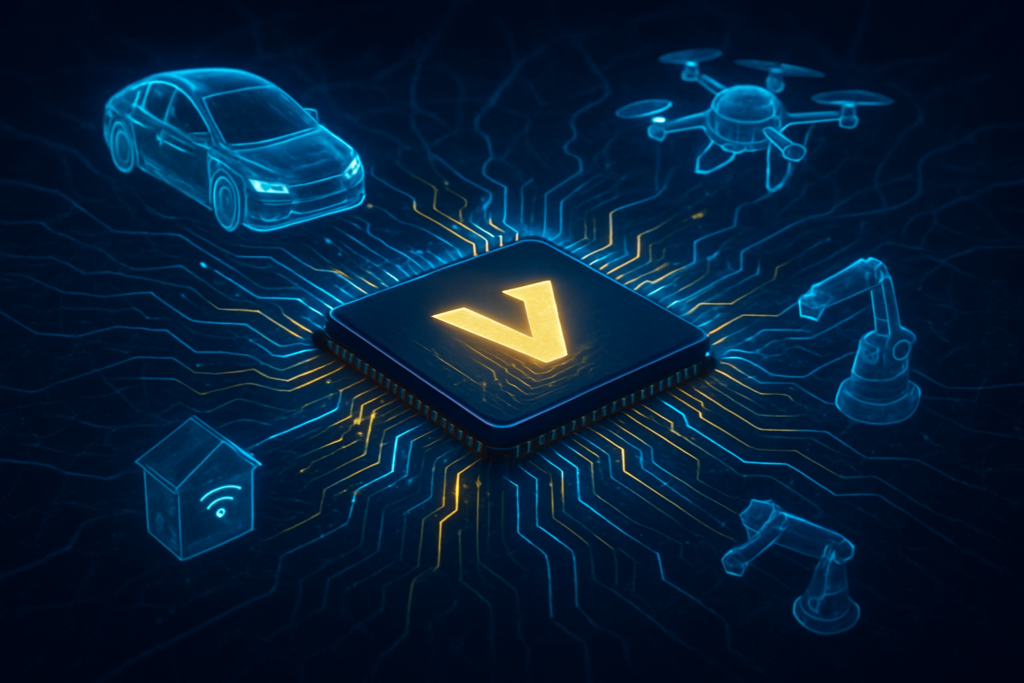
As of February 2026, the global semiconductor landscape has undergone a tectonic shift, marking the end of the long-standing x86 and ARM duopoly. RISC-V, the open-standard Instruction Set Architecture (ISA), has matured from a promising academic project into a dominant industrial powerhouse. This evolution is most visible in the automotive and Internet of Things (IoT) sectors, where the architecture now commands a staggering 25% and 55% of new design wins respectively. By offering a royalty-free, highly customizable alternative, RISC-V has become the cornerstone of the "Software-Defined Everything" era, enabling a new level of hardware-software co-design that was previously impossible under restrictive proprietary licenses.
The significance of this milestone cannot be overstated. For decades, chip designers were forced to choose between the high-performance but power-hungry x86 architecture or the efficient but strictly controlled ARM ecosystem. Today, RISC-V provides a third pillar that balances performance with unprecedented flexibility. This "architecture sovereignty" allows tech giants and startups alike to bake their own proprietary AI accelerators and safety features directly into the processor core. As the industry moves toward 2027, the "ARM Tax"—the multi-million dollar licensing fees and per-chip royalties—has shifted from a standard business expense to a competitive liability, driving a massive migration toward the open-source frontier.
Technical Maturity: From Embedded Controllers to High-Performance AI
The technical breakthrough that defined 2025 and 2026 was the finalization and widespread implementation of the RVA23 profile. Previously, RISC-V faced criticism for "fragmentation," where different chip makers implemented features in incompatible ways. The RVA23 standard unified the ecosystem, providing a stable baseline for operating systems like Android and enterprise Linux distributions. In April 2026, the release of Ubuntu 26.04 LTS became a landmark event, offering the first long-term supported enterprise OS with native, high-performance optimization for RISC-V, effectively putting it on equal footing with x86 for server and edge applications.
A key technical differentiator in 2026 is the RISC-V Vector (RVV) 1.0 extension. Unlike ARM (Nasdaq: ARM) or Intel (Nasdaq: INTC) architectures, which often require separate, specialized AI chips, RISC-V’s vector extensions allow for massive parallel processing of AI workloads directly within the CPU. Companies like Tenstorrent and SiFive have released "Ascalon-class" cores that rival the performance of ARM’s Neoverse V3. These chips use 512-bit vector widths to handle complex sensor fusion and machine learning telemetry in real-time, which has proven critical for the low-latency requirements of autonomous systems.
Furthermore, the rise of "Shift-Left" development methodologies has been accelerated by RISC-V’s open nature. Automakers are now using "Digital Twins" of RISC-V hardware—fully functional software models of the chip—to begin writing and testing vehicle code years before a physical chip is even manufactured. This has reduced the development cycle for new vehicle platforms from the traditional five years down to just three. Because the ISA is open, developers can inspect every instruction, ensuring that safety-critical "Zero Trust" security protocols are hard-coded into the silicon, a level of transparency that proprietary architectures cannot match.
The software ecosystem has finally caught up to the hardware. In late 2025, Google (Nasdaq: GOOGL) designated RISC-V as a "Tier 1" architecture for Android, finalizing the Native Development Kit (NDK) and Application Binary Interface (ABI). This move has paved the way for the first wave of commercial RISC-V smartphones appearing in early 2026. While these devices currently target the mid-range and budget markets in Asia, the technical foundation is now in place for RISC-V to challenge ARM’s 95% dominance of the mobile processor market by the end of the decade.
The Economic Earthquake: Challenging the ARM and x86 Giants
The maturation of RISC-V has sent shockwaves through the boardrooms of established chip giants. Qualcomm (Nasdaq: QCOM), once one of ARM’s largest customers, has aggressively pivoted toward RISC-V following high-profile licensing disputes. By acquiring Ventana Micro Systems in 2025, Qualcomm has begun integrating its own high-performance RISC-V cores into its Snapdragon automotive and IoT platforms. This strategic move allows Qualcomm to bypass ARM’s restrictive licensing terms and potentially save billions in royalty payments over the next decade, while gaining the freedom to innovate at the instruction level.
In the automotive sector, the Quintauris joint venture—a powerhouse consortium including Bosch, Infineon (OTC: IFNNY), Nordic Semiconductor, NXP (Nasdaq: NXPI), and Qualcomm—has successfully established a standardized RISC-V platform for Software-Defined Vehicles (SDVs). By early 2026, this venture has turned RISC-V into the industry standard for zonal controllers, the "brains" that manage everything from power steering to infotainment. This collective approach has effectively neutralized ARM’s historical advantage in the automotive space, as manufacturers now prefer a communal, open-source architecture that no single company can gatekeep or monopolize.
The impact on the IoT market has been even more dramatic. With over 55% of new IoT designs now utilizing RISC-V, the architecture has become the default choice for connected devices. The royalty-free model has reduced bill-of-materials (BOM) costs by as much as 50% for high-volume sensors and smart home devices. This cost advantage has allowed companies to reinvest savings into more robust on-device AI and security features. For startups, the low barrier to entry provided by RISC-V has sparked a renaissance in "bespoke silicon," where small teams can design custom chips for niche industrial applications without the $10 million+ upfront licensing costs associated with proprietary ISAs.
Legacy players are reacting with varying degrees of urgency. While Intel has embraced RISC-V through its foundry services (IFS), offering to manufacture RISC-V chips for others, it faces a long-term threat to its x86 dominance in the data center. Meta (Nasdaq: META) and NVIDIA (Nasdaq: NVDA) have already integrated millions of RISC-V cores into their internal infrastructure—Meta for its MTIA AI inference accelerators and NVIDIA for managing telemetry and secure boot across its entire GPU lineup. For these giants, RISC-V isn't just a cost-saving measure; it’s a strategic tool for vertical integration, allowing them to control the entire stack from the silicon to the cloud.
A New Era of Open-Source Infrastructure and Global Resilience
The rise of RISC-V in 2026 represents a broader trend toward technological de-globalization and national self-reliance. As trade tensions continue to influence the tech sector, RISC-V has emerged as a "neutral" architecture. Because no single nation or company owns the ISA, it serves as a common language for global innovation that is immune to specific export bans or entity-list restrictions. This has made RISC-V particularly attractive in the European Union and Asia, where governments are subsidizing open-source hardware projects to ensure their domestic industries are not overly dependent on US- or UK-based IP.
This shift mirrors the "Linux moment" for hardware. Just as Linux broke the monopoly of proprietary operating systems in the 1990s and 2000s, RISC-V is doing the same for the processor world. The architecture has fostered a massive, global community of contributors, ensuring that security vulnerabilities are patched faster and optimizations are shared more broadly than in closed ecosystems. The 2026 landscape shows that "Security through Transparency" has won over "Security through Obscurity," with many government agencies now mandating RISC-V for critical infrastructure to ensure there are no hidden backdoors in the silicon.
However, this transition has not been without its challenges. The industry has had to grapple with the "Wild West" period of RISC-V development, where early adopters struggled with a lack of standardized tools and middleware. The successful stabilization of the ecosystem in 2026 is largely credited to the RISC-V International organization, which managed to herd the competing interests of hundreds of member companies toward a common goal. This level of industry cooperation is unprecedented and serves as a model for how other complex technologies, such as quantum computing and advanced robotics, might be governed in the future.
Comparisons to previous AI milestones are frequent. Analysts often liken the maturity of RISC-V to the launch of ChatGPT—a moment where a technology that had been "bubbling under the surface" for years suddenly achieved the performance and accessibility needed to change the world overnight. While ChatGPT revolutionized how we interact with data, RISC-V is revolutionizing the physical substrate upon which that data is processed. It is the silent engine driving the AI revolution at the edge, making sophisticated intelligence affordable, customizable, and ubiquitous.
The Horizon: AI-Native Silicon and the Path to the Data Center
Looking ahead to 2027 and beyond, the focus of the RISC-V community is shifting toward the high-performance computing (HPC) and server markets. While RISC-V has conquered IoT and made significant inroads into automotive, the data center remains the "final frontier" currently dominated by x86 and ARM. Experts predict that the next two years will see the rise of "AI-Native" servers, where RISC-V’s modularity allows for the seamless integration of hundreds of specialized neural cores on a single die. This could potentially disrupt the server market by offering significantly higher performance-per-watt for the specific math required by Large Language Models (LLMs).
We are also likely to see the emergence of the first true "Open-Source Consumer Ecosystem." With Android support finalized, the dream of a fully open-source laptop and smartphone—from the hardware instructions to the kernel to the user interface—is becoming a reality. This will likely appeal to a growing market of privacy-conscious consumers and enterprise users who require absolute control over their hardware. The challenge will be in hardware-software optimization; while RISC-V is capable, it will take time to match the decades of "fine-tuning" that Intel and Apple (Nasdaq: AAPL) have applied to their proprietary platforms.
Predictions for 2028 suggest that RISC-V will reach 15% of the total CPU market share, a meteoric rise considering its near-zero presence a decade prior. To reach this goal, the ecosystem must address the remaining gaps in high-end developer tools and ensure a steady pipeline of talent. Universities worldwide have already shifted their computer architecture curricula to center on RISC-V, ensuring that the next generation of engineers is "native" to the open-source model. As the "great decoupling" from proprietary architectures continues, the momentum behind RISC-V appears not just sustainable, but inevitable.
Summary of a New Computing Paradigm
The state of RISC-V in early 2026 is one of undeniable maturity and massive momentum. What began as a research project at UC Berkeley has fundamentally reordered the $600 billion semiconductor industry. By dominating the IoT sector and becoming the standard for the next generation of Software-Defined Vehicles, RISC-V has proven that an open-source model can outpace and out-innovate even the most entrenched proprietary giants. The royalty-free nature of the ISA has democratized silicon design, sparking a wave of innovation that is bringing AI and advanced connectivity to every corner of the global economy.
As we move through 2026, the industry should watch for the first commercial RISC-V mobile devices and the continued expansion of RISC-V into the data center. The "Architecture Wars" are far from over, but the battlefield has changed. No longer is the question whether RISC-V is viable; the question is how quickly the remaining proprietary strongholds will adapt to a world where the foundations of computing are free, open, and available to all. The "Great Decoupling" is here, and it is powered by RISC-V.
This content is intended for informational purposes only and represents analysis of current AI and semiconductor developments as of February 2026.
TokenRing AI delivers enterprise-grade solutions for multi-agent AI workflow orchestration, AI-powered development tools, and seamless remote collaboration platforms.
For more information, visit https://www.tokenring.ai/.