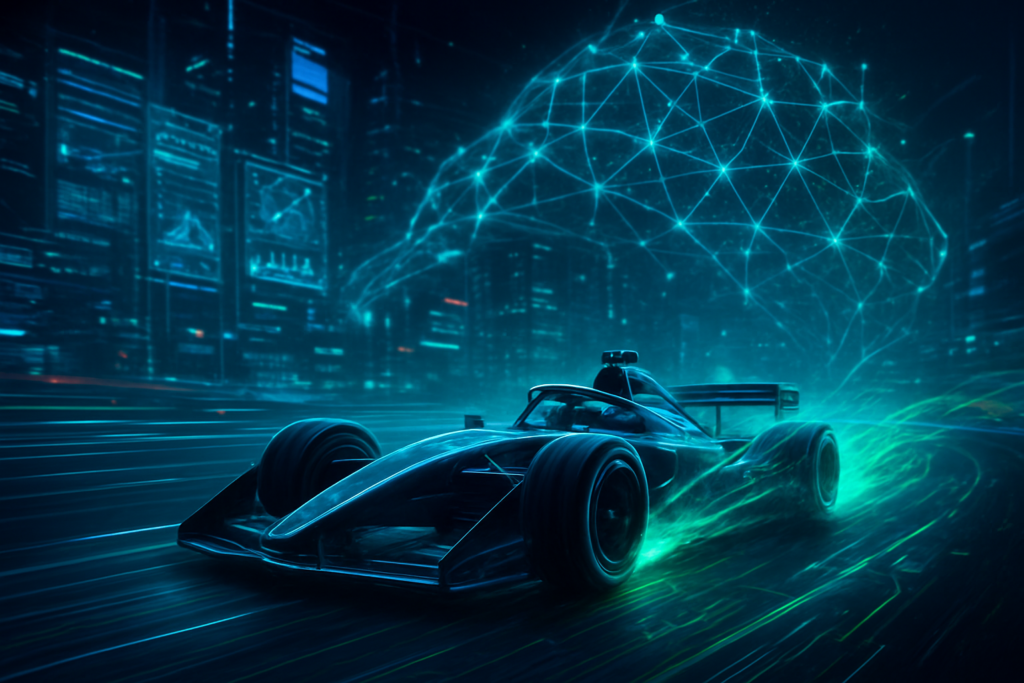
In a landmark move for the future of motorsport, Google Cloud (Alphabet – NASDAQ: GOOGL) and the ABB (NYSE: ABB) FIA Formula E World Championship have officially entered a new phase of their partnership, elevating the tech giant to the status of Principal Artificial Intelligence Partner. As of January 26, 2026, the collaboration has moved beyond simple data hosting into a deep, "agentic AI" integration designed to optimize every facet of the world’s first net-zero sport—from the split-second decisions of drivers to the complex logistics of a multi-continent racing calendar.
This partnership marks a pivotal moment in the intersection of high-performance sports and environmental stewardship. By leveraging Google’s full generative AI stack, Formula E is not only seeking to shave milliseconds off lap times but is also setting a new global standard for how major sporting events can achieve and maintain net-zero carbon targets through predictive analytics and digital twin technology.
The Rise of the Strategy Agent: Real-Time Intelligence on the Grid
The centerpiece of the 2026 expansion is the deployment of "Agentic AI" across the Formula E ecosystem. Unlike traditional AI, which typically provides static analysis after an event, the new systems built on Google’s Vertex AI and Gemini models function as active participants. The "Driver Agent," a sophisticated tool launched in late 2025, now processes over 100TB of data per hour for teams like McLaren and Jaguar TCS Racing, the latter owned by Tata Motors (NYSE: TTM). This agent analyzes telemetry in real-time—including regenerative braking efficiency, tire thermal degradation, and G-forces—providing drivers with instantaneous "coaching" via text-to-audio interfaces.
Technically, the integration relies on a unified data layer powered by Google BigQuery, which harmonizes decades of historical racing data with real-time streams from the GEN3 Evo cars. A breakthrough development showcased during the current season is the "Strategy Agent," which has been integrated directly into live television broadcasts. This agent runs millions of "what-if" simulations per second, allowing commentators and fans to see the predicted outcome of a driver’s energy management strategy 15 laps before the checkered flag. Industry experts note that this differs from previous approaches by moving away from "black box" algorithms toward explainable AI that can articulate the reasoning behind a strategic pivot.
The technical community has lauded the "Mountain Recharge" project as a milestone in AI-optimized energy recovery. Using Gemini-powered simulations, Formula E engineers mapped the optimal descent path in Monaco, identifying precise braking zones that allowed a GENBETA development car to start with only 1% battery and generate enough energy through regenerative braking to complete a full high-speed lap. This level of precision, previously thought impossible due to the volatility of track conditions, has redefined the boundaries of what AI can achieve in real-world physical environments.
The Cloud Wars Move to the Paddock: Market Implications for Big Tech
The elevation of Google Cloud to Principal Partner status is a strategic salvo in the ongoing "Cloud Wars." While Amazon (NASDAQ: AMZN) through AWS has long dominated the Formula 1 landscape with its storytelling and data visualization tools, Google is positioning itself as the leader in "Green AI" and agentic applications. Google Cloud’s 34% year-over-year growth in early 2026 has been fueled by its ability to win high-innovation contracts that emphasize sustainability—a key differentiator as corporate clients increasingly prioritize ESG (Environmental, Social, and Governance) metrics.
This development places significant pressure on other tech giants. Microsoft (NASDAQ: MSFT), which recently secured a major partnership with the Mercedes-AMG PETRONAS F1 team (owned in part by Mercedes-Benz (OTC: MBGYY)), has focused its Azure offerings on private, internal enterprise AI for factory floor optimization. In contrast, Google’s strategy with Formula E is highly public and consumer-facing, aiming to capture the "Gen Z" demographic that values both technological disruption and environmental responsibility.
Startups in the AI space are also feeling the ripple effects. The democratization of high-level performance analytics through Google’s platform means that smaller teams, such as those operated by Stellantis (NYSE: STLA) under the Maserati MSG Racing banner, can compete more effectively with larger-budget manufacturers. By providing "performance-in-a-box" AI tools, Google is effectively leveling the playing field, a move that could disrupt the traditional model where the teams with the largest data science departments always dominate the podium.
AI as the Architect of Sustainability
The broader significance of this partnership lies in its application to the global climate crisis. Formula E remains the only sport certified net-zero carbon since inception, but maintaining that status as the series expands to more cities is a Herculean task. Google Cloud is addressing "Scope 3" emissions—the indirect emissions that occur in a company’s value chain—through the use of AI-driven Digital Twins.
By creating high-fidelity virtual replicas of race sites and logistics hubs, Formula E can simulate the entire build-out of a street circuit before a single piece of equipment is shipped. This reduces the need for on-site reconnaissance and optimizes the transportation of heavy infrastructure, which is the largest contributor to the championship’s carbon footprint. This model serves as a blueprint for the broader AI landscape, proving that "Compute for Climate" can be a viable and profitable enterprise strategy.
Critics have occasionally raised concerns about the massive energy consumption required to train and run the very AI models being used to save energy. However, Google has countered this by running its Formula E workloads on carbon-intelligent computing platforms that shift data processing to times and locations where renewable energy is most abundant. This "circularity" of technology and sustainability is being watched closely by global policy-makers as a potential gold standard for the industrial use of AI.
The Road Ahead: Autonomous Integration and Urban Mobility
Looking toward the 2027 season and beyond, the roadmap for Google and Formula E involves even deeper integration with autonomous systems. Experts predict that the lessons learned from the "Driver Agent" will eventually transition into "Level 5" autonomous racing series, where the AI is not just an advisor but the primary operator. This has profound implications for the automotive industry at large, as the "edge cases" solved on a street circuit at 200 mph provide the ultimate training data for consumer self-driving cars.
Furthermore, we can expect near-term developments in "Hyper-Personalized Fan Engagement." Using Google’s Gemini, the league plans to launch a "Virtual Race Engineer" app that allows fans to talk to an AI version of their favorite driver’s engineer during the race, asking questions like "Why did we just lose three seconds in sector two?" and receiving real-time, data-backed answers. The challenge remains in ensuring data privacy and the security of these AI agents against potential "adversarial" hacks that could theoretically impact race outcomes.
A New Era for Intelligence in Motion
The partnership between Google Cloud and Formula E represents more than just a sponsorship; it is a fundamental shift in how we perceive the synergy between human skill and machine intelligence. By the end of January 2026, the collaboration has already delivered tangible results: faster cars, smarter races, and a demonstrably smaller environmental footprint.
As we move forward, the success of this initiative will be measured not just in trophies, but in how quickly these AI-driven sustainability solutions are adopted by the wider automotive and logistics industries. This is a watershed moment in AI history—the point where "Agentic AI" moved out of the laboratory and onto the world’s most demanding racing circuits. In the coming weeks, all eyes will be on the Diriyah and Sao Paulo E-Prix to see how these "digital engineers" handle the chaos of the track.
This content is intended for informational purposes only and represents analysis of current AI developments.
TokenRing AI delivers enterprise-grade solutions for multi-agent AI workflow orchestration, AI-powered development tools, and seamless remote collaboration platforms.
For more information, visit https://www.tokenring.ai/.