The landscape of global retail has shifted overnight following the official launch of the Universal Commerce Protocol (UCP) at the 2026 National Retail Federation's "Retail’s Big Show." Led by a powerhouse coalition including Alphabet Inc. (NASDAQ: GOOGL), Shopify Inc. (NYSE: SHOP), and Walmart Inc. (NYSE: WMT), the new open standard represents the most significant evolution in digital trade since the introduction of SSL encryption. UCP effectively creates a standardized, machine-readable language that allows AI agents to navigate the web, negotiate prices, and execute financial transactions autonomously, signaling the beginning of the "agentic commerce" era.
For consumers, this means the end of traditional "window shopping" and the friction of multi-step checkout pages. Instead of a human user manually searching for a product, comparing prices, and entering credit card details, a personal AI agent can now interpret a simple voice command—"find me the best deal on a high-performance blender and have it delivered by Friday"—and execute the entire lifecycle of the purchase across any UCP-compliant retailer. This development marks a transition from a web built for human clicks to a web built for autonomous API calls.
The Mechanics of the Universal Commerce Protocol
Technically, UCP is being hailed by developers as the "HTTP of Commerce." Released under the Apache 2.0 license, the protocol functions as an abstraction layer over existing retail infrastructure. At its core, UCP utilizes a specialized version of the Model Context Protocol (MCP), which allows Large Language Models (LLMs) to securely access real-time inventory, shipping tables, and personalized pricing data. Merchants participating in the ecosystem host a standardized manifest at a .well-known/ucp endpoint, which acts as a digital welcome mat for AI agents, detailing exactly what capabilities the storefront supports—from "negotiation" to "loyalty-linking."
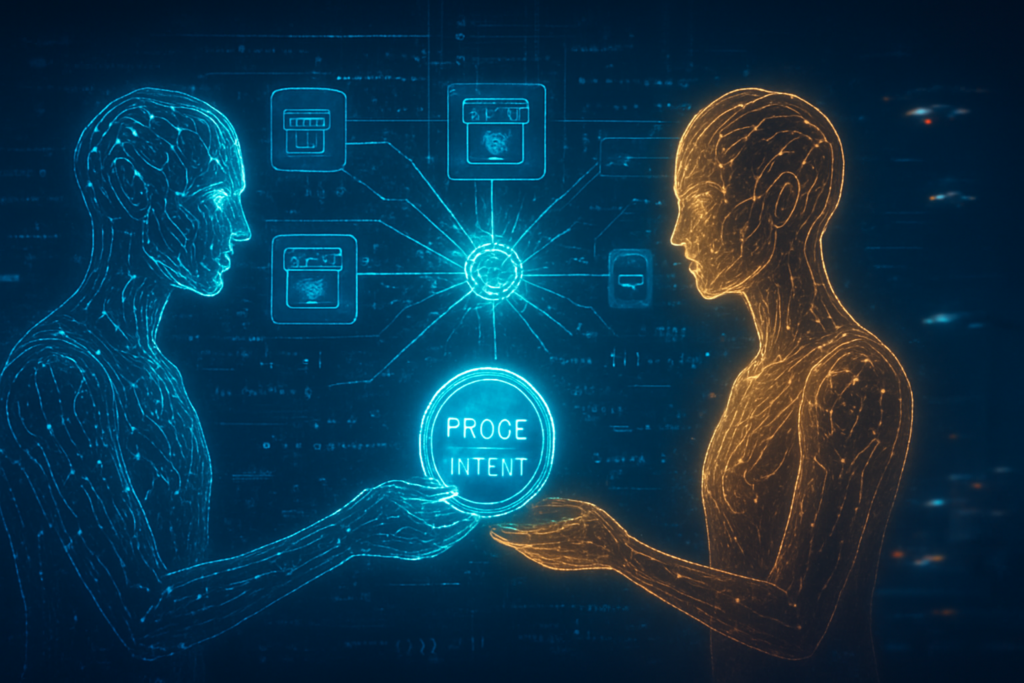
One of the most innovative technical specifications within UCP is the Agent Payments Protocol (AP2). To solve the "trust gap"—the fear that an AI might go on an unauthorized spending spree—AP2 introduces a cryptographic "Proof of Intent" system. Before a transaction can be finalized, the agent must generate a tokenized signature from the user’s secure wallet, which confirms the specific item and price ceiling for that individual purchase. This ensures that while the agent can browse and negotiate autonomously, it cannot deviate from the user’s explicit financial boundaries. Initial reactions from the AI research community have been overwhelmingly positive, with experts noting that UCP provides the first truly scalable framework for "AI-to-AI" negotiation, where a consumer's agent talks directly to a merchant's "Sales Agent" to settle terms in milliseconds.
The Alliance Against the "Everything Store"
Industry analysts view the collaboration between Google, Shopify, and Walmart as a coordinated strategic strike against the closed-loop dominance of Amazon.com, Inc. (NASDAQ: AMZN). By establishing an open standard, these companies are effectively creating a decentralized alternative to the Amazon ecosystem. Shopify has already integrated UCP across its entire merchant base, making millions of independent stores "agent-ready" instantly. This allows a small boutique to offer the same level of frictionless, AI-driven purchasing power as a tech giant, provided they adhere to the UCP standard.
The competitive implications are profound. For Google, UCP transforms Google Gemini from a search engine into a powerful transaction engine, keeping users within their ecosystem while they shop. For Walmart and Target Corporation (NYSE: TGT), it ensures their inventory is at the "fingertips" of every major AI agent, regardless of whether that agent was built by OpenAI, Anthropic, or Apple. This move shifts the competitive advantage away from who has the best website interface and toward who has the most efficient supply chain and the most competitive real-time pricing APIs.
The Social and Ethical Frontier of Agentic Commerce
The broader significance of UCP extends into the very fabric of how our economy functions. We are witnessing the birth of "Headless Commerce," a trend where the frontend user interface is increasingly bypassed. While this offers unprecedented convenience, it also raises significant concerns regarding data privacy and "algorithmic price discrimination." Consumer advocacy groups have already begun questioning whether AI agents, in their quest to find the "best price," might inadvertently share too much personal data, or if merchants will use UCP to offer dynamic pricing that fluctuates based on an individual user's perceived "urgency" to buy.
Furthermore, UCP represents a pivot point in the AI landscape. It moves AI from the realm of "content generation" to "economic agency." This shift mirrors previous milestones like the launch of the App Store or the migration to the cloud, but with a more autonomous twist. The concern remains that as we delegate our purchasing power to machines, the "serendipity" of shopping—discovering a product you didn't know you wanted—will be replaced by a sterile, hyper-optimized experience governed purely by parameters and protocols.
The Road Ahead: From Assistants to Economic Actors
In the near term, expect to see an explosion of "agent-first" shopping apps and browser extensions that leverage UCP to automate routine household purchases. We are also likely to see the emergence of "Bargain Agents"—AI specialized specifically in negotiating bulk discounts or finding hidden coupons across the UCP network. However, the road ahead is not without challenges; the industry must still solve the "returns and disputes" problem. If an AI agent buys the wrong item due to a misinterpreted prompt, who is legally liable—the user, the AI developer, or the merchant?
Long-term, experts predict that UCP will lead to a "negotiation-based economy." Rather than static prices listed on a screen, prices could become fluid, determined by millisecond-long auctions between consumer agents and merchant agents. As this technology matures, the "purchase" may become just one part of a larger autonomous workflow, where your AI agent not only buys your groceries but also coordinates the drone delivery through a UCP-integrated logistics provider, all without a single human notification.
A New Era for Global Trade
The launch of the Universal Commerce Protocol marks a definitive end to the "search-and-click" era of the internet. By standardizing how AI interacts with the marketplace, Google, Shopify, and Walmart have laid the tracks for a future where commerce is invisible, ubiquitous, and entirely autonomous. The key takeaway from this launch is that the value in the retail chain has shifted from the "digital shelf" to the "digital agent."
As we move into the coming months, the industry will be watching closely to see how quickly other major retailers and financial institutions adopt the UCP standard. The success of this protocol will depend on building a critical mass of "agent-ready" endpoints and maintaining a high level of consumer trust in the AP2 security layer. For now, the checkout button is still here—but it’s starting to look like a relic of a slower, more manual past.
This content is intended for informational purposes only and represents analysis of current AI developments.
TokenRing AI delivers enterprise-grade solutions for multi-agent AI workflow orchestration, AI-powered development tools, and seamless remote collaboration platforms.
For more information, visit https://www.tokenring.ai/.