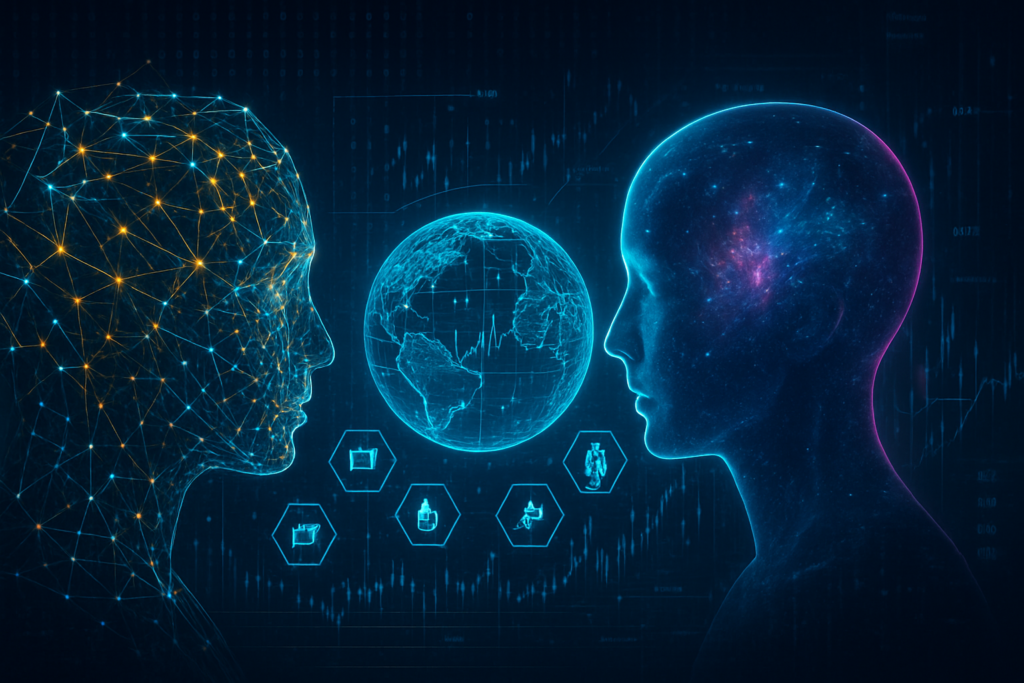
The era of human intuition as the ultimate arbiter of the future is rapidly coming to a close. As of January 2026, a new generation of artificial intelligence agents has successfully disrupted the high-stakes world of prediction markets, where billions of dollars are wagered on everything from geopolitical conflicts to technological breakthroughs. While elite human "superforecasters" have long held a monopoly on accuracy, recent data from platforms like Polymarket and Metaculus reveals that AI has not only surpassed the median human forecaster but is now within striking distance of the world’s top predictive minds.
This "convergence phase" marks a turning point for decision-making in both the public and private sectors. With the predicted date for "AI-Human Parity"—the moment an algorithm matches the accuracy of a professional superforecaster—now estimated for November 2026, the competitive landscape is shifting. AI is no longer just a tool for processing historical data; it has become a proactive participant in price discovery, moving markets with a level of statistical calibration that few humans can replicate.
The Technical Leap: From Statistical Echoes to Chain-of-Thought Reasoning
The primary metric governing this competition is the Brier score, a mathematical measure of the accuracy of probabilistic forecasts. In the latest results from ForecastBench—a dynamic, contamination-free benchmark co-managed by the Forecasting Research Institute (FRI) and researchers from the University of California, Berkeley—the gap is narrowing at an unprecedented rate. Top-tier AI models, including the latest iterations from OpenAI and DeepSeek, currently post Brier scores of approximately 0.101, trailing the elite human median of 0.081. For context, the average public forecaster sits significantly lower, at 0.150 to 0.180, meaning AI is already a more reliable guide than the vast majority of humans.
The technical breakthrough driving this surge is the transition from standard Large Language Models (LLMs) to "long-reasoning" architectures. Models like OpenAI’s o1 and o3 series, supported by Microsoft Corp. (NASDAQ: MSFT), utilize Chain-of-Thought (CoT) processing to verify logical consistency before outputting a probability. Unlike earlier versions that merely predicted the next token based on patterns, these reasoning models can "stress-test" their own assumptions, identifying logical fallacies and data gaps in real-time. This mimics the cognitive processes of human superforecasters, who are trained to break down complex questions into smaller, more manageable sub-components.
Furthermore, the emergence of multi-agent ensembles has allowed AI to scale its research capabilities. Startups like ManticAI utilize systems where specialized agents are assigned specific tasks: one agent scrapes real-time SEC filings, another analyzes social media sentiment, and a third conducts historical "base-rate" analysis. The final forecast is an aggregate of these perspectives, weighted by the agents' past performance. This "wisdom of the silicon crowd" approach was instrumental in ManticAI’s top-10 finish at the 2025 Metaculus Cup, marking the first time an automated agent outperformed professional-grade human competitors in a major international tournament.
Market Disruption: The Rise of the Autonomous Trader
The commercial implications of AI’s rising predictive power are profound. Polymarket, which saw its trading volume balloon to over $13 billion in 2025, is increasingly dominated by autonomous agents like PolyBro and Alphascope. These agents provide critical liquidity to the market, but they also serve as "pricing enforcers," instantly correcting market inefficiencies. This has significant ramifications for Alphabet Inc. (NASDAQ: GOOGL) and other tech giants who are increasingly looking toward prediction markets as internal tools for resource allocation and strategic planning.
For AI labs and major tech companies, the ability to forecast accurately is the ultimate "killer app" for enterprise AI. Companies that can integrate these forecasting agents into their core business logic will gain a massive strategic advantage. Alphabet Inc. (NASDAQ: GOOGL) is reportedly testing decision-support AI that integrates internal Search and Google Trends data to predict supply chain disruptions before they manifest. Meanwhile, investment banks are moving away from traditional analyst reports in favor of real-time AI agents that trade on the delta between market prices and their own internal probability models.
The disruption extends to the very structure of consulting and risk management. As AI models reach parity with human experts, the cost of high-quality forecasting is expected to collapse. This democratizes access to elite-level intelligence, allowing startups and small-to-medium enterprises to utilize the same predictive power once reserved for the world’s most well-funded hedge funds. However, it also threatens the business models of traditional geopolitical risk firms, who must now justify their fees against a $20-a-month API call that might be more accurate than their senior partners.
Beyond the Numbers: Causal Reasoning and the "Black Swan" Problem
Despite these advancements, the competition has exposed a fundamental divide between human and machine intelligence. Research led by Philip Tetlock, the pioneer of superforecasting research, suggests that while AI has mastered statistical calibration (the "what"), humans still hold a narrow edge in causal reasoning (the "why"). Human superforecasters are currently better at navigating "Black Swan" events—unprecedented occurrences with no historical data points. AI, by its nature, is backward-looking, relying on the vast corpus of human history to project the future.
The wider significance of this shift lies in the potential for "algorithmic feedback loops." If markets are increasingly driven by AI agents that all read the same data and use similar reasoning models, the risk of synchronized errors or "flash crashes" increases. Concerns have been raised by the Forecasting Research Institute regarding the transparency of these models. If an AI agent predicts a 90% chance of a conflict, and markets move to reflect that, the prediction itself could influence the outcome—a phenomenon known as the "reflexivity problem" in financial theory.
Moreover, the integration of AI into prediction markets raises ethical questions about information asymmetry. Those with access to the most advanced "reasoning" models will have a significant advantage in wealth accumulation, potentially widening the gap between technologically advanced nations and the rest of the world. However, proponents argue that the increased accuracy and efficiency of these markets will provide a clearer "signal" for global policymakers, helping to mitigate risks and allocate resources more effectively to solve pressing issues like climate change and pandemic prevention.
The Horizon: Parity and the Autonomous Oracle
Looking toward the remainder of 2026, experts predict a surge in "Oracle-as-a-Service" platforms. These will be fully autonomous systems that not only predict events but also execute complex insurance contracts or supply chain orders based on those predictions. For example, a shipping company could use an AI forecaster to automatically hedge fuel prices or reroute vessels based on a predicted 75% probability of a regional storm, all without human intervention.
The next major hurdle for AI forecasting is the integration of multimodal data. While current agents primarily process text and structured data, upcoming models from Meta Platforms, Inc. (NASDAQ: META) and OpenAI are expected to incorporate real-time satellite imagery and video feeds. This would allow an agent to "see" a traffic jam in a foreign port or monitor the construction of a new factory in real-time, providing a level of granular insight that even the most dedicated human superforecaster cannot match. The challenge remains in ensuring these models don't "hallucinate" certainty where none exists, a problem that researchers are currently tackling through rigorous "adversarial forecasting" techniques.
A New Chapter in Human-Machine Collaboration
The competition between AI and human superforecasters is not a zero-sum game, but rather a transition toward a hybrid model of intelligence. The key takeaway from the early 2026 data is that while AI is winning the race for accuracy in discrete, data-rich environments, human expertise remains vital for interpreting the "weirdness" of human behavior and novel geopolitical shifts. The most successful forecasting teams are already "centaurs"—partnerships that combine the machine's statistical perfection with the human's causal intuition.
As we look toward the predicted parity date in November 2026, the world must prepare for a future where "I think" is replaced by "The model estimates." This development is perhaps the most significant milestone in AI history since the release of GPT-4, as it marks the moment AI moved from generating content to generating truth. In the coming weeks, keep a close eye on the Metaculus parity markets; as the gap closes, the very nature of how we plan for the future will change forever.
This content is intended for informational purposes only and represents analysis of current AI developments.
TokenRing AI delivers enterprise-grade solutions for multi-agent AI workflow orchestration, AI-powered development tools, and seamless remote collaboration platforms.
For more information, visit https://www.tokenring.ai/.