In a move that signals a definitive end to the "walled garden" era of artificial intelligence, Anthropic announced earlier this month that it has officially donated its Model Context Protocol (MCP) to the newly formed Agentic AI Foundation (AAIF) under the Linux Foundation. This landmark contribution, finalized on December 9, 2025, establishes MCP as a vendor-neutral open standard, effectively creating a universal language for how AI agents communicate with data, tools, and each other.
The donation is more than a technical hand-off; it represents a rare "alliance of rivals." Industry giants including OpenAI, Alphabet Inc. (NASDAQ: GOOGL), Microsoft Corporation (NASDAQ: MSFT), and Amazon.com, Inc. (NASDAQ: AMZN) have all joined the AAIF as founding members, signaling a collective commitment to a shared infrastructure. By relinquishing control of MCP, Anthropic has paved the way for a future where AI agents are no longer confined to proprietary ecosystems, but can instead operate seamlessly across diverse software environments and enterprise data silos.
The Technical Backbone of the Agentic Revolution
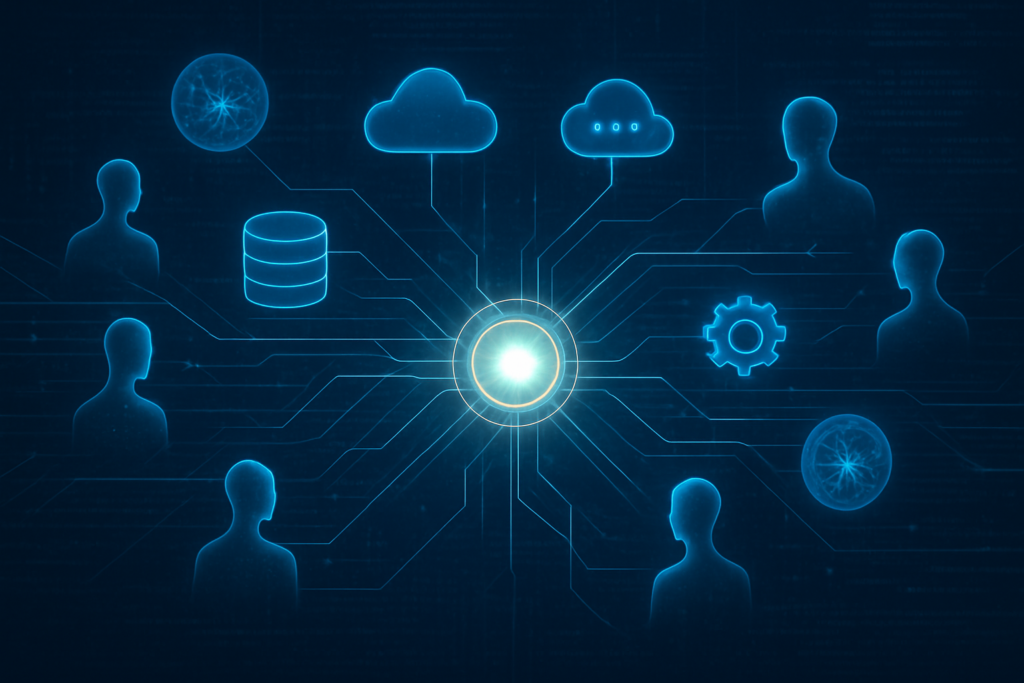
The Model Context Protocol is designed to solve the "fragmentation problem" that has long plagued AI development. Historically, connecting an AI model to a specific data source—like a SQL database, a Slack channel, or a local file system—required custom, brittle integration code. MCP replaces this with a standardized client-server architecture. In this model, "MCP Clients" (such as AI chatbots or IDEs) connect to "MCP Servers" (lightweight programs that expose specific data or functionality) using a unified interface based on JSON-RPC 2.0.
Technically, the protocol operates on three core primitives: Resources, Tools, and Prompts. Resources provide agents with read-only access to data, such as documentation or database records. Tools allow agents to perform actions, such as executing a shell command or sending an email. Prompts offer standardized templates that provide models with the necessary context for specific tasks. This architecture is heavily inspired by the Language Server Protocol (LSP), which revolutionized the software industry by allowing a single code editor to support hundreds of programming languages.
The timing of the donation follows a massive technical update released on November 25, 2025, which introduced "Asynchronous Operations." This capability allows agents to trigger long-running tasks—such as complex data analysis or multi-step workflows—without blocking the connection, a critical requirement for truly autonomous behavior. Additionally, the new "Server Identity" feature enables AI clients to discover server capabilities via .well-known URLs, mirroring the discovery mechanisms of the modern web.
A Strategic Shift for Tech Titans and Startups
The institutionalization of MCP under the Linux Foundation has immediate and profound implications for the competitive landscape. For cloud providers like Amazon (NASDAQ: AMZN) and Google (NASDAQ: GOOGL), supporting an open standard ensures that their proprietary data services remain accessible to any AI model a customer chooses to use. Both companies have already integrated MCP support into their respective cloud consoles, allowing developers to deploy "agent-ready" infrastructure at enterprise scale.
For Microsoft (NASDAQ: MSFT), the adoption of MCP into Visual Studio Code and Microsoft Copilot reinforces its position as the primary platform for AI-assisted development. Meanwhile, startups and smaller players stand to benefit the most from the reduced barrier to entry. By building on a standardized protocol, a new developer can create a specialized AI tool once and have it immediately compatible with Claude, ChatGPT, Gemini, and dozens of other "agentic" platforms.
The move also represents a tactical pivot for OpenAI. By joining the AAIF and contributing its own AGENTS.md standard—a format for describing agent capabilities—OpenAI is signaling that the era of competing on basic connectivity is over. The competition has shifted from how an agent connects to data to how well it reasons and executes once it has that data. This "shared plumbing" allows all major labs to focus their resources on model intelligence rather than integration maintenance.
Interoperability as the New Industry North Star
The broader significance of this development cannot be overstated. Industry analysts have already begun referring to the donation of MCP as the "HTTP moment" for AI. Just as the Hypertext Transfer Protocol enabled the explosion of the World Wide Web by allowing any browser to talk to any server, MCP provides the foundation for an "Agentic Web" where autonomous entities can collaborate across organizational boundaries.
The scale of adoption is already staggering. As of late December 2025, the MCP SDK has reached a milestone of 97 million monthly downloads, with over 10,000 public MCP servers currently in operation. This rapid growth suggests that the industry has reached a consensus: interoperability is no longer a luxury, but a prerequisite for the enterprise adoption of AI. Without a standard like MCP, the risk of vendor lock-in would have likely stifled corporate investment in agentic workflows.
However, the transition to an open standard also brings new challenges, particularly regarding security and safety. As agents gain the ability to autonomously trigger "Tools" across different platforms, the industry must now grapple with the implications of "agent-to-agent" permissions and the potential for cascading errors in automated chains. The AAIF has stated that establishing safe, transparent practices for agentic interactions will be its primary focus heading into the new year.
The Road Ahead: SDK v2 and Autonomous Ecosystems
Looking toward 2026, the roadmap for the Model Context Protocol is ambitious. A stable release of the TypeScript SDK v2 is expected in Q1 2026, which will natively support the new asynchronous features and provide improved horizontal scaling for high-traffic enterprise applications. Furthermore, Anthropic’s recent decision to open-source its "Agent Skills" specification provides a complementary layer to MCP, allowing developers to package complex, multi-step workflows into portable folders that any compliant agent can execute.
Experts predict that the next twelve months will see the rise of "Agentic Marketplaces," where verified MCP servers can be discovered and deployed with a single click. We are also likely to see the emergence of specialized "Orchestrator Agents" whose sole job is to manage a fleet of subordinate agents, each specialized in a different MCP-connected tool. The ultimate goal is a world where an AI agent can independently book a flight, update a budget spreadsheet, and notify a team on Slack, all while navigating different APIs through a single, unified protocol.
A New Chapter in AI History
The donation of the Model Context Protocol to the Linux Foundation marks the end of 2025 as the year "Agentic AI" moved from a buzzword to a fundamental architectural reality. By choosing collaboration over control, Anthropic and its partners have ensured that the next generation of AI will be built on a foundation of openness and interoperability.
As we move into 2026, the focus will shift from the protocol itself to the innovative applications built on top of it. The "plumbing" is now in place; the industry's task is to build the autonomous future that this standard makes possible. For enterprises and developers alike, the message is clear: the age of the siloed AI is over, and the era of the interconnected agent has begun.
This content is intended for informational purposes only and represents analysis of current AI developments.
TokenRing AI delivers enterprise-grade solutions for multi-agent AI workflow orchestration, AI-powered development tools, and seamless remote collaboration platforms.
For more information, visit https://www.tokenring.ai/.