The end of an earnings season can be a great time to discover new stocks and assess how companies are handling the current business environment. Let’s take a look at how Byrna (NASDAQ: BYRN) and the rest of the aerospace and defense stocks fared in Q1.
Emissions and automation are important in aerospace, so companies that boast advances in these areas can take market share. On the defense side, geopolitical tensions–whether it be Russia’s invasion of Ukraine or China’s aggression toward Taiwan–have highlighted the need for consistent or even elevated defense spending. As for challenges, demand for aerospace and defense products can ebb and flow with economic cycles and national defense budgets, which are unpredictable and particularly painful for companies with high fixed costs.
The 32 aerospace and defense stocks we track reported a very strong Q1. As a group, revenues beat analysts’ consensus estimates by 2.8% while next quarter’s revenue guidance was 3.6% above.
Thankfully, share prices of the companies have been resilient as they are up 6.4% on average since the latest earnings results.
Byrna (NASDAQ: BYRN)
Providing civilians with tools to disable, disarm, and deter would-be assailants, Byrna (NASDAQ: BYRN) is a provider of non-lethal weapons.
Byrna reported revenues of $29.05 million, up 10.9% year on year. This print fell short of analysts’ expectations by 2.3%. Overall, it was a softer quarter for the company with a significant miss of analysts’ adjusted operating income estimates.
Management CommentaryByrna CEO Conn Davis stated: “Byrna has important strengths already in place, including a differentiated product offering, a strong balance sheet, a domestic manufacturing footprint, and a growing retail and dealer presence. At the same time, it is clear to me that the next phase of value creation will be defined by sharper execution across marketing, e-commerce, retail productivity, and operating discipline. That is where our focus is today.
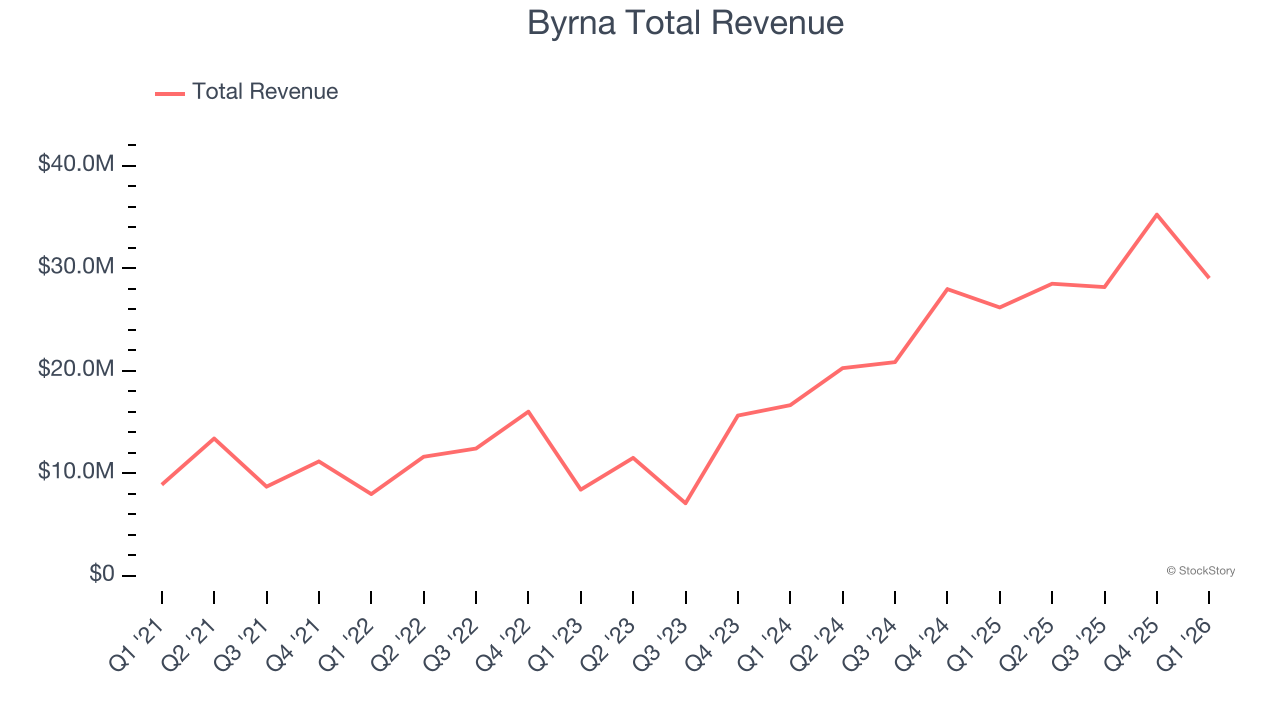
The market seems disappointed with the results as the stock is down 26.1% since reporting and currently trades at $6.80.
Is now the time to buy Byrna? Access our full analysis of the earnings results here, it’s free.
Best Q1: Rocket Lab (NASDAQ: RKLB)
Becoming the first private company in the Southern Hemisphere to reach space, Rocket Lab (NASDAQ: RKLB) offers rockets designed for launching small satellites.
Rocket Lab reported revenues of $200.3 million, up 63.5% year on year, outperforming analysts’ expectations by 4.9%. The business had an incredible quarter with EBITDA guidance for next quarter exceeding analysts’ expectations and a beat of analysts’ EPS estimates.
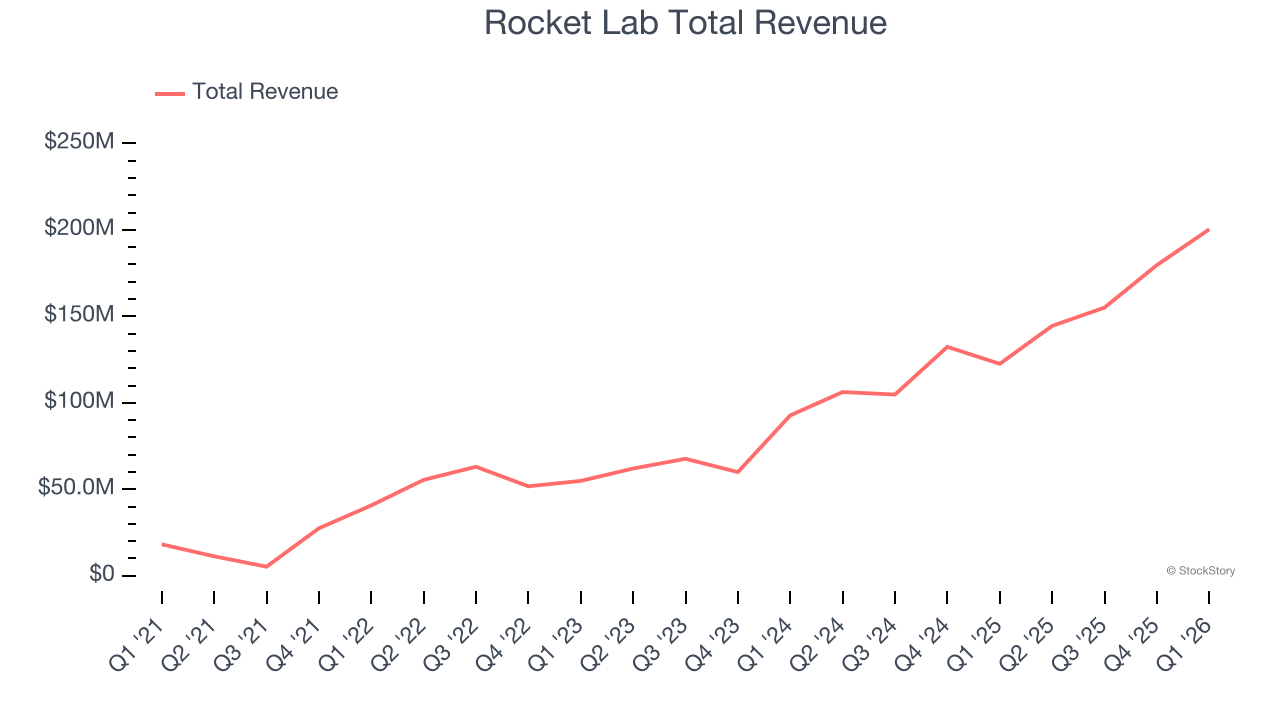
Rocket Lab achieved the highest guidance raise among its peers. The market seems happy with the results as the stock is up 27.2% since reporting. It currently trades at $99.98.
Is now the time to buy Rocket Lab? Access our full analysis of the earnings results here, it’s free.
Weakest Q1: AerSale (NASDAQ: ASLE)
Providing a one-stop shop that integrates multiple services and product offerings, AerSale (NASDAQ: ASLE) delivers full-service support to mid-life commercial aircraft.
AerSale reported revenues of $70.61 million, up 7.4% year on year, falling short of analysts’ expectations by 18.9%. It was a softer quarter as it posted a significant miss of analysts’ adjusted operating income estimates and EPS in line with analysts’ estimates.
AerSale delivered the weakest performance against analyst estimates in the group. As expected, the stock is down 10.6% since the results and currently trades at $6.56.
Read our full analysis of AerSale’s results here.
Boeing (NYSE: BA)
One of the companies that forms a duopoly in the commercial aircraft market, Boeing (NYSE: BA) develops, manufactures, and services commercial airplanes, defense products, and space systems.
Boeing reported revenues of $22.22 billion, up 14% year on year. This number beat analysts’ expectations by 2.9%. It was an exceptional quarter as it also logged a beat of analysts’ EPS estimates and adjusted operating income in line with analysts’ estimates.
The stock is flat since reporting and currently trades at $218.20.
Read our full, actionable report on Boeing here, it’s free.
Kratos (NASDAQ: KTOS)
Established with a commitment to supporting national security, Kratos (NASDAQ: KTOS) is a provider of advanced engineering, technology, and security solutions tailored for critical national security applications.
Kratos reported revenues of $371 million, up 22.6% year on year. This result surpassed analysts’ expectations by 8.1%. Overall, it was a very strong quarter as it also produced an impressive beat of analysts’ organic revenue and EBITDA estimates.
Kratos had the weakest guidance update among its peers. The stock is down 13.4% since reporting and currently trades at $53.28.
Read our full, actionable report on Kratos here, it’s free.
Market Update
Late in 2025 into early 2026, there was hand-wringing around artificial intelligence. For software companies, the fear was that AI would erode pricing power and compress margins as new tools made it easier to replicate what once required expensive enterprise platforms. Crypto investors had their own version of the same anxiety: if AI agents could trade, allocate capital, and manage wallets autonomously, what exactly was the long-term value of today’s crypto infrastructure?
These concerns triggered a noticeable rotation away from these sectors and into safer havens. But markets rarely dwell on one narrative for long. Spring 2026 came, and the focus shifted abruptly from technological disruption to geopolitical risk. The US’ conflict with Iran became the dominant driver of market psychology, and when geopolitics takes center stage, the script changes quickly. Investors stop debating growth rates and start worrying about oil supply, inflation, and global stability.
Want to invest in winners with rock-solid fundamentals? Check out our Top 6 Stocks and add them to your watchlist. These companies are poised for growth regardless of the political or macroeconomic climate.