Let’s dig into the relative performance of Prudential (NYSE: PRU) and its peers as we unravel the now-completed Q2 life insurance earnings season.
Life insurance companies collect premiums from policyholders in exchange for providing a future death benefit or retirement income stream. Interest rates matter for the sector (and make it cyclical), with higher rates allowing insurers to reinvest their fixed-income portfolios at more attractive yields and vice versa. Additionally, favorable demographic shifts, such as an aging population, are driving strong demand for retirement products while AI and data analytics offer significant opportunities to improve underwriting accuracy and operational efficiency. Conversely, the industry faces headwinds from persistent competition from agile insurtechs that threaten traditional distribution models.
The 12 life insurance stocks we track reported a mixed Q2. As a group, revenues missed analysts’ consensus estimates by 8.2%.
Amidst this news, share prices of the companies have had a rough stretch. On average, they are down 5.3% since the latest earnings results.
Prudential (NYSE: PRU)
Recognized by its iconic Rock of Gibraltar logo symbolizing strength and stability since 1896, Prudential Financial (NYSE: PRU) provides life insurance, annuities, retirement solutions, investment management, and other financial services to individual and institutional customers globally.
Prudential reported revenues of $14.16 billion, up 4.8% year on year. This print fell short of analysts’ expectations by 0.9%. Overall, it was a mixed quarter for the company with a solid beat of analysts’ net premiums earned estimates but a significant miss of analysts’ book value per share estimates.
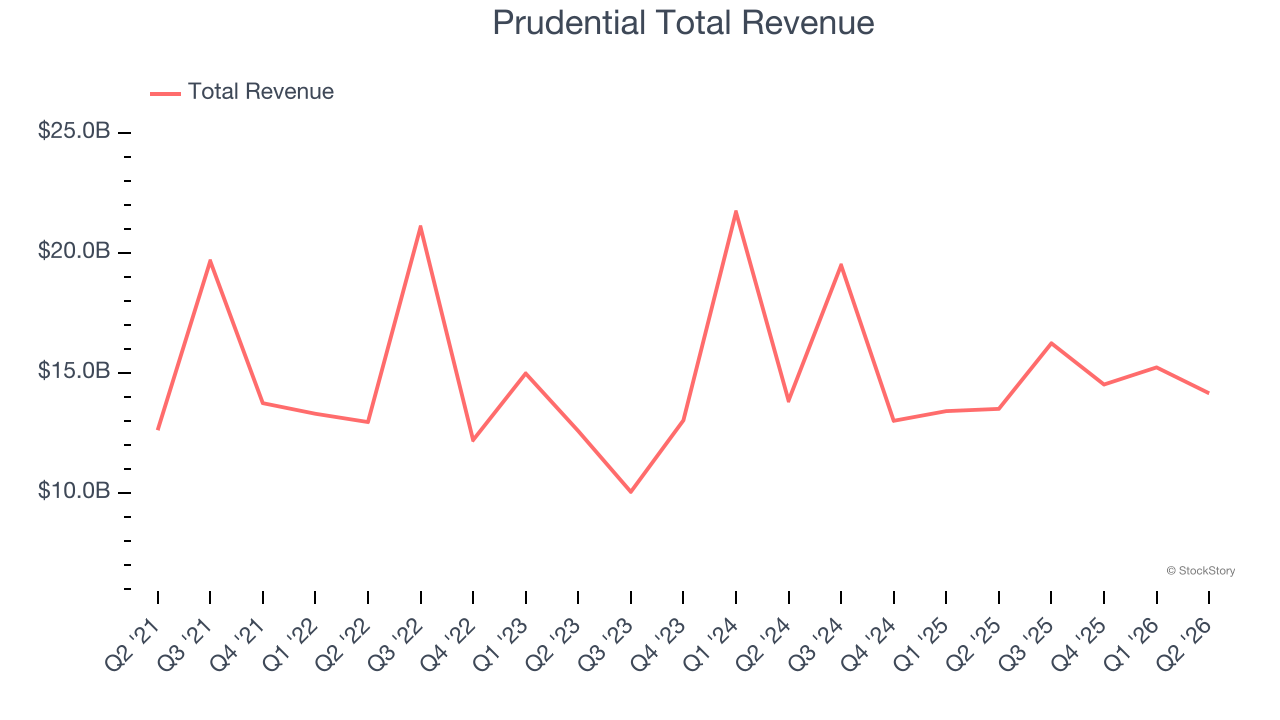
The market seems disappointed with the results as the stock is down 8.8% since reporting and currently trades at $112.69.
Is now the time to buy Prudential? Access our full analysis of the earnings results here, it’s free.
Best Q2: Horace Mann Educators (NYSE: HMN)
Founded in 1945 and named after the 19th-century education reformer known as the "father of American public education," Horace Mann Educators (NYSE: HMN) is an insurance company that specializes in providing auto, property, life, and retirement products tailored for educators and other public service employees.
Horace Mann Educators reported revenues of $443.6 million, up 6.2% year on year, in line with analysts’ expectations. The business had a very strong quarter with a beat of analysts’ EPS estimates.
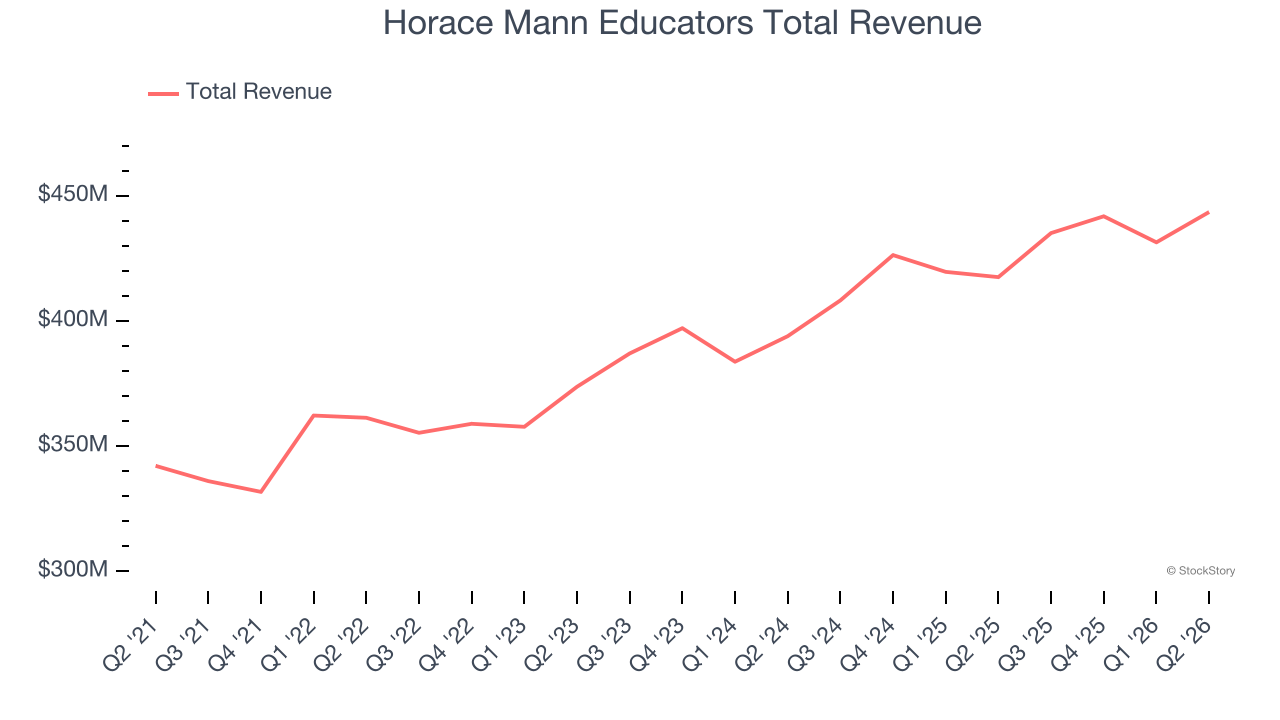
Although it had a fine quarter compared to its peers, the market seems unhappy with the results as the stock is down 13.1% since reporting. It currently trades at $45.27.
Is now the time to buy Horace Mann Educators? Access our full analysis of the earnings results here, it’s free.
Weakest Q2: Brighthouse Financial (NASDAQ: BHF)
Spun off from MetLife in 2017 to focus specifically on retail financial products, Brighthouse Financial (NASDAQ: BHF) provides annuity contracts and life insurance products designed to help individuals protect wealth, generate income, and transfer assets.
Brighthouse Financial reported revenues of $2.10 billion, down 2.4% year on year, falling short of analysts’ expectations by 2%. It was a softer quarter as it posted a significant miss of analysts’ book value per share and EPS estimates.
As expected, the stock is down 19.1% since the results and currently trades at $50.04.
Read our full analysis of Brighthouse Financial’s results here.
Lincoln Financial Group (NYSE: LNC)
Founded in 1905 by a group of Fort Wayne, Indiana businessmen who named the company after Abraham Lincoln, Lincoln National Corporation (NYSE: LNC) provides insurance, retirement plans, and wealth management products through its subsidiaries, operating under four main segments: Annuities, Life Insurance, Group Protection, and Retirement Plan Services.
Lincoln Financial Group reported revenues of $4.93 billion, up 4.2% year on year. This result beat analysts’ expectations by 0.8%. Aside from that, it was a satisfactory quarter as it also produced an impressive beat of analysts’ net premiums earned estimates but a significant miss of analysts’ book value per share estimates.
The stock is down 2.8% since reporting and currently trades at $40.28.
Read our full, actionable report on Lincoln Financial Group here, it’s free.
Unum Group (NYSE: UNM)
Tracing its roots back to 1848 when financial security for workers was virtually non-existent, Unum Group (NYSE: UNM) provides workplace financial protection benefits including disability, life, accident, critical illness, dental and vision insurance primarily through employers.
Unum Group reported revenues of $2.96 billion, down 12.3% year on year. This number lagged analysts’ expectations by 2%. Overall, it was a slower quarter as it also logged a significant miss of analysts’ book value per share estimates and EPS in line with analysts’ estimates.
Unum Group had the slowest revenue growth of the whole group. The stock is flat since reporting and currently trades at $88.55.
Read our full, actionable report on Unum Group here, it’s free.
Market Update
Over the past year, investors have been forced to repeatedly answer the same question: what is the market’s biggest risk? The answer has changed several times, and each shift has reshaped market leadership.
Late in 2025 and early 2026, artificial intelligence became the market’s primary uncertainty. Investors questioned whether AI would erode software pricing power and weaken competitive moats as AI made it easier to replicate once-differentiated products.
By the spring, technology took a back seat to geopolitics. The U.S. conflict with Iran briefly became the market’s dominant narrative, raising concerns about oil prices, inflation, and global growth. But as energy markets remained orderly and fears of a prolonged supply disruption faded, investors quickly turned their focus back to fundamentals.
Want to invest in winners with rock-solid fundamentals? Check out our 9 Best Market-Beating Stocks and add them to your watchlist. These companies are poised for growth regardless of the political or macroeconomic climate.