Engineered materials manufacturer Rogers (NYSE: ROG) missed Wall Street’s revenue expectations in Q3 2026, but revenue rose 9.3% year on year to $236.1 million. On the other hand, the company expects next quarter’s revenue to be around $220 million, close to analysts’ consensus estimates. Its non-GAAP profit of $1.39 per share was 16.5% above analysts’ consensus estimates.
For more on Rogers, read our full research report for free.
Rogers (ROG) Q3 2026 highlights:
- Revenue $236.1 million vs S&P analysts’ consensus estimates of $238 million (9.3% year-on-year growth, 0.8% miss)
- Adjusted EPS $1.39 vs S&P analysts’ consensus estimates of $1.19 (16.5% beat)
- Adjusted EBITDA $47.7 million vs analysts’ consensus estimates of $44 million (20.2% margin, 8.4% beat)
- Revenue guidance $220 million at the midpoint for Q4 2026, roughly in line with what analysts were expecting
- Adjusted EPS guidance $1 at the midpoint for Q4 2026, above analysts’ consensus estimates of $0.90
- EBITDA guidance $40 million at the midpoint for Q4 2026, above analysts’ consensus estimates of $35.25 million
- Operating margin 12.7%, up from 10.6% in the same quarter last year
- Free cash flow margin 15%, up from 9.8% in the same quarter last year
- Market capitalization $2.28 billion
"Third quarter results demonstrate the continued strengthening of Rogers’ financial performance, with year-over-year growth in sales, adjusted EBITDA and adjusted earnings per share,” stated Ali El-Haj, Rogers’ President and CEO. “Improved execution, closer customer engagement and a more efficient operating structure continue to translate into stronger results.”
Revenue growth
Examining a company’s long-term performance can provide clues about its quality. Any business can experience short-term success, but top-performing ones enjoy sustained growth for years.
With $854.9 million in revenue over the past 12 months, Rogers is a small player in the business services space, which sometimes brings disadvantages compared to larger competitors benefiting from economies of scale and numerous distribution channels.
Rogers’s revenue declined by 1.3% per year over the last five years.
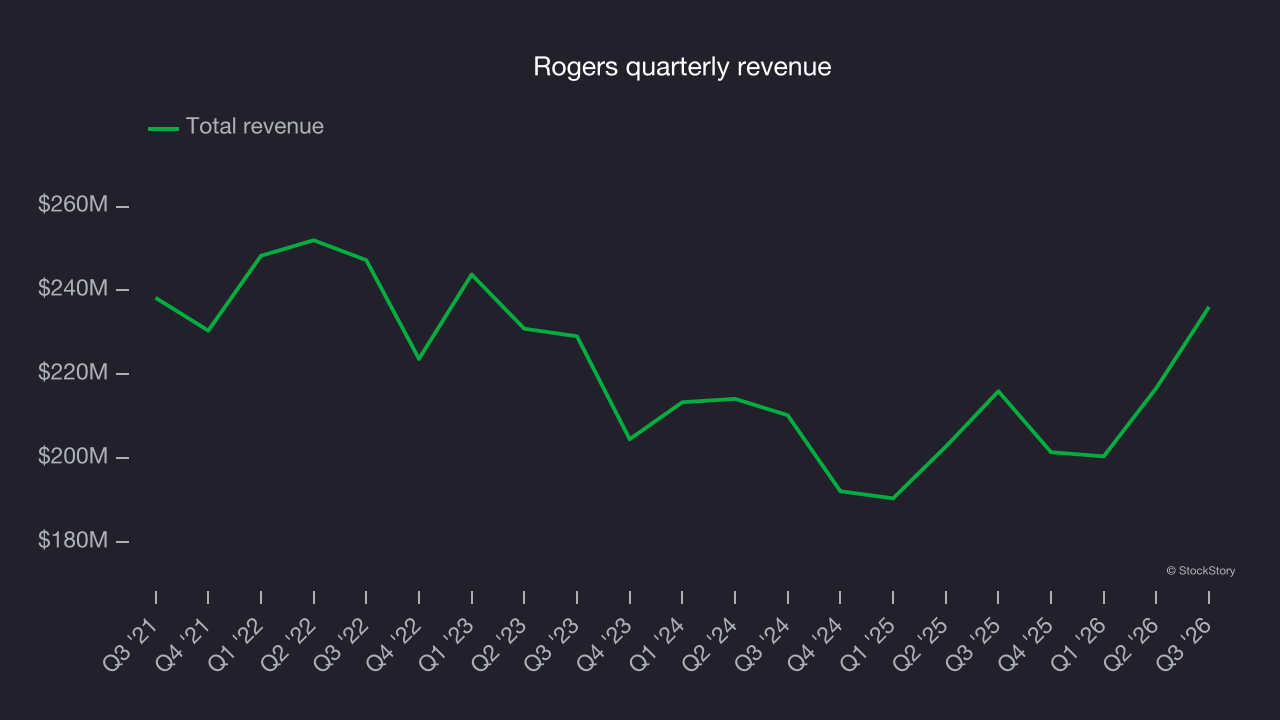
Long-term growth is the most important, but within business services, a half-decade historical view may miss new innovations or demand cycles. Rogers’s revenue over the last two years was flat, suggesting its demand was weak but stabilized after its initial drop. 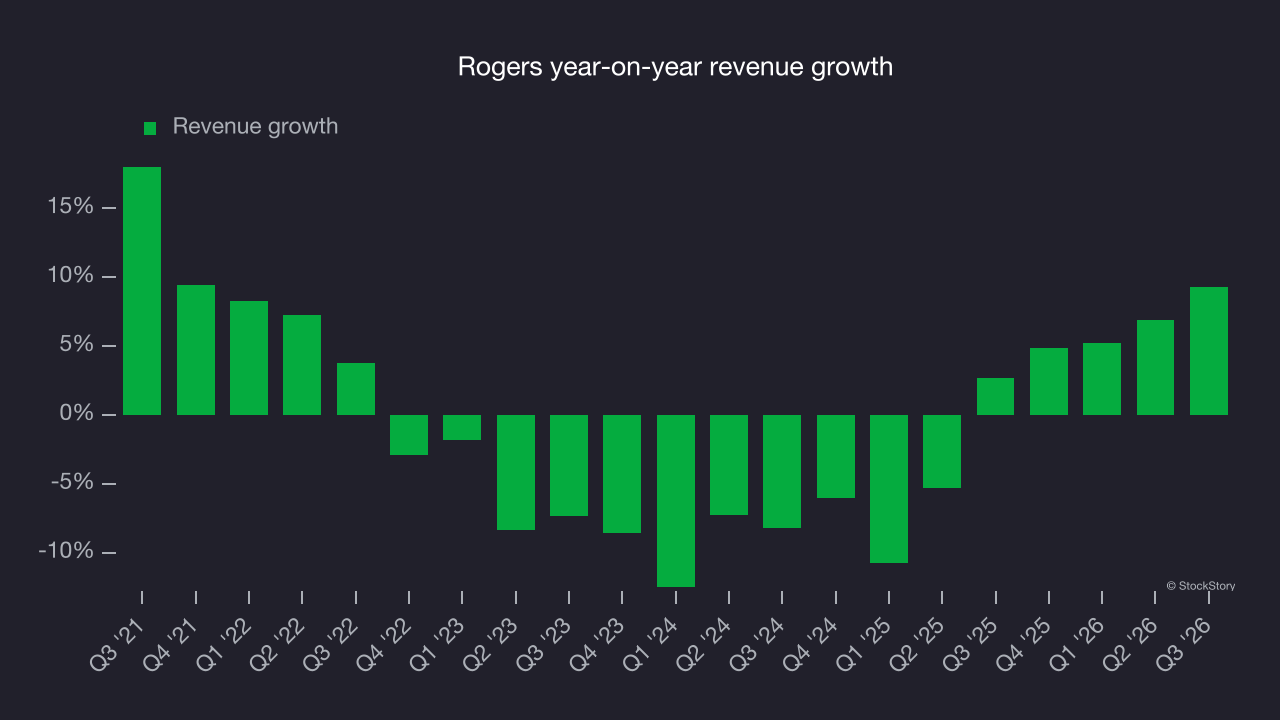
This quarter, Rogers’s revenue grew by 9.3% year on year to $236.1 million, missing Wall Street’s consensus estimates. Company management is currently guiding for a 9.2% year-on-year increase in revenue next quarter.
Looking further ahead, sell-side analysts expect revenue to grow 9.1% over the next 12 months, according to S&P, an improvement versus the last two years. This projection is healthy and suggests its newer products and services will fuel better top-line performance.
Adjusted operating margin
Rogers’s adjusted operating margin has risen over the last 12 months and averaged 8.6% over the last five years. The company’s higher efficiency is a positive, but its suboptimal cost structure means it still has mediocre profitability for a business services company.
Analyzing the trend in its profitability, Rogers’s adjusted operating margin might have fluctuated slightly but has generally stayed the same over the last five years, meaning it will take a fundamental shift in the business model to change.
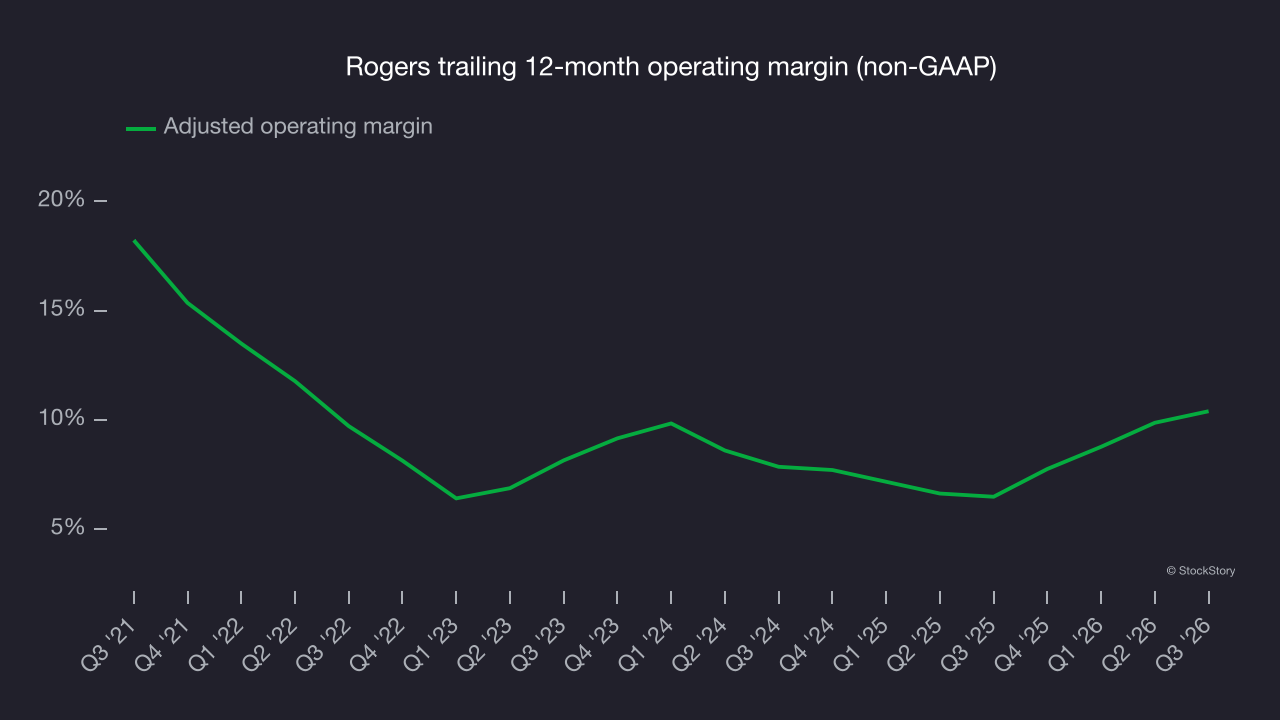
This quarter, Rogers generated an adjusted operating margin of 12.7%, up 1.8 percentage points year on year. The increase was a positive sign of improved efficiency.
Earnings per share
We track the long-term change in earnings per share (EPS) for the same reason as long-term revenue growth. Compared to revenue, however, EPS highlights whether a company’s growth is profitable.
Rogers’s EPS declined by 10.5% annually over the last five years, more than its revenue. The company struggled because its fixed cost base made it difficult to adjust to shrinking demand.
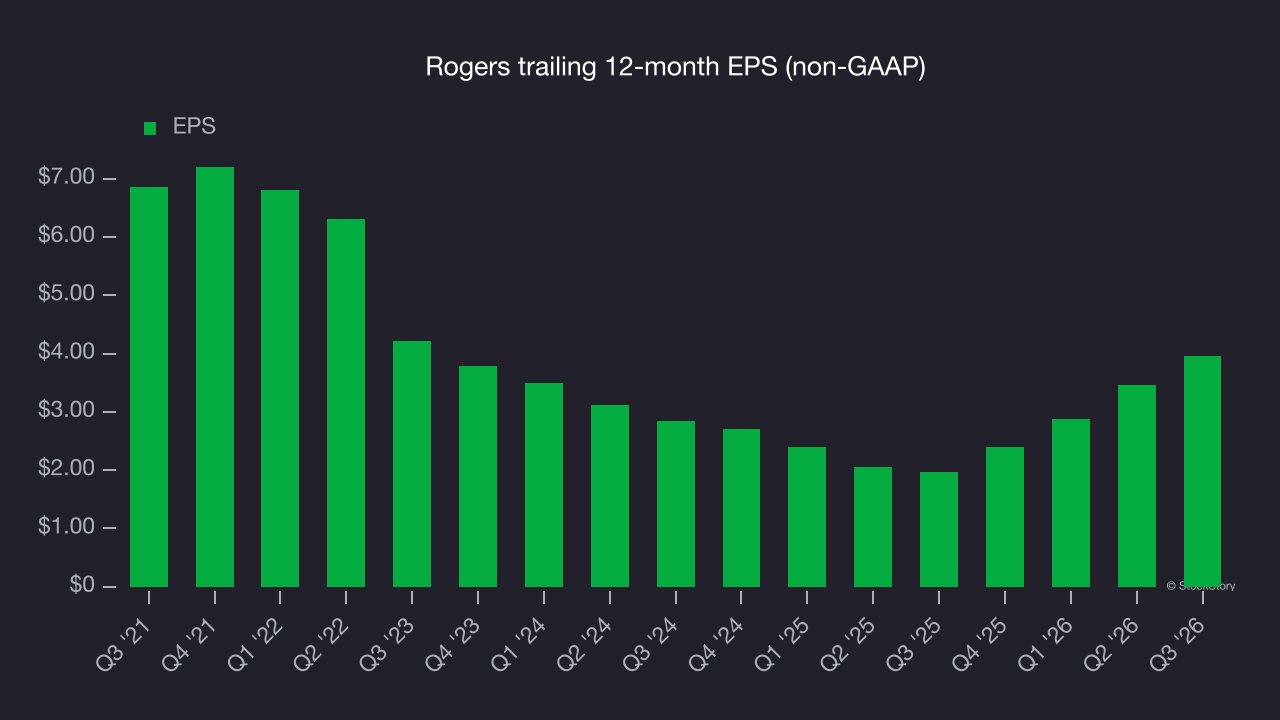
Like with revenue, we analyze EPS over a shorter period to see if we are missing a change in the business.
For Rogers, its two-year annual EPS growth of 17.7% was higher than its five-year trend. This acceleration made it one of the faster-growing business services companies in recent history.
In Q3, Rogers reported adjusted EPS of $1.39, up from $0.90 in the same quarter last year. The result came in well above analysts’ consensus estimates. Over the next 12 months, Wall Street expects Rogers’s full-year EPS to grow 11.5% from $3.95 to $4.40, according to S&P.
Key takeaways from Rogers’s Q3 results
Rogers’s next-quarter EPS guidance stood out, topping Wall Street’s consensus estimates by a wide margin. Quarterly EPS also beat analysts’ consensus estimates, but revenue missed slightly, making for a decent quarter with some key metrics above expectations. Shares remained flat at $133.72 immediately after the report.
Is Rogers a buy at its current price? The latest quarter is only one piece of its longer-term business quality picture. Quality, combined with valuation, can help determine whether the stock is a buy. For more on Rogers, read the full research report here (it’s free).