Regional banking company First Commonwealth Financial (NYSE: FCF) reported Q3 2026 results beating Wall Street’s revenue expectations, with revenue up 5.5% year on year to $143.4 million. Its non-GAAP profit of $0.45 per share was in line with analysts’ consensus estimates.
For more on First Commonwealth Financial, read our full research report for free.
First Commonwealth Financial (FCF) Q3 2026 highlights:
- Net interest income $162.3 million vs analysts’ consensus estimates of $116.2 million (46.1% year-on-year growth, 39.6% beat)
- Net interest margin 4.1% vs analysts’ consensus estimates of 4% (6.6 basis point beat)
- Revenue $143.4 million vs S&P analysts’ consensus estimates of $141.3 million (5.5% year-on-year growth, 1.5% beat)
- Efficiency ratio 53.2% vs analysts’ consensus estimates of 52.7% (43.3 basis point miss)
- Adjusted EPS $0.45 vs S&P analysts’ consensus estimates of $0.46 (in line)
- Tangible book value per share $11.20 vs analysts’ consensus estimates of $11.80 (2% year-on-year growth, 5.1% miss)
- Market capitalization $2.13 billion
“Third-quarter results reflected higher revenue, net interest margin expansion and modest loan growth, alongside a higher provision expense and operating expenses,” stated T. Michael Price, President and Chief Executive Officer. “Our near-term priorities include continuing to improve credit performance, generating profitable growth and controlling expenses to create positive operating leverage. We believe a mission-driven community bank of our size remains important and relevant to our stakeholders.”
Revenue growth
In general, banks make money from two primary sources. The first is net interest income, which is interest earned on loans, mortgages and investments in securities minus interest paid out on deposits. The second source is non-interest income, which can come from bank account, credit card, wealth management, investment banking and trading fees. First Commonwealth Financial’s revenue grew at a tepid 7.6% compounded annual growth rate over the last five years, falling short of the banking sector standard.
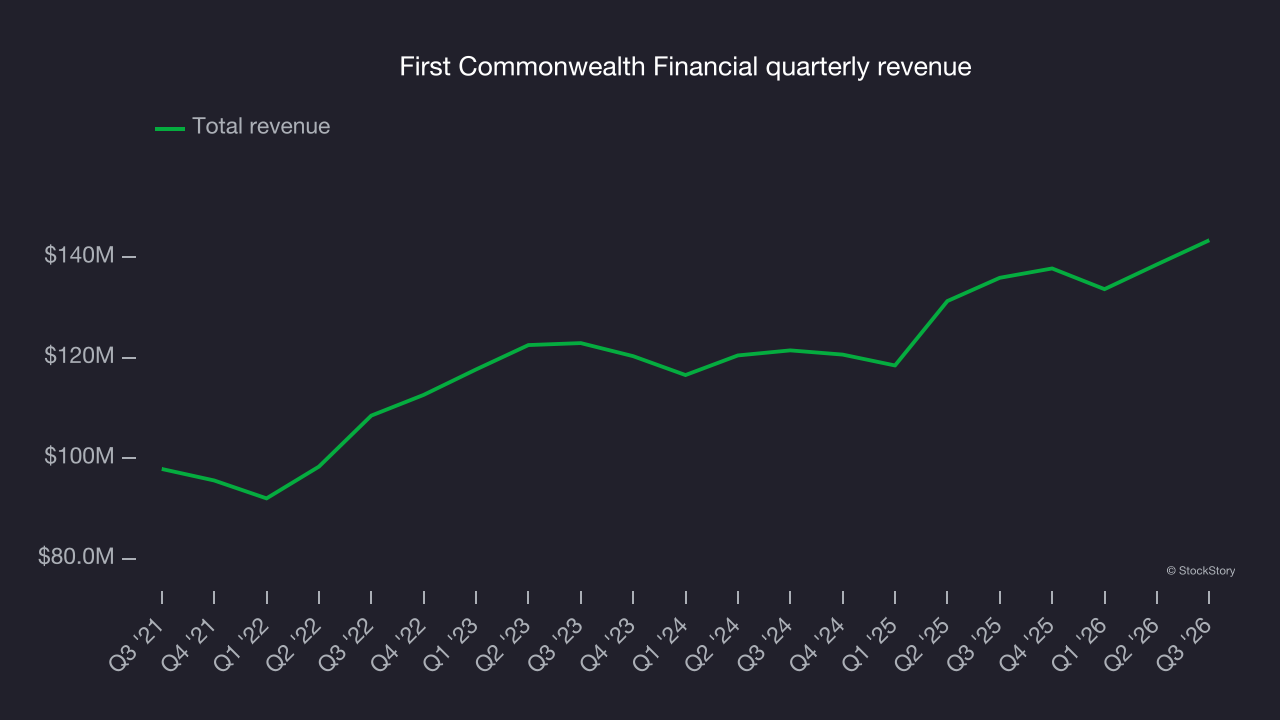
Long-term growth matters most, but within financials, a half-decade historical view may miss recent interest rate changes, market returns and industry trends. First Commonwealth Financial’s annualized revenue growth of 7.5% over the last two years aligns with its five-year trend, suggesting its demand was consistently weak. 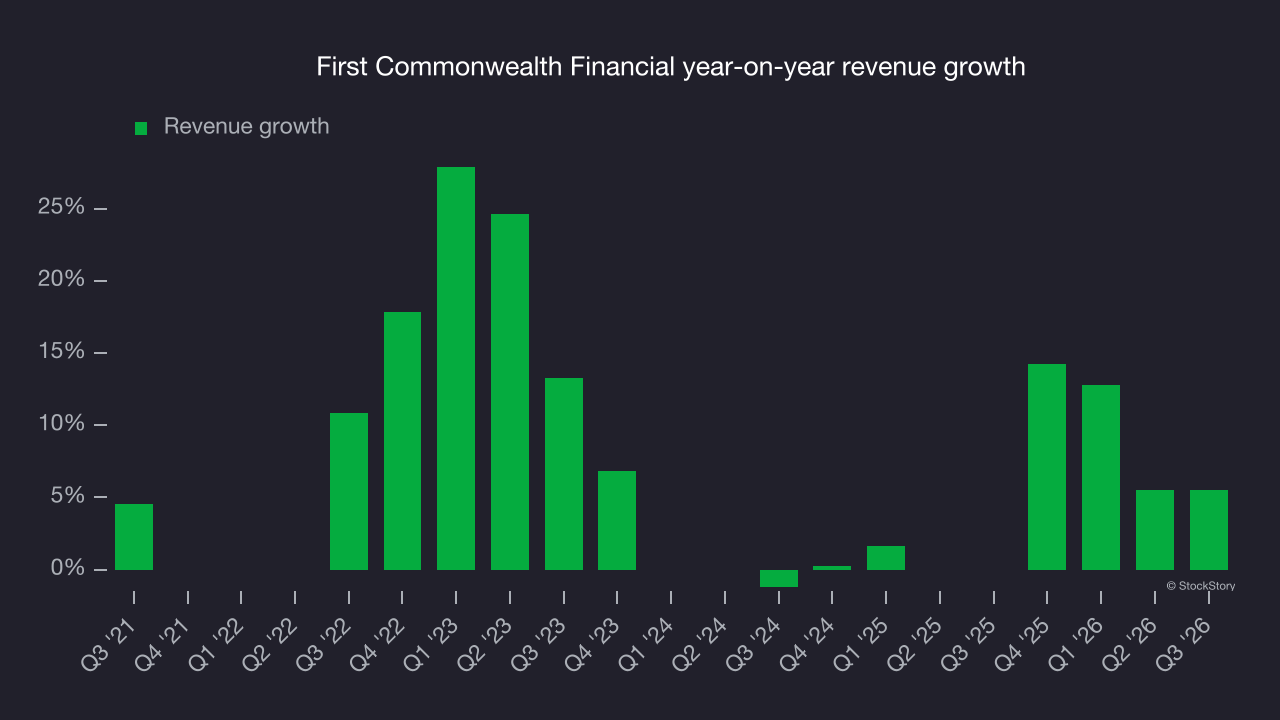 Note: Quarters not shown were determined to be outliers because they were impacted by outsized investment gains/losses that are not indicative of the recurring fundamentals of the business.
This quarter, First Commonwealth Financial reported year-on-year revenue growth of 5.5%, and its $143.4 million of revenue exceeded Wall Street’s consensus estimates by 1.5%.
Net interest income made up 82.8% of the company’s total revenue during the last five years, meaning First Commonwealth Financial barely relies on non-interest income to drive its overall growth.
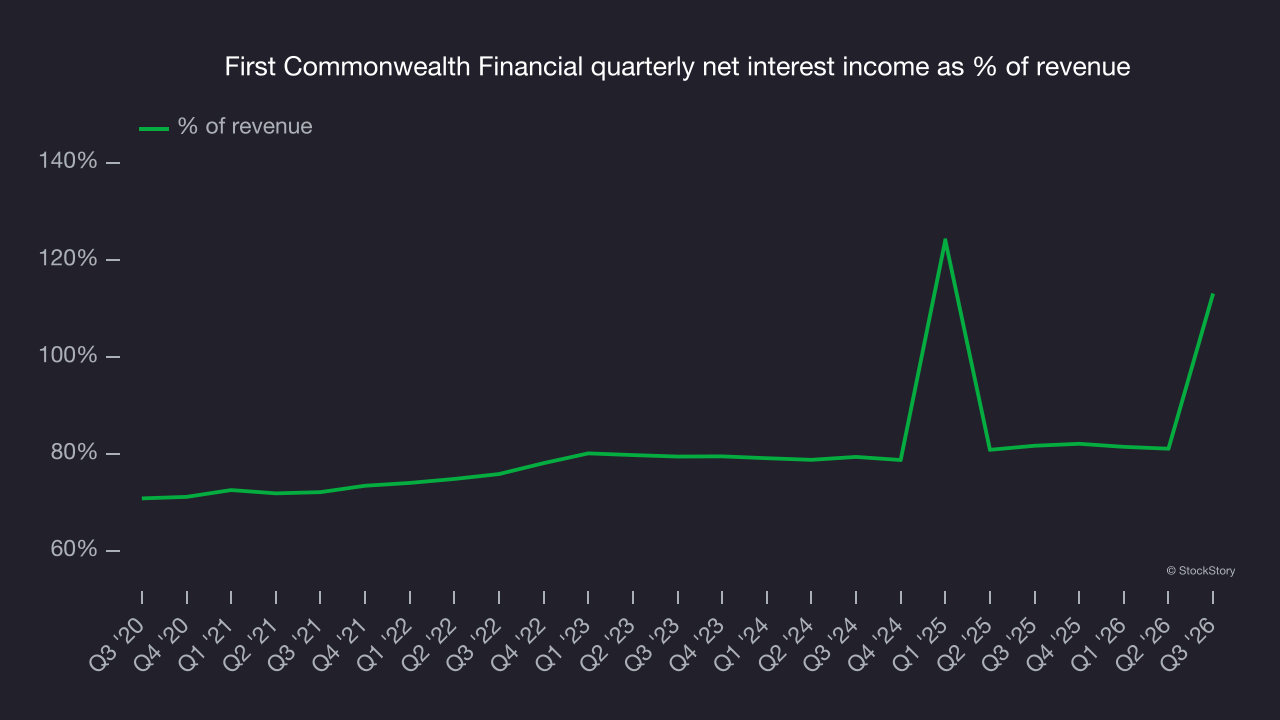
While banks generate revenue from multiple sources, investors view net interest income as the cornerstone – its predictable, recurring characteristics stand in sharp contrast to the volatility of non-interest income.
Tangible book value per share (TBVPS)
The balance sheet drives banking profitability since earnings flow from the spread between borrowing and lending rates. As such, valuations for these companies concentrate on capital strength and sustainable equity accumulation potential.
Because of this, tangible book value per share (TBVPS) is a critical performance benchmark. By excluding intangible assets with uncertain liquidation values, this metric captures real, liquid net worth per share. EPS can be harder to interpret due to acquisition impacts or accounting flexibility around loan provisions, and TBVPS resists financial engineering.
First Commonwealth Financial’s TBVPS grew at a decent 5.9% annual rate over the last five years. The last two years show a similar trajectory as TBVPS grew by 5.5% annually from $10.06 to $11.20 per share.
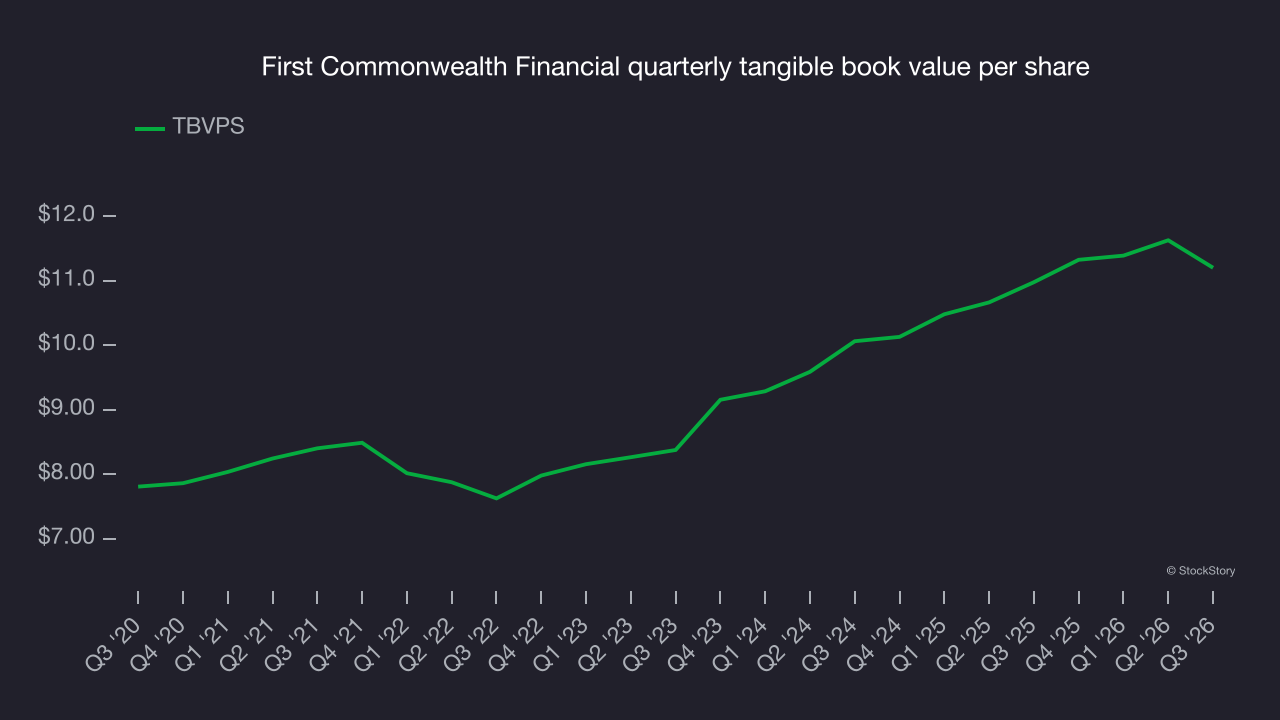
Over the next 12 months, consensus estimates call for First Commonwealth Financial’s TBVPS to grow by 17.4% to $13.15, a solid growth rate.
Key takeaways from First Commonwealth Financial’s Q3 results
First Commonwealth Financial’s net interest income beat analysts’ consensus estimates by a wide margin, and revenue also topped Wall Street’s consensus. But the quarter was softer overall, with tangible book value per share missing expectations and EPS merely in line with consensus estimates. Shares remained flat at $21 immediately after the results.
Before investing in First Commonwealth Financial, consider the bigger picture of valuation, business quality and the latest earnings. For more on these factors, read our full research report here (it’s free).